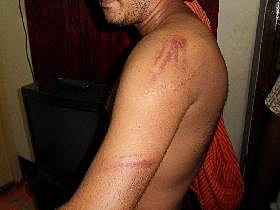
'RAB used excessive force in Abbas home raid'
Amnesty International has said security forces used excessive force during a raid on the house of BNP leader Mirza Abbas during June 27 countrywide hartal.
bdnews24.com News Service
bdnews24.com
Published :
02 Jul 2010, 12:56 PM
Updated :
11 Aug 2022, 02:26 PM
Dhaka, July 2 (bdnews24.com)-- Amnesty International has said security forces used excessive force during a raid on the house of BNP leader Mirza Abbas during June 27 countrywide hartal.
In a statement released on Thursday, the London-based human-rights watchdog strongly criticised the government's highhanded approach against the opposition forces.
Rapid Action Battalion (RAB) carried out a violent attack on those gathered peacefully inside the house of Abbas, a former mayor of Dhaka, according to testimony given to Amnesty International.
Victims of the raid described sustained and unprovoked beatings of activists and Abbas' family members, denial of medical treatment after arrests, and the eliciting of signatures on blank papers as a condition of release, which Amnesty fears might be used to make false confessions.
More than 20 people were injured during the raid, including Mirza Abbas' wife Afroza Abbas and his 85-year old mother.
"The government should immediately investigate the circumstances surrounding this violent raid and ensure that any people hurt by security officials receive justice and appropriate compensation," said Abbas Faiz, Amnesty's Bangladesh researcher, from Dhaka.
"There has been no evidence that the people in Mirza Abbas' house were violating any law or in any way threatening anyone, so the violent actions of RAB seem totally unjustified," said Faiz.
"Given RAB's history of using excessive, even lethal, force, this incident demands an immediate and strong reaction from the authorities".
At least 80 people have been injured over the past two days as police clashed with striking textile workers and protesters contesting the arrest of three top leaders of the opposition Jamaat-e-Islami party.
A RAB official who spoke to Amnesty International said "perhaps there should have been more restraint; if there have been excesses, these would be investigated."
"The government of Bangladesh must stop praising security forces for carrying out human rights violations, and instead make them accountable to the rule of law," said Abbas Faiz.
The current ruling party, the Awami League, and the opposition party, the Bangladesh Nationalist Party, have alternated in government since the early 1990s. When in power, they have both allowed security forces to carry out raids on opposition rallies, beat demonstrators, arrest opposition members, bring politically motivated criminal charges against opposition politicians, and to commit acts of torture and other cruel, inhuman or degrading treatment or punishment, with impunity.
Although some police personnel have been prosecuted for committing human rights violations, members of the Rapid Action Battalion have never been prosecuted for allegations of excessive use of force or torture.
Local and international human rights organisations have for many years expressed concern about 'crossfire' deaths or extra judicial killings in Bangladesh.
Most recently, a US State Department Human Rights Report on Bangladesh, released on Mar 12, said law enforcement officials were responsible for 154 deaths, 129 of which were attributed to 'crossfire', recently dubbed as 'shootout', in 2009, representing a 3 percent increase from the previous year.
The report went on to say that RAB accounted for 38 crossfire killings; members of the police were responsible for 63; combined security units consisting of the RAB and police were responsible for 25; and the army committed three crossfire killings.
The government, however, has repeatedly claimed that no extra-judicial killings are being committed by law-enforcers. They say RAB and police only fire in self defence when they are under attack.
Last year, the High Court ordered the government to explain why killings without trial in so-called 'crossfire' or encounters should not be declared illegal. It also asked why departmental and criminal actions should not be taken against those who perpetrate such killings in custody and outside.
bdnews24.com/im/am/1743h