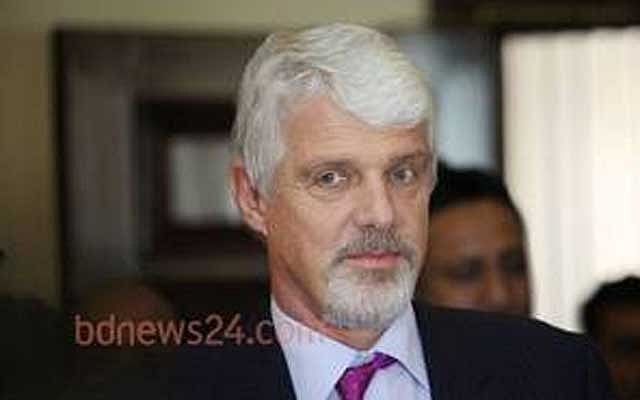
EU Dhaka head of delegation William Hanna said so many uncontested victories in more than half the seats had made them change their minds against sending poll observers.
But Hanna told bdnews24.com, this should not be interpreted as 'taking sides'.
“We waited until it became clear in the end. We tried to wait so that people understand we don’t take sides,” he said on Saturday.
"This should be seen as part of our long term support for democracy in Bangladesh”.
The EU on Friday in a statement from Brussels said they decided not to send poll observers until there are “transparent, inclusive and credible” elections.
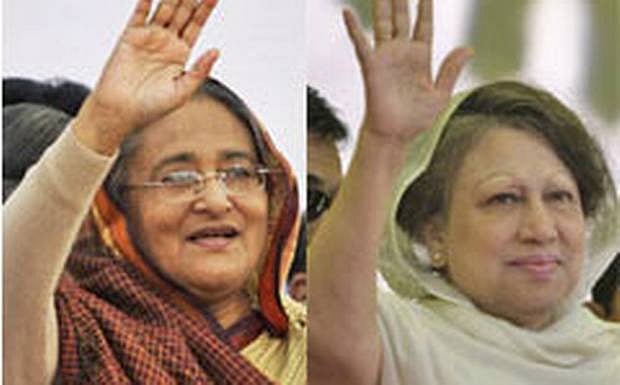
The main opposition BNP has boycotted the polls expressing no confidence in the dispensation that will conduct the polls.
With the deadline of nominations process to contest elections over,
more than half the seats
in the 10th parliament returned winners without a contest.
“When it became clearer that majority of seats were already decided without voters having voted , the EU saw no point to send observers to observe (the elections),” the EU ambassador said.
Hanna said based on their long experiences of elections monitoring, they were clear what 'transparent, inclusive and credible elections' meant.
So the Jan 5 elections will enjoy credibility with the European Union, if held?
“There has been no discussion. There is no point having hypothetical discussion,” he said, but for him the post-Jan 5 remained “uncharted territory”.
“It will be a different situation. So we have to sit down and work out what we do next. We cannot say right now. But I have already been asked (by Brussels) what do we do after the 5th January”.
He said their decision making process was “based on reporting, on discussions, on agreeing and then also sending observations to our capital where leaders sit down, discuss, debate and then take decisions.
“It’s a complicated procedure the way we work. It’s too early at this stage to comment,” he said urging Bangladeshis to realise that after Jan 5 elections “it’ll be a different situation. We have to assess what we do”.
He, however, called political parties to use the weeks before Jan 5 elections and come to “some understanding” about what next. “If it’s (understanding) done, it would be useful”.

He said the EU always supports democratic rights of people and had waited until the very last, hopeful of a solution when UN envoy Oscar Fernandez-Taranco arrived in Dhaka to mediate.
“EU does not take sides. We did not want our pulling out to be seen as supporting one or staying to be seen supporting the other side, that’s not the point.
“We want to support the democratic rights of the people to be able to go out and vote to choose next government,” he said, describing it as EU's 'long commitment to Bangladesh'.
He said the EU supports the trial of war crimes, but they would remain against death penalty anywhere in the world. “They (war criminals) should be brought to justice and we agree with that”.
The EU missions in Dhaka had their coordination meeting to send the collective report on Dec 16 when Bangladesh was observing Victory Day.
They could not join the morning ceremony at Savar mausoleum, but joined the President’s reception at Bangabhavan.
A section of media, however, interpreted their absence in the morning session as boycott.
Opposition BNP also said
the EU team protested
the ruling Awami League’s move to hold what it said one-sided elections.
But the ambassador said they would “never meant any disrespect for Bangladesh, its people or those who fought and died for the freedom of Bangladesh”.
He said after the things changed “dramatically” on Dec 14 when the Election Commission announced that more than half of the seats returned winners without a contest.
"We had to sit and send a report to Brussels."
“It was not holiday in Europe (Bangladesh’s Victory Day). We decided to work in the morning and in the afternoon go to the celebrations of President and meet Prime Minister….not intended to disrespect at all”.
He said their Friday’s decision came “after lot of thought and consideration”.
He said their exploratory mission in Sep tried to understand the situation. "Our experience is what happens on elections day, much of it has happened while preparing for the polls."
But he said the mission could not understand what would happen and they kept waiting. “We kept moving forward”.
The ambassador once again called for “dialogue, compromise and unconditional talks so that both sides find a way down the middle”.
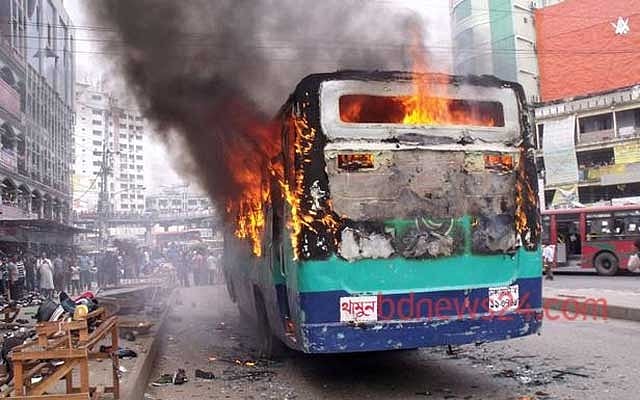
He, however, said they were “very concerned” about the appalling violence and its consequences on the life of the people and country’s economy.
“I think it would be great if people at the top could see that something is needed to be agreed or some understanding before that elections so that there will be a way forward as soon as possible and the disruption to people’s life and economy will stop."
Hanna said the solution should be “politically acceptable and constitutionally viable and people know what that is”.
“We have to remain hopeful,” he said and that “we stand ready to deploy heavy machinery (elections observers) when the condition is right”.