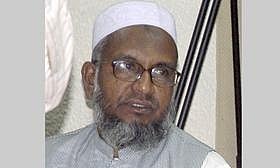
New charge against Molla sought
Prosecution secures hearing on Thursday over allegation that the Jamaat leader directed the murder of an entire family Full story
bdnews24.com News Service
bdnews24.com
Published :
07 Mar 2012, 07:19 AM
Updated :
09 Aug 2022, 03:31 PM
Dhaka, Mar 7 (bdnews24.com) — Jamaat-e-Islami assistant secretary general Abdul Quader Molla had led a band of Biharis and Pakistani troops and in one case, directed the murder of an entire family, the war crimes tribunal heard on Wednesday.
The prosecution's eighth charge against Molla, which is yet to be included, also accuses Molla of directing the band of marauders to shoot Abu Taleb, slaughter his pregnant wife and youngest daughter, slam his two-year old son against the ground and kill him.
Molla was allegedly also present when about 12 men had gangraped the man's 11-year old daughter.
The only survivor, 'Momena', Taleb's eldest daughter who was 12 at that time, had hidden under a bed and had lost her mental balance for a while.
The tribunal will hear the prosecution's application to add the eighth charge against Molla on Thursday.
The International Crimes Tribunal, set up to deal with crimes against humanity during the nation's war of independence in 1971, will also hear the prosecution's arguments following presentation of the formal charges.
The judges also provided certain pointers to the conducting prosecutor, Mohammad Ali, about the kind of questions that he would be facing on Thursday when the court convenes at 2pm.
The tribunal also ordered, in reply to a number of petitions including one for adjournment in the case against Jamaat chief Matiur Rahman Nizami, that the prosecution would have to provide all the necessary documents to the defence by Mar 12 and begin indictment hearing on Mar 13.
Tribunal chairman Nizamul Huq said he would not pass an order on the adjournment petition but would set a date for the defence to reply to the prosecution's charges only after the prosecution was done with the formal charge hearing.
Prosecutor Mohammad Ali finished reading out formal charges when tribunal member Justice A T M Fazle Kabir pointed out that the law at hand specified four groups that could be tried at the tribunal.
"Which group does Quader Molla fall into? Have you mentioned that anywhere in your formal charge?"
Ali fell silent briefly and replied that Molla would fall under 'individual' or 'groups of individuals' as defined in section 4.1 of the International Crimes (Tribunal) Act of 1973.
"So you are saying he would fall under 'auxiliary force' or 'armed force'?" asked Justice Kabir.
The prosecutor replied that Molla would fall under auxiliary force too and suggested that Biharis and non-Bengalis would constitute auxiliary forces.
Judge A K M Zaheer Ahmed went to some length to explain to the prosecutor that merely being a non-Bengali or a Bihari did not automatically constitute member of auxiliary forces, which were, for instance, the Razakars, Al Badr or Al Shams.
Prosecutor Ali had detailed seven charges against Molla. He also elaborated upon an eighth charge which was not included in the formal charge.
But upon an objection of the defence counsel Fariduddin Khan, tribunal chairman Justice Huq decided to conduct a hearing on the matter on Thursday.
Judge Zaheer Ahmed was the first to intervene and tell the prosecutor that he had a few queries which he expected to be answered the following day when the counsel would begin arguments.
He asked the prosecutor to go through his sixth charge which also included other members of the current Jamaat leadership, including the party chief, secretary general and a fellow assistant secretary general, making the same allegations against them.
The judge asked whether these Jamaat men had the same charge against them in their formal charge.
The prosecutor said they probably did.
Judge Ahmed: Do those charges repeat this one verbatim?
Mohammad Ali could not answer with much confidence. The judge continued, "If it does not, why then include these other names here? Why don't you simply confine yourself to Molla?"
The judge said he did not expect the answer then but merely let the prosecutor know about his query.
Justice Fazle Kabir then began with his queries. He first asked the prosecutor, about one 'Akhtar', most likely a Bihari, who had shot a Bangla college student Pallab at the command of Molla.
"Where is this Akhtar? Have you mentioned anywhere?"
Justice Kabir continued that for that specific charge, Akhtar should have been made the first accused and Molla second because Akhtar was the principal offender.
The judge also noted that the same person had been referred to in several charges as the main offender. The questions were left hanging as the tribunal judges made it clear that they expected answers on Thursday.
The investigation panel started probe against Quader Molla on July 21 last year, and he was shown arrested in the tribunal on Aug 2.
In the investigation report submitted on Nov 1 against the Jamaat leader, he was charged for involvement in war crimes and crimes against humanity – including murder, rape, arson, genocide and looting. The tribunal on Dec 28 took cognisance of charges of crimes against humanity pressed against him.
On Dec 18, the prosecution submitted formal charges against Quader, indicting him of genocide and crimes against humanity on seven counts, including the killing of 344 people at Mirpur in Dhaka during the 1971 war.
Seven specific charges brought against Quader Molla include killing, arson and looting in Mohammadpur, Mirpur and Keraniganj areas in the city.
THE 'BUTCHER' OF BENGALIS
During the war, Quader was widely known as a "butcher" for his direct involvement in massacring Bangalis. In league with the Urdu-speaking Biharis and other non-Bangalis, he unleashed a killing spree even before the crackdown on Bangalis by Pakistani forces on the night of March 25, 1971, known as "Operation Searchlight".
Quader and some others were accused by Mozaffar Hossain, in a case filed at Keraniganj police station on Dec 17, 2007, of killing his father Mostafa during the war.
Another case was filed against him with Pallabi police the following year in which he was finally arrested on July 13, 2010.
Besides Quader, others already arrested on war crimes charges are former Jamaat-e-Islami chief Ghulam Azam, present Jamaat chief Matiur Rahman Nizami, secretary general Ali Ahsan Mohammad Mojaheed, executive council member Delwar Hossain Sayedee, assistant secretary general Mohammad Kamaruzzaman, BNP's standing committee member and lawmaker Salauddin Quader Chowdhury, and former member of BNP founder Gen Ziaur Rahman's cabinet Abdul Alim.
Of the eight Jamaat and BNP leaders facing the charges, only Alim is out on conditional bail.
bdnews24.com/ta/bd/1721h