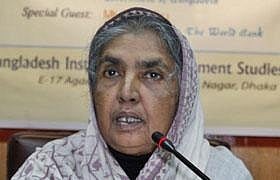
Matia wants Economist to apologise
The London-based magazine must offer a public apology, insists the agriculture minister
bdnews24.com News Service
bdnews24.com
Published :
13 Aug 2011, 07:52 PM
Updated :
10 Aug 2022, 05:16 PM
Dhaka, Aug 13 (bdnews24.com) -- Agriculture minister Matia Chowdhury has said The Economist must seek public apology for publishing 'false' news about Bangladesh.
Speaking at a discussion organised by Bangladesh Samyabadi Dal (ML) on Saturday at National Press Club, ahead of the National Mourning Day, the minister said, "The Economist has published false news under the influence of drugs and arms mafia, and supporters of militancy."
"Very soon the magazine will have to apologise for publishing wrong news," said a press statement quoting her on Saturday.
Motia said after the overwhelming victory of the grand alliance in 2008, The Economist had wrote about how free and fair the election was. "Now, the magazine has forgotten it."
The discussion was chaired by Bangladesh Samyabadi Dal general secretary Dilip Barua.
Among others, foreign minister Dipu Moni, Dhaka University vice-chancellor A A M S Arefin Siddique and Awami League leader Bahauddin Nasim spoke at the meeting.
The London-based magazine on Aug 12 published two articles on its website headlined "In the name of the father: An obsession with Bangladesh's past may explain its prime minister's growing intolerance" and "The poisonous politics of Bangladesh".
These reports apparently spoke of the 'legendary mutual animosity' between the top women of the two leading parties of the country, and how their pronounced bickering constitutes the politics of Bangladesh, among many other things.
In a virtual frontal attack on Sheikh Hasina, it tries to reason out why she chose reportedly to cut to size Nobel Peace laureate Muhammad Yunus.
Referring to rumours, The Economist article says Yunus was "resented for his high international profile, which threatened to eclipse the sacred memory of Sheikh Hasina's father, Sheikh Mujibur Rahman, who led Bangladesh to independence".
According to the article, Yunus's other sins included his accepting the Nobel Peace prize that 'Sheikh Hasina felt should have been hers, failing to commiserate after an assassination attempt on her in 2004, and being ungrateful for the help she gave Grameen'.
Prior to this, the globally-acclaimed magazine in its July 30 edition, in a report titled 'India and Bangladesh: Embraceable You' narrated the growing geopolitical interests of India that force it to seek better relations closer home.
The government, however, binned the report and on Aug 4 sent a rejoinder saying that it was "disappointed as the report is less than well-researched and contains elements of misinformation and misrepresentation of facts."
bdnews24.com/pc/pd/mrh/nir/2345h