


Published : 24 Jan 2013, 05:14 PM
Updated : 23 Apr 2022, 04:03 PM


She said the country now had evolved into “a society where there would not be space for the culture of impunity or horrors of impunity”.
“Now for the people of Bangladesh this judgment is a belated and therefore well-justified reason to feel elated and free of a national shame, ignominy and liability that we have been carrying with us for decades,” she said.
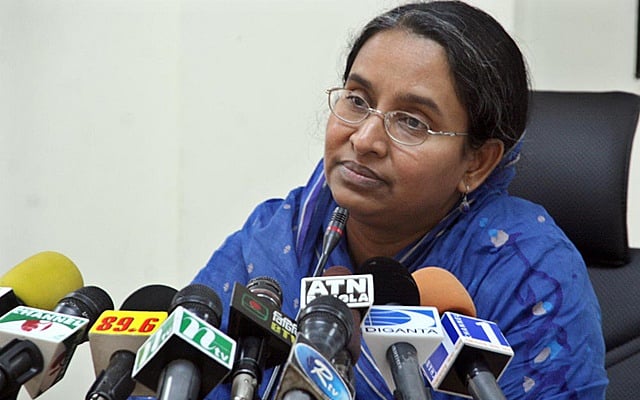
The minister was briefing diplomats and heads of international agencies at her ministry about the Jan 21 verdict of the ICT-2 condemning absconding Abul Kalam Azad alias Bacchu Razakar to death.
She said the judgment was a ‘clear vindication’ of the government’s ‘commitment to build a secular, democratic polity that cherishes its multi-religious, multi-ethnic and multi-cultural characters’.
She observed that the ongoing trials often ‘wrongly perceived and projected’ by certain sections of the international community and the media. The detail background information provided by the judgment, particularly about the convict, ‘makes it abundantly clear that there has been no political motive behind holding these trials’.
She sought continued support and cooperation from all ‘friends’ in the international community to pursue the nation-building objectives.
“We expect, in particular, that the international community would fully appreciate the aspiration for justice among our people, and accordingly respect their sentiments by standing on the side of justice and human rights,” she said welcoming constructive suggestion for the trials’ compliance with international standards.
Dipu Moni, however, said: “Bangladesh would expect that the judgment and its process through which it has emerged would allow certain sections of the international media, which has been running an ill-motivated campaign against the tribunals and the cases, to rest their case.”
She said the verdict was delivered after the tribunal found the accused guilty of “abduction, confinement and torture, murder, rape and genocide (killing the members of the Hindu community)” as listed in charges 1,3,4,5,6,7,8 of the case”.
The government constituted the first tribunal in March, 2010 and the second one in March, 2012 under the International Crimes Tribunal Act (ICTA). The Minister told the diplomats that they were established as per law, as an independent, open and transparent court.
She said the trials were being conducted in open tribunals witnessed by the relatives of the accused, the media and independent observers to ensure full transparency to meet the requirements of fair trials in compliance with the standards invoked in other trials of international crimes committed around the globe.
“The trial proceedings are being observed and monitored by the prosecutors and defence counsels and the accused through separate computer monitors set up for them in the courtrooms.”
According to her, the recent judgment provided a fairly comprehensive account of the relevant provisions of ICTA and its rules “that were in consonance with the International Covenant on Civil and Political Rights in particular”.
She said the accused persons had the right to engage one or more counsels, enrolled as legal practitioners of the Bangladesh Bar Council, for their defence.
“In case of absentia trial, the tribunals have the authority to engage a state counsel (for the accused) as per section 12 of ICTA.”
She said the justice process that the act envisaged is purely domestic. “This means, the International Crimes Tribunals in Bangladesh are not international in nature. For all meaning and purposes they are domestic.”
“The only international element in the whole scheme of things is the nature of the offences, that is, the international crimes,” she said.
“The ICTA internalised these crimes and thus made them a part of the jurisprudence of the tribunal and of Bangladesh’s legal system.”
She continued that the tribunal, in its judgment, reaffirmed that no person guilty of committing such atrocious crimes, as had been proved beyond doubt against the convicted, should stay outside the reach or purview of justice as it tended to give validity to the culture of impunity.
“... and that prolonged impunity and related denial of truths allow old wounds to fester and make the victims suffer post-traumatic stress.”
Moni requested the diplomats to imagine what a post-war Europe would have been if the trials of war crimes, genocide and crimes against humanity were not held, and the perpetrators of such crimes were allowed to roam around freely amongst the victims and their families or assume state power.
She said her government has been making unstinting efforts to heal the long-festering wounds and to mend the fissures in the political culture and socio-cultural values.
“This is a difficult exercise no doubt, but the party that helped this nation achieve its independence must also undertake the challenging task of building it on a firm footing so that no forces can make it deviate from its course.”







