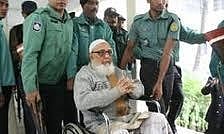
Deposition against Ghulam Azam begins June 24
Prosecution completes reading its opening statement mostly reiterating points against the 89-year old former Jamaat chief.
bdnews24.com News Service
bdnews24.com
Published :
10 Jun 2012, 12:01 PM
Updated :
09 Aug 2022, 03:52 PM
Tanim Ahmed
Dhaka, Jun 10 (bdnews24.com) — The first war crimes tribunal of Bangladesh will hear the first witness against Jamaat-e-Islami guru Ghulam Azam on Jun 24.
The prosecution completed reading its opening statement on Sunday mostly reiterating points already made in the formal charge against the 89-year old former chief.
This effectively marked the beginning of trial against a man, who was a 'spring board for collaborators and anti-liberation activities during 1971' in the words of chief prosecutor Ghulam Arieff Tipoo.
The tribunal on May 13 indicted the political science graduate of Dhaka University on five charges including incitement, conspiracy and abetment for crimes against humanity.
In another matter, the tribunal chief sternly said he would pass an "appropriate order" on Monday when he found out that an almost three-week old order had not yet been complied with despite cautioning the prosecution last week.
Chairman Justice Mohammad Nizamul Huq made the statement when Azam's defence counsel brought to his notice that the former college professor had not been supplied with books he had wished for.
The International Crimes Tribunal – 1, set up to deal with crimes against humanity during the 1971 Liberation War, had directed the prosecution through an order around the middle of May that the Jamaat guru be supplied with the Qur'an and Hadith and a few other religious books.
The matter was brought to the court's attention on Jun 6. M Tajul Islam told the court that its order had still not been complied with. Justice Huq then told prosecutor Zead-Al-Malum, "We want the order to be complied with by today."
Malum replied that the matter had to be handled according to the jail code in which case certain formalities had to be maintained.
Justice Huq was adamant about his deadline that the books be supplied within the day.
Malum said, "But I will be standing before you all day. How can I do that?"
The judge took the point and extended the deadline by one day. Justice Huq also cautioned the prosecutor, hardly concealing his disappointment, that if the order were not complied with, then he would pass an order in this regard.
Justice Huq did not heed the prosecutor's suggestion that the court could then pass an order saying that the books be supplied to the accused regardless of whether they complied with prison rules.
The tribunal chief told Malum that adherence to the laws were not his headache, suggesting that the prosecutor would have to figure out a way. He had passed an order and wanted it to be complied with, he indicated.
The matter came up at the very onset of proceedings on Sunday. Tajul Islam added to his complaint, "It is obvious from the learned prosecutor's deliberations that he is personally unwilling to comply with the order."
Justice Huq's reply was quick. "No. That is not correct."
The defence counsel went on, "If the tribunal's orders are not complied with then people will lose its respect for the court."
Justice Huq summarily dismissed the matter saying, "Tomorrow for order."
Prosecutor Malum stood up to make some submissions and handed in a copy of some official correspondence. But the judge said, "We don't want to hear you today. Tomorrow for order."
Malum took back his sheaf of paper and returned to his seat muttering in protest.
Justice Huq then said he would allow only the chief prosecutor to speak. Ghulam Arieff Tipoo, however, did not appear to be fully conversant with the issue and Syed Haider Ali, another senior prosecutor, then proceeded to assist the court.
He said that the jail authorities were apparently in a quandary over how to comply with its regulations for inspection of the articles given since there was no one designated or competent to examine the books and verify their authenticity.
The tribunal chief said, "Yes that is fine, the jail authorities will certainly check the materials."
Haider Ali then conveyed the jail authority's suggestion that it was becoming difficult for them to provide Ghulam Azam with the books that the defence had supplied and that there could be a list of books which the jail would then buy.
"Then you will come back to say that the books cannot be found, they are not available on the market and so on," Justice Huq shot back.
Haider Ali lamented, "You suspect us that much?!"
Justice Huq: I would not have. I would not have done so. But in light of what is happening, I cannot help it.
He then repeated his previous statement a little more sternly. "Appropriate order will be passed tomorrow."
At this point tribunal member Judge A K M Zaheer Ahmed intervened and told the prosecutor that all these matters could have been brought up before the tribunal soon after the order had been passed. "It has been over two weeks that the order was given."
Justice Huq added, "Why did you not make these arguments when the order was passed?"
He went on to point out that the jail authorities also supplied letters to the inmates and they had a right to check the mail. "They can even black out portions of letters. But they do deliver the material."
Tajul Islam stood up to say, "Repeated non-compliance of the court's order has turned it into a farce and joke. This is a court of law!"
Haider Ali retorted, saying that the prosecution was merely making submissions to the court and if anyone were turning the court into a farce, it would be the defence counsel.
Tajul Islam's voluble protests and Haider Ali clipped retorts were soon cut short when the Chairman cautioned them. "It is going a little too far on both sides."
The volleys stopped and the chief prosecutor began reading the 142-page opening statement marking the commencement of Ghulam Azam's trial.
Azam's defence appealed to the tribunal if the former Jamaat leader might be excused since he was feeling very sick and also requested that the court allowed him to remain at the hospital's prison cell until deposition of prosecution witnesses began.
The court found the prayer acceptable and granted it. Justice Huq also marked that Ghulam Azam woud often felt sick after some time in the dock. The case, however, would continue, said the judge. Ghulam Azam was taken away around 11:50am.
Adjourned until Jun 24
The defence counsels Mizanul Islam and Tajul Islam that they needed some more time for completing further formalities once Zead-Al-Malum wrapped up his lengthy opening statement.
Justice Huq did not appear convinced and insisted that they comply with one part of their obligation.
"I suggest you submit your witness list and materials to be relied upon," and proceeded to fix Jun 17, at which Mizanul Islam politely put up a strong protest.
He said that such a short deadline would mean that they merely put together a list of people. "Effectively though it would not be too fruitful."
Justice Huq said, "But you were due to have submitted that list and materials on Jun 5, and you still have not."
Mizanul Islam pointed out that the defence had prayed for time which the judge granted too. The defence had in fact prayed for an adjournment for four weeks to which Justice Huq said the court would fix a date after the opening statement had been read out.
The senior defence counsel said, "We are not saying that the court has not given us time. Not for a second. And we are not saying that it is the court's failure in any way. It is completely our failure for not being able to have completed the list."
Mizanul Islam requested that the proceedings be adjourned for 20 days. Justice Huq shook his head strongly enough that suggested it would be far too long.
Tajul Islam stood up to say that the court should consider human limitations. "It is simply not possible for us to prepare the list in such a short time. And all we are asking is that the court takes it into consideration."
He further pleaded with the court saying that defence 'really needed the time'.
Justice Huq then called for his bench officer to take down an order while the defence lawyers were still trying to convince him. He indicated that he had heard enough. "Both the sides will be happy," he said sending Zead-Al-Malum back as he had come to the podium to protest against the defence's prayer for adjournment.
Jamaat Guru in ICT-1
On Dec 12, 2011, the prosecution brought a 52-point charter of charges against Azam and appealed for his arrest. Later, following the tribunal order, charges were re-arranged and presented to the tribunal on Jan 5.
He was produced before the tribunal on Jan 11 and sent to jail the same day. Since that evening, Ghulam Azam has been kept at the prison cell of the Bangabandhu Sheikh Mujib Medical University for better treatment considering his delicate health.
The prosecution's numerous charges against him mainly consist of incitement, conspiracy, complicity and command responsibility for crimes against humanity.
A former chief of Jamaat-e-Islami, arguably the largest Islamist organisation in the subcontinent, Azam is allegedly among the key people who pioneered anti-liberation efforts in 1971 colluding with the Pakistani military junta of that time.
He is widely perceived to have been among core group of right-wing supporters of the Pakistani Army, who came out strongly in support of a united Pakistan.
Ghulam Azam, then chief of Jamaat, was instrumental in setting up the infamous Peace Committee at the national level. The Razakars, an auxiliary force set up mainly to actively thwart the liberation forces, are said to have been mobilised through the Peace Committees across Bangladesh.
Among the most notorious vigilante militia groups is the Al Badr, whose membership is said to have been mainly dominated by the Jamaat's student wing called the Islami Chhatra Sangha at that time.
The Al Badr is alleged to have spearheaded execution of the intellectual elites of Bangladesh just days before the victory on Dec 16, 1971.
Azam also spoke in favour of Pakistan to the Middle Eastern countries during the war, according to the prosecution.
He stayed in London for seven years after 1971 and returned to Bangladesh in 1978 during BNP founder Ziaur Rahman's rule. Having led Jamaat for long, Azam retired from active politics in 1999.
His party remains a key ally of the main opposition BNP. Two Jamaat leaders, also behind bars for war crimes charges, have even served as ministers during the BNP's last tenure in government between 2001 and 2006, when Azam's party was part of the ruling coalition.
bdnews24.com/ta/bd/1720h