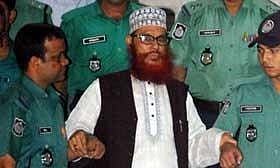
Defence seeks Sayedee's discharge
Claims fraud upon court by investigators in the light of 'witness house records'. Full report with quotes
bdnews24.com News Service
bdnews24.com
Published :
11 Jun 2012, 10:06 AM
Updated :
09 Aug 2022, 03:53 PM
Dhaka, Jun 11 (bdnews24.com) — Jamaat-e-Islami Executive Council member Delwar Hossain Sayedee's defence has sought his discharge at the first war crimes tribunal of Bangladesh saying the prosecution's case was built on lies.
As evidence the senior defence counsel Abdur Razzaq proceeded to prove the veracity of registers of records at the witness home. The prosecution, however, denied the very existence of any such records.
The defence lawyer began his deliberations saying, "It is impossible to concoct such records and in such detail."
Prosecutor Haider Ali said no such records of the witness house existed. "But since they have introduced the document to the tribunal, the onus would be upon the defence to prove its veracity."
Razzaq showed in the records that certain witnesses had indeed come to Dhaka and stayed at the witness house for long periods without ever being produced at the tribunal.
The three-judge International Crimes Tribunal -1, set up to deal with crimes against humanity the 1971 Liberation War, has indicted Sayedee on 20 war crimes charges in his native Pirojpur district.
The senior lawyer set out to prove the authenticity of the documents that has been the centre of much discussion at the tribunal.
Three registers
Razzaq referred to two specific cases that he claimed proved that the documents were 'genuine quite beyond doubt'.
The defence lawyer referred to one entry in one of the three registers, quite meticulous in their records, which mentioned Sub-inspector Kalachan Ghosh went to Dhaka magistrate's court on Jan 12 to depose in a certain case.
Razzaq then produced the court's records of that date with the same policeman's deposition of Jan 12.
Razzaq referred to another entry (#375) in one of the registers that listed detailed bills of phones at the witness house and stated that one of the staff members looking after the tribunal witnesses was sent to pay those bills.
The defence counsel also produced the receipts of those bills from the telephone office concerned and showed that the dates of the entry and figures of the bills matched.
He referred to another incident to illustrate the meticulous record-keeping and reiterate his point that the records could not be concocted.
This entry (#249) of Jan 16 related to Gouranga Chandra Saha's deposition at the tribunal and the record notes that higher officials of the investigation agency were rather happy. The records stated the officials saying, Saha 'had done really well'.
The investigation agency official agreed readily and the witness along with the first prosecution witness Mahbubul Alam Howladar were then bought sweets from a nearby Bikrampur Mishtanno Bhandar outlet.
The record stated that besides Tk 250 on sweetmeat, cigarettes and medicine, a total Tk 500 were spent which went towards buying the witness new clothes.
Gouranga Chandra Saha had told the court on Jan 16 that Sayedee had been involved in the rape of his three sisters. The Jamaat leader had allegedly looted his house and then took away his sisters to hand over to Pakistani military personnel.
Razzaq said the prosecution's case was built upon lies. "The prosecution cannot be allowed to proceed," he said suggesting that it would in fact give the tribunal a bad name.
During his submission that spanned the entire first half of the court's proceedings till lunch recess, the senior defence counsel said that there was no way the tribunal could rely upon information produced by the investigation agency or the veracity of the prosecution's case. "The investigation agency has committed fraud upon court."
First, the defence counsel said that the court had been 'cheated' when the prosecution said the witnesses were not available whereas they had come to Dhaka, stayed and dined there.
The prosecution had petitioned the court to receive a number of witness statements given to the investigation officer as evidence against Sayedee because they could not produced before the court because they were too ill, indisposed of or traceless.
The court accepted the prosecution's application in part in case of 15 witnesses.
Razzaq said that the only "earthly reason" for such denial on the part of prosecution that the witnesses were not available was that 'those witnesses refused to tell the court a certain story that the prosecution had concocted'.
Secondly, the defence lawyer said, the prosecution went on to deny the very existence of the records that the defence had produced.
The defence had produced what it said photocopied records of three registers of the witness house. One had details of people arriving or leaving including the staff and witnesses. Another one related to food consumption. A third register noted the general information.
The three-judge tribunal held a closed door session with two lawyers each from the prosecution and defence asking the witness house staff members questions to verify the defence records.
'Discharge Sayedee'
Abdur Razzaq himself brought up the matter of where he got the photocopies from and said that it was available on the public domain and cited newspaper reports and a web address where these might be found.
Tribunal chairman, Justice Mohammad Nizamul Huq said, "That has to be verified who put the records on the web," after he had suggested that the defence lawyers could have themselves given those records to be put up on a certain site.
The counsel said, "However, how we got it is irrelevant but the question is rather whether you can rely upon it."
Razzaq went on to cite a few verdicts regarding admissibility of evidence and the chairman agreed.
Justice Huq said, "Even if you stole the records it could be admissible but you would have committed offence at the same time."
Razzaq said, "But the prosecution's offence is far greater."
Justice Huq: That could be the case and we will ask them about that. Right now, you are before us.
He said, "The prosecution has failed to perform its sacred duties."
It is the duty of the prosecution to find out the truth. "But it is evident that this prosecution's only intention is to hang Sayedee."
Razzaq said it was only after the witnesses refused to lie that they were sent back and the tribunal was told that they were not available.
"But how do you conclude that?" asked Justice Huq.
"That is our case," said Razzaq.
Justice Huq: It may be your case but we must find it so too.
Razzaq: There is no earthly reason for them to deny the facts then.
Tribunal member Judge A K M Zaheer Ahmed said, "But they are saying these records don't even exist."
Justice Huq: Does it lead to the conclusion that a witness was asked to tell a certain story?
Razzaq: Witnesses came and went back. They were being tutored and that could be the only reason for [the prosecution] to make a sweeping denial about the existence of these records. It is only for a relief from this embarrassment.
He said that the tribunal could come "one conclusion only". "If the prosecution continues then it will give a bad name to the tribunal."
The lawyer said, "Sayedee must be discharged and the prosecution stopped from proceeding any further."
The tribunal asked about the legal sanctions about discharging Sayedee at this point of trial since 16 other ocular witnesses had been deposed and cross-examined.
Tribunal member Judge A K M Zaheer Ahmed told him, "It would not be possible to discard those evidences without even scanning them first."
Justice Huq said that once the charges had been framed there was no scope to discharge an individual. "It will have to lead to a conviction or acquittal."
Razzaq said he agreed with the judge. "But this is a different court with a different law where the powers of the tribunal had expansive powers spanning from horizon to horizon."
The lawyer said he was therefore invoking those inherent powers of the tribunal to ensure the ends of justice.
Prosecution's reply
Prosecutor Syed Haider Ali took the podium after the court returned from lunch recess and began his forceful submissions, which even the defence counsel Abdur Razzaq admitted were rather convincing.
The prosecutor said there was no possibility of such existing since this establishment was not set up under any specific government orders. It was not even a proper office he suggested.
"This is not a station or a police check-post that there would be records and registers," said Haider Ali.
The prosecutor said that even if there were records, the records produced do not correspond with those stipulated by the police rules. "There is no scope of such records to exist. It was a house for witnesses and victims."
He said the prosecution had merely arranged for the provision of witness accommodation and that is what we did.
The prosecutor argued that it was in no way a 'witness safe home' as the defence was suggesting. "The question of 'safety' comes only when there is a perceived threat."
Haider Ali then moved on to the documents in question. He said it is not enough that the presentation is attractive. "The documents must also have credibility, and that too within the law."
In this respect the prosecutor said the onus of proving the authenticity of the documents was entirely upon the defence according to the rules of the tribunal. "They will have to provide their source, disclose how they got those documents and prove them in the court."
He said there had indeed been a fraud upon court. "The question is who has done that."
Haider Ali said, "Someone must have manufactured those documents." He continued to say that the records had been produced by personnel familiar with the technicalities.
"It is just like counterfeit notes. I cannot tell the difference but bankers can."
The tribunal asked a few questions. Judge Zaheer Ahmed took the initiative. "So these telephone numbers referred to in the documents. Are they indeed the numbers of the witness house?"
Prosecutor Haider Ali said, "I know one of those numbers to exist. But I can't confirm the rest. I will have to ask the investigation agency."
Judge Zaheer Ahmed: Of course. You will have to rely on whatever the investigation agency tells you."
The judge then asked about the records of the witness house. "So you are suggesting that this place is run like a 'free for all boarding'? There are no records of comes, who goes, who dines or whatever?"
The judge said, "The exchequer's money is being spent here. There must be some form of records of that?"
Haider Ali said, "There were certain records but they were kept centrally at the head quarters of the agency."
The judge wondered if even the duty roster were kept at the headquarters. "Besides there must be some sort records about who goes where and so forth. Surely that cannot be maintained from an office five miles away."
The prosecutor held his ground that the records produced by the defence were not official records of the witness house.
Abdur Razzaq told the tribunal that if there were no possibilities of the tribunal discharging the case in light of the 'gigantic lie' that had been concocted, then the witness home staff members should be called as witnesses and the defence given the opportunity to cross-examine them.
"Let us cross-examine the witness house staff if the prosecution insists that the documents are concocted."
He also asked the court that a hand-writing expert be called for to verify the writing in the registers.
Monday's hearing was part of a defence application to review the court's decision on the 15 witness statements. The court said it would rule on the petition later but did not fix a date.
First case to trial
Sayedee's is the first case to proceed to the trial stage at ICT – 1. The prosecution on Sept 4 proposed framing of charges against him on 31 counts of crimes against humanity and genocide.
The tribunal also sent Jamaat's former chief Ghulam Azam to jail on Jan 11. His indictment hearing began on Feb 15 and the court indicted Azam on May 13. Deposition will begin on Jun 24.
Jamaat chief Nizami, Secretary General Ali Ahsan Mohammad Mujaheed and assistant secretaries general Mohammad Kamaruzzaman and Abdul Quader Molla have been detained on war crimes charges.
BNP MP and Standing Committee member Salauddin Quader Chowdhury, also behind bars, was indicted for 23 charges on Apr 4. The prosecution had been ordered to begin with its opening statement on Apr 29.
Former BNP lawmaker and rail minister Abdul Alim is the only one out on bail. He had been indicted on Jun 11 for his involvement in nine incidents of crimes against humanity.
bdnews24.com/ta/sk/nir/2345h