Awal's cross-examination ends
The defence is done with cross-examination of Pirojpur MP who had testified against Delwar Hossain Sayedee.
bdnews24.com News Service
bdnews24.com
Published :
11 Jan 2012, 10:22 AM
Updated :
09 Aug 2022, 03:17 PM
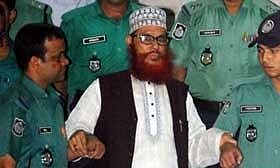
Dhaka, Jan 10 (bdnews24.com)—Pirojpur MP A K M A Awal's cross-examination ended on Wednesday in a case against Jamaat-e-Islami leader Delwar Hossain Sayedee at the war crimes tribunal.
He was the 12th witness to testify at the International Crimes Tribunal, set up to try crimes against humanity, which indicted Jamaat's executive council member on 20 counts of crimes against humanity on Oct 3.
Defence counsel Mizanul Islam continued quizzing the witness until after the lunch recess in a far more cheerful manner. It was in a sharp contrast from the day before when the courtroom broke into a heated and lengthy argument over the witness wishing to change a part of his deposition.
He was followed by Mohammed Kafil Uddin Chowdhury and Manjur Ahmed Ansari. However, the judges did not allow them as much of a free hand as on previous occasions.
Judge A K M Zaheer Ahmed intervened a few times asking the counsels whether the question being asked was in any way relevant to the case.
Soon after lunch, judge Ahmed said, "I cannot help but intervene at this point."
Mizanul Islam had asked Awal whether he had taken any initiative to file a complaint against anyone for war crimes.
Judge Ahmed told the defence counse, "You have a specific case against a specific person. What is the point of this general question?"
The counsel then rephrased the question and asked the witness whether he had taken any initiative to lodge a case against Sayedee, to which Awal said he had not.
He then suggested that the witness had not said anything against Sayedee anywhere since the war of independence until he gave testimony before the investigation officer of the case.
Awal said that he had indeed, since Sayedee was political rival and thus he had said a lot of things against Sayedee at large rallies. Judge Zaheer Ahmed had to step in as the interpreter again and asked whether Awal had deposed against Sayedee.
Awal said he had not.
There appeared some disagreement regarding a certain question from Kafil Uddin Chowdhury, who asked Awal, in charge of the Sundarbans sub-sector headquarter operations, whether the offices had an organorgram with the list of commanders, maps of the Sundarbans and Bangladesh and eight portraits including those of Sheikh Mujibur Rahman, Maulana Abdul Hamid Khan Bhashani, Rabindranath Tagore and Kazi Nazrul Islam. He also asked him whether the sub-sector commander Ziauddin Ahmed had a personal assistant and typist.
Tribunal head Justice Nizamul Huq said he refused to show that the tribunal, the defence and prosecution had no knowledge of the circumstances of the Liberation War and how it was fought by allowing this question. "This will not go."
Justice ATM Fazle Kabir remarked that it sounded rather like really well done up office room, which was quite outlandish during the war.
Counsel Mizanul Islam then told the tribunal that the sub-sector commander, Ziauddin Ahmed, a retired major, still residing mainly in the Sundarbans, had written a book with vivid details of his headquarters.
Awal was then directed to answer the question at the insistence of the defence. He said maps were naturally there since anyone waging a war would need the maps. He however, did not mention anything about the organorgram.
As for the portraits, he said there was one of Bangabandhu Sheikh Mujibur Rahman. However, I do not know whether Ziauddin Ahmed had a specific typist or an assistant, but he did delegate his tasks to different people at different times. "Although they were the headquarters of a sub-sector, it was not like any other military office establishment that we see today."
Awal became very agitated when Kafil Uddin Chowdhury suggested he was not at all a commander, that he was neither in charge of the sub-sector headquarters or its operations and mentioned several other names who were appointed as commanders.
The Pirojpur MP requested protection of the court in this regard saying that he would not tolerate anyone questioning his role in the war.
The tribunal then asked Kafil Uddin what he intended to establish through the question. Both judge Zaheer Ahmed and his chairman, Justice Nizamul Huq, told the counsel that even if what he was suggesting was right, it would hardly have any impact on the case.
Awal told the tribunal that he was indeed charged with grave responsibilities and his authority went higher than that of the commanders since he had been delegated with certain responsibilities by the wartime Mujibnagar Government itself.
"But what would he know of all that?" the witness said indicating the counsel, "He is against the spirit of liberation in the first place."
Both Chowdhury and Ansari had to wrap their generally lengthy quizzing within an hour and a quarter under the watchful tribunal that would not allow counsels to stray too much.
Sayedee's is the first case to proceed to the trial at the tribunal. The prosecution on Sept 4 proposed the framing of charges against Sayedee on 31 counts for crimes against humanity and genocide in ICT Case-1/2011.
The tribunal also ordered Jamaat's guru, and a former party chief, Ghulam Azam into jail on Wednesday. His indictment hearing has been scheduled on Feb 15.
Apart from Sayedee, Jamaat chief Matiur Rahman Nizami, secretary general Ali Ahsan Mohammad Mojaheed and assistant secretaries general Mohammad Kamaruzzaman and Abdul Quader Molla, and Bangladesh Nationalist Party's standing committee member Salauddin Quader Chowdhury, also a lawmaker, have been detained, along with others, on charges of committing war crimes.
The tribunal, however, on March 31 granted conditional bail to former BNP MP and minister Abdul Alim.
bdnews24.com/ta/bd/1654h