Published : 07 Jul 2021, 12:02 PM
Updated : 03 Aug 2022, 01:47 PM


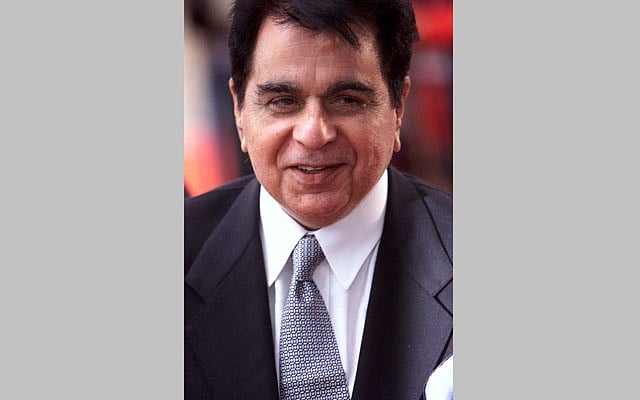
It was the lilt in his voice, the impeccable Urdu in which the dialogues came, which defined Dilip Kumar. In real life, apart from reel life, it was a delight listening to Dilip Kumar expound on matters, serious as well as humdrum, in chaste Urdu. It was hard to believe that he was a man from Peshawar, born into the Pashto language. In simple terms, versatility, in the movies and in the manner in which he conducted himself in his day-to-day existence, was his crowning glory.
And nowhere is this glory more evident than in the wide range of movies that were to turn him into a household name, into a point of reference for generations of film aficionados all over the Indian subcontinent. There are all the images which come alive, even as we mourn his passing, of Dilip Kumar making the audience identify with him in his varied roles. His reputation as the great tragedian in Indian movies --- and remember that the language employed in his movies was Urdu as distinct from the Hindi which was later to be the norm --- has endured. In Suchitra Sen’s company, he played Devdas. No future Devdas could scale the heights he achieved with his Devdas.
This morning, it is the suave Dilip Kumar we recall for the movies that systematically turned him into a great thespian. The gentlemanly way in which he sings with Vyjayanthimala --- dil tarhap tarhap ke kaeh raha hai --- remains behaviour by which love is measured, in that polite, old-fashioned way. Juxtapose such scenes with the impish behaviour Dilip Kumar demonstrates in such works as Ram Aur Shyam, where his brilliant portrayal of a double role has remained unmatched. Mohammad Rafi’s voice matched his artistry. Try humming aayi hain baharen mitey zulm o sitam / pyar ka zamana aaya duur huye gham. You will get the feel.
Dilip Kumar was a gentleman past compare, with that sophisticated sense of humour of his. Back in the mid-1990s, here in Dhaka, a group of Indian diplomatic wives waited on the lawns of the Indian high commissioner’s residence to welcome him. They had set up food stalls on the occasion of their country’s Republic Day, and incidentally the thespian happened to be in town. The women were thrilled that the actor would be before them and were quite taken in by the thought of the good conversation they would have with a man who had already morphed into a legend.
Moments later, when Dilip Kumar appeared before them, the women lost, or so it appeared, their power of speech. Having done the usual namaste bit, they stared at him. It was the actor who broke the silence, in chaste Urdu, ‘Aap log kiya mujhe dekhte-hi rahenge ya kuch khaane ko bhi denge (will you go on looking at me or will you give me something to eat)?’ A burst of laughter greeted his words. Conversation, and not just from the women at the food stalls, flowed.
It was vintage Dilip Kumar, soft-spoken, polite and therefore eminently respectable. The sheer romance of the thespian’s celluloid appeal has been the stuff of conversation for decades. The tragic roles he has played in a career that began in tortuous circumstances (because critics were only too ready to write his obituary every time any of his early movies were released) are even today cited as instances of purposeful acting.
He has been put on the same pedestal by admirers as such western film men as Gregory Peck, Kirk Douglas, Richard Burton, Peter O’Toole and so many others. Indeed, had it been his fortune to be born in Britain or America, he would have occupied space in the halls of fame those others have always inhabited. There are the unforgettable movies, such as Mughal-e-Azam, which are pointed to as proof of his skills. His reputation as a tragedian on screen has endured through the decades.
There are all the reasons why tragedy has been Dilip’s forte. In movies like Madhumati, Aadmi, Daag, Devdas and a host of others, he has been the very epitome of the suffering young man unable to beat back the cataclysm of gathering misfortune around him. And yet the stereotypical is not what he has been content with. His performance in politically-oriented films like Leader has down the years upheld the high ideals of politics, particularly in the struggle of the common man against historical injustice.
In all the movies that Dilip Kumar has been in, there has been a clear preponderance of the lover in his attitude to the society around him. He has loved his women on screen with the kind of quiet passion that is today a story of the past. In these times, the blatant demonstration of passion, with little of the subtle about it, is a truth Dilip Kumar and his generation would not look upon with kindness. You only have to recall that intensely touching scene in Mughal-e-Azam where he caresses Madhubala’s cheek with a feather. It is then, to the observant eye, the plainly orgasmic that comes over Madhubala’s face.
That old tale of how Dilip Kumar and Madhubala almost ended up getting married but did not, because the actress’ father came in the way, is remembered tragedy, together with the legal difficulties involving Madhubala’s role in Naya Daur. It was Vyjanthimala who ended up playing the role. Of bigger importance is that the Naya Daur tale went all the way to court where, in a moment of emotional spontaneity, Dilip Kumar declaimed in the packed room on his feelings for Madhubala. ‘I love this woman and shall love her till my dying day.’
But the love, as subsequent events showed, did not last. Relations between the two turned bitter, to a point where Madhubala’s verbal message through a common friend to Dilip about her unending love for the thespian drew a dismissive ‘What love?’ from Dilip Kumar. The actor would move on, at a point developing feelings for Vyjayanthimala before marrying Saira Banu. He was forty four. She was twenty two. Madhubala married Kishore Kumar, but there was always the sense that she had not got over her feelings for Dilip. She would die in 1969. The hole in her heart, a condition from her childhood, would finally do her in.
For all his devotion to Saira Banu, there was at least one moment when Dilip Kumar stumbled. In 1982, unbeknownst to her, indeed to anyone else, he secretly married Asma Begum. When news reports began revealing the details of the marriage, Dilip went into denial mode. As Saira Banu was to report, ‘In fact, he took the Koran and swore (that he had not married Asma).’ Nothing worked, though, and the actor quickly moved to dissolve the nuptial links with Asma Begum, of course on payment of the meher of Rs. 3,00,000. He pleaded with Saira for a second chance. ‘Mujhse ghalti ho gayi. Kisse ghalti nahi hoti?’ Saira Banu forgave him.
Dilip Kumar straddled an era that produced the likes of Raj Kapoor and Dev Anand and yet in his performances on screen he convinced people he was a far better, far more involved and versatile actor than his contemporaries. His sense of originality has been remarkable. For the song Madhuban Mein Radhika Naache Re, he would insist on learning to master the sitar over a period of weeks because he did not want someone else’s hands to be passed off as his during the shooting of the scene. In later years, younger actors would, consciously or otherwise, try to emulate him. Most considered it an honour to work with him. Raj Babbar had the chance. And the same was true of Amitabh Bachchan.
Dilip Kumar was a man of the world, a voracious reader whose subjects ranged across a wide arena, from politics and literature to horticulture and farming. Deeply religious, his Islamic nature manifested itself in the way he delivered the azaan, the Muslim call to prayer. As Asif Farooqui, a family friend and politician, was to narrate the story:
“I have seen him read the Quran like a true scholar. What is remarkable is the way he tries to understand the message of the Quran.”
The star that was Dilip Kumar passes into a universe of ancient stars, up there in the heavens. There will not be another like him.
(Dilip Kumar, born Muhammad Yusuf Khan on 11 December 1922 in Peshawar, passed away on 7 July 2021 in Mumbai)
Syed Badrul Ahsan is a politics and history analyst.