
Published : 29 Sep 2026, 01:24 AM
Updated : 29 Sep 2026, 01:24 AM


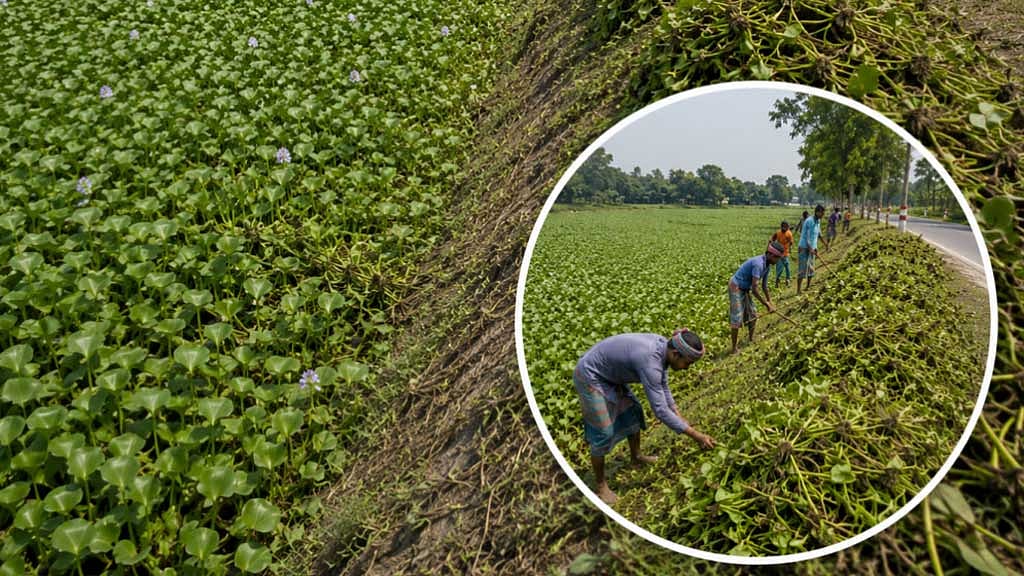
Every monsoon, Bangladesh witnesses a familiar yet frustrating sight. Rivers, canals, ponds, wetlands, and roadside marshes become blanketed by dense mats of water hyacinth. Fishing boats struggle to move, irrigation channels become clogged, drainage systems lose efficiency, and stagnant water creates ideal conditions for mosquitoes. For decades, this invasive aquatic plant has been viewed as little more than a costly environmental nuisance.
But have we ever stopped to ask ourselves: is water hyacinth merely a problem, or could it also be part of the solution?
A Resource in Disguise
As Bangladesh confronts the growing challenges of climate change, food insecurity, soil degradation, and biodiversity loss, innovative yet affordable solutions are becoming increasingly important. One such solution may already be floating on our waterways. Instead of treating water hyacinth as waste, we should explore its potential as a renewable biological resource that can support environmental restoration, sustainable agriculture, and healthier communities.
Water hyacinth (Eichhornia crassipes) is among the world's fastest-growing aquatic plants. The International Union for Conservation of Nature (IUCN) identifies invasive alien species as one of the leading drivers of biodiversity loss, threatening ecosystems, food security, and livelihoods. Bangladesh's extensive network of rivers, canals, wetlands, and floodplains makes effective management of this invasive plant particularly important.
The Power of Nature-Based Bioengineering
A practical starting point would be to organise seasonal harvesting of excess water hyacinth from canals, wetlands, and roadside water bodies. Rather than leaving the removed plants to rot or disposing of them as waste, they could be strategically placed along road embankments, canal banks, and other erosion-prone areas.
This approach reflects the principles of nature-based bioengineering, which uses vegetation and biodegradable biological materials to solve engineering and environmental problems. Around the world, similar techniques have been successfully applied to stabilise slopes, reduce soil erosion, restore riverbanks, and improve ecosystem resilience while reducing reliance on concrete structures.
Harvested water hyacinth forms a natural protective layer that cushions the impact of rainfall, slows surface runoff, and minimises soil loss. As the biomass gradually decomposes, it enriches the soil with organic matter, improving soil structure and moisture retention. This dual function -- erosion control followed by soil improvement -- demonstrates how biological materials can provide effective engineering solutions while restoring ecosystems.
Restoring Ecosystems and Protecting Health
Removing excessive water hyacinth also restores the ecological health of freshwater ecosystems. Dense vegetation blocks sunlight, reduces dissolved oxygen, restricts water circulation, and degrades aquatic habitats. Harvesting excess plants allows sunlight to penetrate the water, improves oxygen availability, and creates healthier conditions for fish and other aquatic organisms, thereby enhancing biodiversity.
The benefits extend beyond the environment. Thick mats of floating vegetation often create stagnant water that provides ideal breeding sites for mosquitoes. As Bangladesh continues to face recurring outbreaks of dengue and other mosquito-borne diseases, reducing these breeding habitats should form part of an integrated disease prevention strategy. The World Health Organization (WHO) recognises environmental management as a key component of Integrated Vector Management (IVM), highlighting habitat modification as an effective method of reducing mosquito populations.
From Waste to Wealth
The value of water hyacinth does not end after harvesting. Once composted, it becomes a nutrient-rich organic fertiliser capable of improving soil fertility, increasing water-holding capacity, and reducing dependence on chemical fertilisers. The Food and Agriculture Organization (FAO) emphasises that restoring soil organic matter is fundamental to sustainable agriculture, climate resilience, and long-term food security.
Scientific studies have also demonstrated that water hyacinth biomass can be successfully converted into compost, mulch, livestock feed, bioenergy, handicrafts, and other value-added products. Rather than treating it as waste, Bangladesh can transform this abundant biomass into a valuable economic resource.
Affordable organic compost can reduce production costs for farmers, improve vegetable cultivation, promote safer food production, and create seasonal employment through community-based composting enterprises. Such initiatives support a circular economy in which biological waste is converted into productive resources.
A One Health Approach
The true strength of this strategy lies in its alignment with the One Health concept, which recognises that the health of people, animals, plants, and the environment is interconnected. Healthy wetlands support fisheries and biodiversity, fertile soils improve agricultural productivity, cleaner water benefits livestock, and reduced mosquito breeding lowers disease risks for surrounding communities.
Protecting ecosystems therefore contributes directly to public health, food security, and rural livelihoods. Investing in environmental restoration is ultimately an investment in healthier and more resilient communities.
A Call for Action
Importantly, this solution does not require expensive technology or large-scale infrastructure. Bangladesh already possesses the raw material in abundance. What is needed is coordinated action involving local governments, researchers, universities, educational institutions, NGOs, community organisations, and farmers.
Pilot projects in selected districts could generate evidence on erosion control, ecosystem restoration, compost production, and climate resilience before wider implementation. Research institutions can monitor environmental and economic outcomes, providing the scientific foundation for national guidelines on integrated water hyacinth management.
Bangladesh has repeatedly demonstrated that community-driven innovation can solve complex national challenges. As climate change places increasing pressure on ecosystems, agriculture, and public health, it is time to rethink how we manage the resources already available to us.
Water hyacinth will continue to grow with every monsoon. The real question is not whether we can eliminate it entirely, but whether we can manage it wisely. With science, community participation, and sound policy, this invasive weed can become a powerful ally in building a cleaner environment, healthier communities, and a more climate-resilient Bangladesh.
[Prof Farzana Islam Rume is a Professor in the Department of Microbiology and Public Health at Patuakhali Science and Technology University]