Published : 13 Nov 2026, 01:16 AM
Updated : 13 Nov 2026, 01:16 AM


The Meghna estuary is a landscape in constant flux, where land is lost even as new ground rises from the water. But over the past 35 years, satellite images have captured a striking development: Sandwip, Swarnadwip and Bhasan Char are gradually merging into one vast landmass.
The finding comes from images spanning 1989 to 2025, analysed by a team led by Mohammad Mahmudur Rahman of the Bangladesh Space Research and Remote Sensing Organization (SPARRSO).
The study, “Monitoring the Dynamic Landforms in the Meghna Estuarine Islands”, appeared in the Journal of Coastal Conservation in October.
“We started working around 2018. At that time, we noticed that the three chars [sandbars] were merging. By 2025-26, we saw that the channels inside had become minimal and the islands had indeed turned into a continuous landform,” Mahmudur said.
“Three chars in the Bay of Bengal coming together to form such a large land formation is not very common. If we can make use of it, it will be good news for a densely populated country like Bangladesh.
“The main message of the research is that Sandwip, Swarnadwip (Jahajjar Char) and Bhasan Char are merging to create a large landmass. Urir Char is also included in our research, but it remains separate. We can say that the three islands are merging to form one large island.”
A Landscape still Taking Shape
Researchers caution that the new land may need another one or two decades, or longer, to stabilise. Tides and cyclones could wash it away without careful management and mangrove planting.
Co-researcher Mohammad Shamim Reza Saimun, a lecturer at Shahjalal University of Science and Technology, said: “Usually, because of climate change and rising sea levels, we talk about parts of the coast going under water. But here we are seeing the opposite picture too. So much sediment is arriving that chars are emerging in the estuary and, over time, they are turning into new land.
“Basically, three chars are emerging. But the main purpose of our research was to show that the three chars are merging, that the landforms are coming together. In the future, they may merge into one main landscape.”
Saimun said the merging process had been under way for three decades. Another two or three decades may be needed before the land can be considered stable. A similar formation, Dimer Char, has emerged south of the Sundarbans.
Dhaka University Associate Prof Mohammad Enayet Hossain said the new ground remained at an early stage of development.
“This soil, which is at the preliminary stage of becoming usable, can be called ‘Entisol’ or ‘young soil’,” he said.
There are 12 soil orders, he said, and mature soil can take hundreds or thousands of years to develop.
“Newly emerged char soil is very fertile. So, if it is used properly, with initiatives such as planting mangrove species and afforestation, it will help conserve the land in the future.”
AKM Saiful Islam, a professor at Bangladesh University of Engineering and Technology, said the Padma-Meghna-Jamuna river system carries about 1 billion tonnes of sediment to the Bay of Bengal each year.
“Sediment mainly reaches the Bay of Bengal through the Meghna. There is coastal dynamics here. Although new chars form through sediment deposition, coastal dynamics redistribute the sediment and chars sometimes sink again. Recently, the amount of incoming sediment has been declining; it is no longer arriving in the quantities seen before.”
Prof Saiful called for coordinated coastal protection.
“If tree felling is stopped on newly emerged chars and natural mangrove forests are allowed to grow, alongside afforestation, the land will become more stable and the country will gain new territory. Areas such as Sonadia in Cox’s Bazar could also offer new opportunities for ecotourism.”
Decades of Change
The team also includes Jahangirnagar University Prof Md Shamsul Alam and researcher Milon Kumar Shiuli.
Mahmudur said, “We are mainly seeing land formation there; a substantial amount has taken place since 2000. Sandwip has experienced both erosion and accretion -- some parts have eroded and others have formed. Swarnadwip (Jahajjar Char) was created almost entirely within the last 25 years, particularly since 2000.
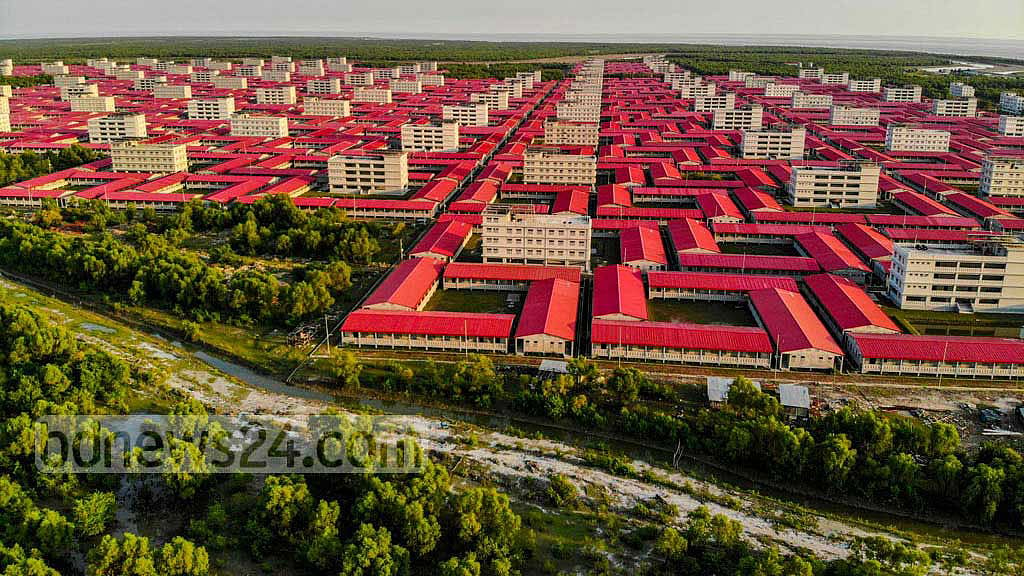
“Bhasan Char emerged after 2010 and is also expanding. The three chars are coming together; they can no longer be seen as separate,” he added.
He said the satellite findings had been shared with the government.
Saimun summarised the study: “Over the past three and a half decades (1989-2025), the rate of new land formation around the four islands in the Meghna estuary -- Sandwip, Urir Char, Swarnadwip and Bhasan Char -- was much higher than the rate of erosion.
“During this period, a total of 543 square kilometres of land was formed through sediment deposition. Only 46 square kilometres disappeared. As a result, Sandwip, Swarnadwip and Bhasan Char show a tendency to merge into one vast, continuous landmass.”
The study recorded these changes:
● Sandwip gained a net 105 square kilometres.
● Swarnadwip expanded from 52 square kilometres in 1989 to 266 in 2025.
● Bhasan Char, which emerged in 2006, reached 165 square kilometres by 2025.
● Urir Char gained a net 91 square kilometres.
Saimun said, “The data from this research will help the government implement coastal development plans. This new landmass will create major opportunities for housing and agriculture in a densely populated country like Bangladesh. To make the new land permanent, we have recommended mangrove afforestation and the construction of protective embankments.”
Prof Shamsul said, “New islands will emerge along Bangladesh’s coastal frontier. In terms of land formation, this is an extremely dynamic land frontier zone. On one side, land is consolidating, while on the other, it is also eroding. What we observed during our study period is certainly encouraging.”
He urged continued monitoring, warning that the newly emerged land could disappear beneath the sea without timely measures.