
Published : 29 Sep 2026, 12:01 AM
Updated : 29 Sep 2026, 12:55 AM


Long before language settled into words, there was movement. That, at least, is the theory behind one of the oldest and most quietly compelling ideas in dance scholarship: when human speech was still finding its footing, people spoke first with their bodies. Out of that primal vocabulary, one of the eight great classical dance traditions of the Indian subcontinent eventually took shape -- Kathak, a form whose very name means "the one who tells a story".
The etymological roots of Kathak lie in the Sanskrit word katha, meaning "story". It is a narrative performance tradition from northern India. A distinctive feature of this dance form is that, unlike other classical dance traditions, Kathak has passed through many cultures, including Hindu temples, Muslim courts, royal patronage and, later, democratic patronage. This paper explores the ways Kathak presents itself through its history and structure.
Origins and Development
The birth of Kathak can be traced to a group of professional performers known as "Kathak", "Gathak", "Pathak" and "Kathaprayana". During the medieval period, these performers were also called "Bhaat", "Charana" and "Granthika" -- people who told stories from the Puranas of the Hindu religion, devoted to Krishna and other gods and goddesses, and recounted miracles performed by deities. They used dance movements while narrating these stories, creating a distinctive performance method that combined storytelling with linguistic elements.
The period from the rise of the Mahajanapadas -- the 16 states of the sixth century BCE -- to the Natyashastra in the second century BCE saw the gradual development of the classical dance tradition. Folk dance traditions existed from the Vedic period through the Puranic period alongside the classical tradition. The Natyashastra, composed by Bharata, provided a theoretical foundation for dance, drama and music that would influence all later Indian classical traditions.
Vaishnava Philosophy and Raas Leela
The fifteenth and sixteenth centuries saw the emergence of Vaishnava philosophy, which emphasised Raas Leela, or the union of Radha and Krishna. According to critics, "The dancing in the Raas Leela consisted, for the most part, of an extension and amplification of the simple, basic mime and gesture of Kathak storytellers combined with elements of whatever folk dancing was then available in the region" (Mukherjee, 2004, p. 31).
During this period, the themes of Kathak began shifting away from general mythology towards the romantic tale of Radha and Krishna, including their moments of union and separation. Although Kathak and Raas Leela were different streams, they shared many similarities in their methods of presentation, and Raas Leela could therefore be seen as a successor to Kathak. Folk elements continued to be incorporated into Kathak, giving rise to forms such as Kajri dance in Uttar Pradesh, Ghumri in Rajasthan, Baccha Nagma among Kashmiri Sufis and other branches that grew from folk traditions.
Mughal Patronage and Cultural Synthesis
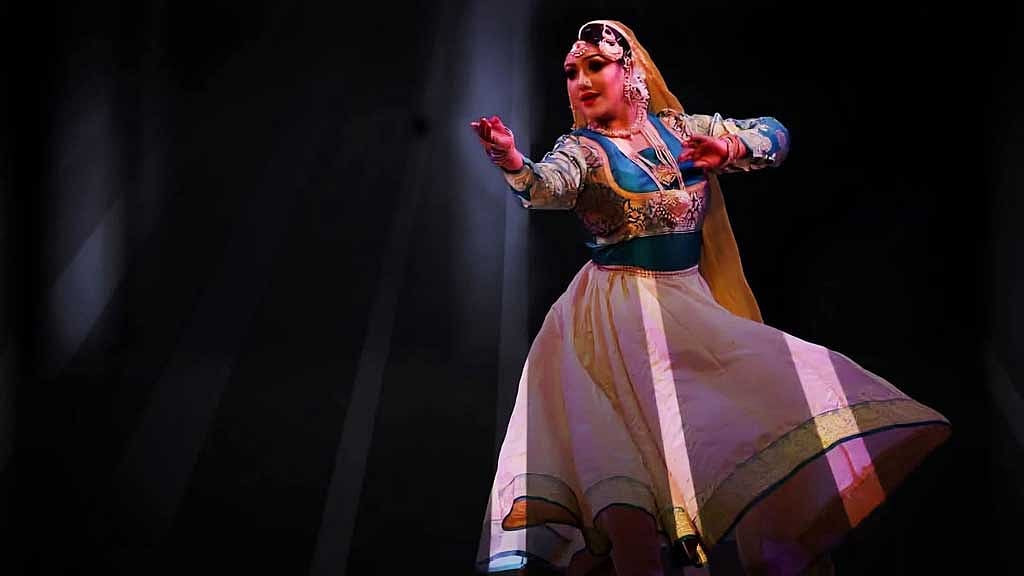
The emergence of Muslim rule in the subcontinent brought a transformation in Kathak's dance and musical styles. Earlier, Kathak had remained largely confined to temple Pujas, but following the arrival of Muslim rulers in India, it found an established place in royal courts. Indigenous styles combined with traditions from Central Asia and Islam to produce a new, synthesised art and music form. In the royal courts, Kathak also moved away from purely religious themes and incorporated aesthetic elements in which technical perfection and rhythmic variation became central.
Under the patronage of three cultured Mughal emperors -- Akbar, Jahangir and Shah Jahan -- Kathak reached its zenith. The dance became an art form combining Hindu, Islamic, Indian and Central Asian traditions. This cultural combination reflects the uniqueness of Kathak as an art form in which Islamic and Hindu traditions coexist, helping explain its wide following in Bangladesh.
After the disintegration of the Mughal Empire, local rulers who gained power, particularly in Rajasthan, continued to patronise Kathak. The Lucknow style of Kathak emerged through the patronage of Nawabs such as Asaf-ud-Daulah (1775-1798) and Wajid Ali Shah (1847-1856). Wajid Ali Shah, himself a dancer, arranged for his wives and mistresses to receive dance training, staged public Raas Leela performances and created original productions called Rahasa. Rahasa was of two types: Nawabi Rahasa, in which the Nawab was the main character, and Awami Rahasa, which was intended for the masses.
Colonial Period and Democratic Reorientation
During the British period, artistic activity shifted towards private and localised productions. Kathak performers became entertainers at receptions held for foreign visitors and British delegates. Raja Chakradhar Singh of Raygarh played an important role in sponsoring Kathak in the twentieth century. After the downfall of Nawab Wajid Ali Shah in 1856, Raja Singh, along with many dancers, singers and artists, moved to Calcutta and helped form a new community around Indian classical dance and music.
In the twentieth century, a democratic transformation took place in Kathak. Educated and cultured people outside royal courts and families began patronising artists. Dance became an important part of social occasions, and people from the elite classes began learning and performing Kathak.
Born to a Bengali Brahmin barrister and landlord, Madame Menaka (Leela Sokhey) defied social conventions to practise and perform Kathak. Leela Sokhey was born on Oct 15, 1899, in Barisal, Bangladesh. She was educated at Loretto Convent and later in London. Despite social taboos associated with women taking up such activities, she practised classical dancing and chose Kathak as her primary interest.
In 1928, Leela gave her first performance at the Bombay Opera House. She actively worked to reform Kathak, increasing its popularity among modern audiences by staging new dance dramas and developing a new form based on the principles of ballet. Leela was the first winner of the Champions Trophy at the International Dance Olympiad of 1936, alongside Uday Shankar, who is known as a pioneer of creative dance. Through her work, Kathak gained worldwide recognition as one of the most sophisticated dance forms, particularly through innovations in storyline, plot, themes, costumes, choreography and stage design.
Adoration and Hymn
The first element in the presentation of Kathak is adoration, or hymn. Originally intended solely to praise gods, this element broadened its scope as different figures gained importance within social hierarchies. Today, hymns may honour monarchs, religious figures, dance teachers and legendary dancers. Artists are free to choose subjects from religious and social life and may even create dances about topical issues.
Whatever the chosen subject, the entire presentation needs to be developed into poetry that can then be performed through corresponding dance movements. Music is usually composed in the Braja language, depicting stories from the Puranas.
Pure Dance (Nritta)
The second element of Kathak is pure dance, which consists of posture, salutation, rapture and other techniques independent of non-verbal elements.
Posture refers to the style and techniques of standing across a wide range of tempos. Posture movements begin immediately after the hymn at the start of a performance, establishing communication throughout the show. According to Pandit Birju Maharaj, "the posture means holding the body in a particular dancing stance, while making very subtle movements of eyebrows, eyes, heels, wrist and upper body" (Maharaj, 2010, p. 80). It is worth noting that posture and standing techniques have no meaning beyond expression.
Amad -- meaning entrance in the Parsi language -- occurs after the pose and before the pure dance. It is both a feature of the choreography and a medium of self-expression, and is performed at a slow tempo. As Mohan Khokar observes, "Amad means arrival and is done at the beginning of the performance. This is done in the form of a quick flourish, and as it comes after the 'Theat' it succeeds in making the audience alert and in preparing it for the more complicated work that is to follow" (Khokar, 2007, p. 99).
Salami was traditionally a salutation and acknowledgement of the audience in temple performances. With the onset of Muslim rule, the tradition remained, although it was adapted in line with other religious instructions and performed at a slow tempo.
Tukra is the simplest form of pure dance; its mnemonics are those of the tabla and emphasise a single pattern, usually terse and free from quarter and two-thirds beats. The Tora is performed with a number of rhythms, including slow and fast tempos. Tehai takes place whenever a lyric or chant is repeated three times in a set. Paramelu is essentially a form of harmony, bringing tempos, tunes, chants and music together. Animal sounds are mimicked to create a dramatic effect.
Parana is performed along with the chants of the Pakhawaj, a lofty incantation of some gravity that is repeated as a chorus. Chakradar takes place when chants or incantations of the same set or magnitude are repeated three times without changes in tempo or cadence. Chakradar is not self-contained but requires the Tora, Tehai and Paramelu-Paran sequence to create the Chakradar cycle.
Laari, or footwork, denotes elaborate footwork generally accompanied by an up-tempo rhythm. Lyrics and chants are repeated in multiples of two and four to end the pure dance sequence. It was during the period when Central Asian Sufi philosophy permeated Kathak that the dance borrowed dimensions of footwork from Sufi traditions.
Acting (Abhinaya)
Acting is an important element of Kathak performance, with pure acting having no semiotic meaning. Acting can be divided into two types: acting involving hand-sign movements and pure acting that tells a story directly. Pandit Birju Maharaj made a significant contribution to acting and narrative, working to develop a unified form of Kathak that ensured consistency in its methods and gestures.
Tarana comes towards the conclusion of a Kathak performance and is the musical component, consisting of tunes and melodies performed at varying tempos. Special sounds that relate to one another through their musical qualities are used in Tarana. "Kathak uses a substantial corpus of compositions of Hindustani music which was specially composed for the dance. 'Tarana', an abstract piece of music is used for the 'Nrtta' sections of Kathak dance." (Vatsyayan, 2007, p. 84).
Influence of Sufism and Cultural Syncretism
Sufism originated in Central Asia and was propagated by poets such as Hafiz and Jalaluddin Rumi, who had a significant influence on Kathak. Like Vaishnava philosophy, Sufism embraced mysticism and physical movements resembling dance as a means of drawing closer to God. "According to Sufi philosophy, if an individual has one hand up pointing to God and another down pointing to Earth and rotating in fixed position, the individual can come nearer to God."
As a result, Arabic, Persian and Urdu have become prominent in Kathak performances alongside Hindi and Sanskrit. The influence can also be seen in the clothing worn during performances. Sufi practice shares similarities with Christian mystical philosophy and Hindu Vaishnava philosophy. Since then, there has been a mixture of languages in music for dance performances, along with changing costumes and make-up. The languages include Sanskrit, Hindi, Arabic, Urdu, Farsi and Parsi. Thus, Kathak is an example of cultural syncretism between Hindu and Muslim religions and philosophies.
Contemporary Developments
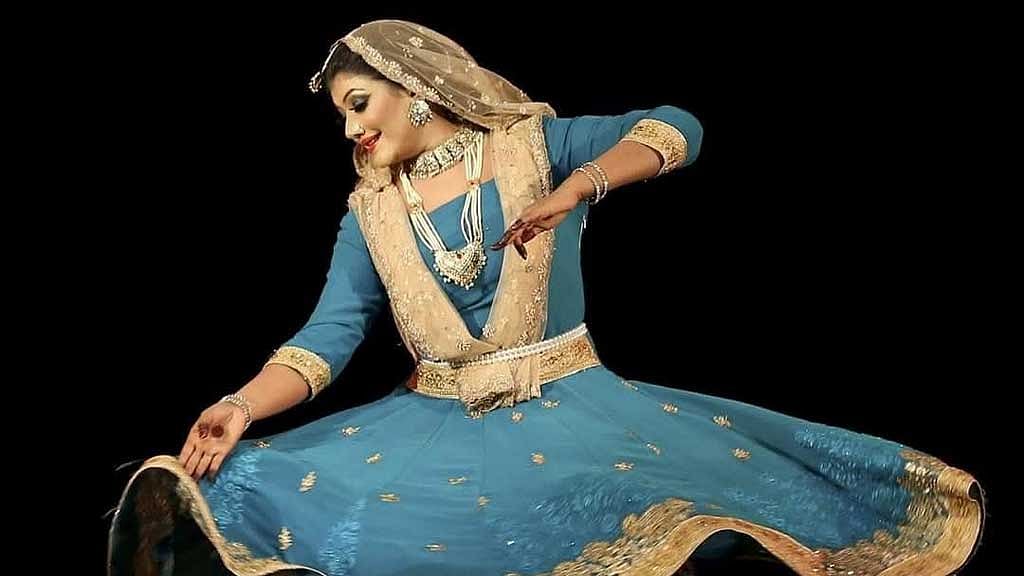
Since independence, the evolution of Kathak has received a boost in post-independence Bangladesh through renowned artists such as Shibli Mohammad, Munmun Ahmed, Saju Ahmed and their peers. In fact, the most noteworthy contributor to the enhancement of Kathak's universal appeal is Pandit Birju Maharaj, as many contemporary Kathak artists are disciples of Pandit Birju Maharaj.
The end of this genealogy brings the realisation that Kathak is highly dependent on the guru or master. While people once came together to perform dances primarily for entertainment, Kathak has now become a high art form. It began as a form of dance in which praise was offered to gods and deities in temples. Later, it was used to show respect to emperors and sultans under imperial rule. After the downfall of the imperial regime, the dance was used to pay tribute to zamindars. Now, in an age of democratic participation, the value of equality has found its way into Kathak.
Thematically and spatially, Kathak has moved beyond royal courts and village settings to the proscenium stage. At various stages of its evolution, Kathak dancers have critically evaluated their art form and techniques to suit changing tastes, realities and technologies.
From the above discussion, it is clear that the history of Kathak dance, from temple courtyards to global stages, reflects a fascinating story of adaptation and resilience. The art's special ability to integrate diverse cultural influences -- including Hindu worship traditions, Islamic courtly art, Sufi mysticism and even democratic culture -- has ensured its relevance through the centuries. The structural aspects of Kathak, such as adoration, pure dance and acting, provide a fuller understanding of its performance and development. The guru-disciple lineage ensures continuity amid change.
As Kathak evolves in the 21st century, maintaining a balance between tradition and transformation makes it necessary to draw lessons from its history and understand how authenticity can be preserved through change.
[Monira Parveen is an Assistant Professor in the Department of Dance at the University of Dhaka]