Home
+
Published : 10 Sep 2015, 11:38 AM
The primary objective of this project was to help youths from rural areas to set up micro-enterprises based on vermiculture technology and also to improve crop productivity by increasing soil fertility through ecological methods of farming.
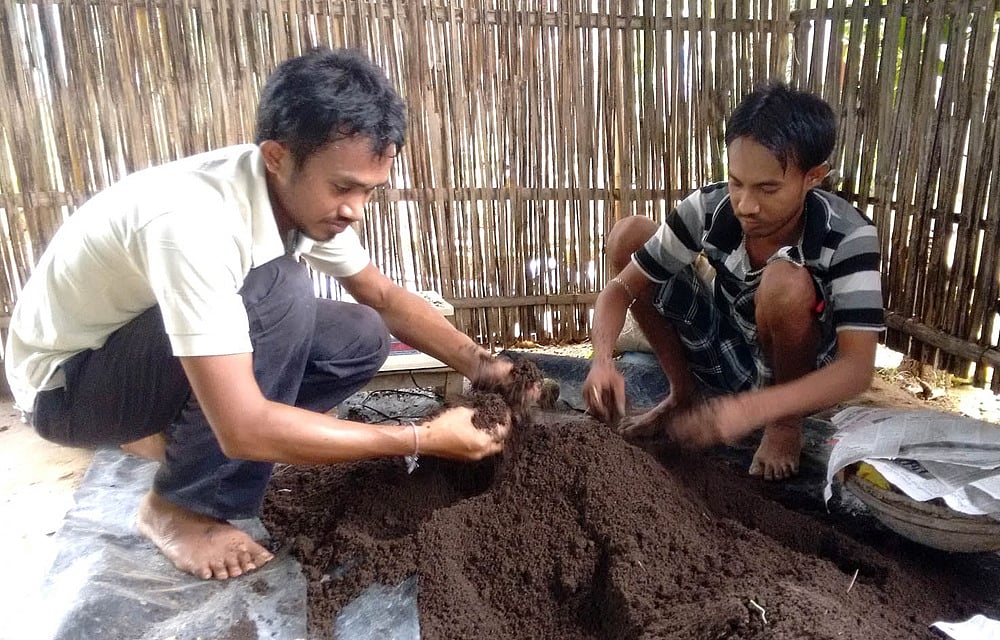
One such micro unit has been setup in the residence of Bidhyadhan Sharma, of Naogaon in bordering Bamutia Kalibazar area which is renowned for its vegetable production.
Bidhyadhan, a third semester student of BCA (bachelor of computer application) under Tripura University, runs this unit under the banner of Naogaon Bamboo Growers Society along with his childhood friend Supen Datta.
Their team, like other young entreprenuers, got training and material support from the CFLE in vermicomposting.
That which is a simple process where special earthworms are used to turn organic wastes consisting of household, kitchen and other available plant wastes into very high quality compost.
"After completion of the week long training CFLE provide the members with a financial help for setting up of low-cost vermicomposting units utilizing bamboo and polythene tanks," said Pawan K Kaushik, Regional Director of CFLE Salbagan.
"To start with they are also provided with a special species of Australian earthworm - Eisenia fetida which live in the upper layer of soil surface and produce more organic waste in less time and thus gives more profit to the entrepreneurs.
Moreover, it is helping the farmers to get involved with non-chemical fertilizers."
The raw materials required for these vermicompost are readily available in the rural areas where various plant parts like banana, alarm, cow dung, vegetable and soft-plant wastes, leaves, grass, hay and neem are used.
Bidhyadhan Sharma, who has two units for micro-vermicompost production, said, "There is very little to do after the compost plants have been filled with the earthworm for transforming garbage into ‘gold’. Only once daily one has to apply little water to maintain the humidity and protect the worms from external enemies like ants, rats and chicken and other domestic animals those feed on earthworms. The money I earn helps me continue my education beside a little help in running our family."
According to an estimate from each unit an entrepreneur with an investment of Rs 700 pls another Rs 3000 can have a net profit of Rs 10,000 to Rs 12,000 annually . Ever two months, each unit can harvest around 400 kg to 450 kg of vermicompost.
With the success of the micro-vermicompost units the Naogaon Bamboo Growers Society is now planning to start it on commercial scale.
They are making good profit from their project since they got potential customers through CFLE.
Meantime, another producer Supen Datta says, "Only organic fertiliser can prevent environmental degradation which is a major threat the world is confronting as because of the rampant use of chemical fertilizers that contributes largely to the deterioration of the environment ."
Besides selling they are also using a part of their produced organic fertilizers in their own vegetable fields which are showing good results besides helping in saving the environment and reducing health hazards due to overuse of chemical fertilizers and pesticides."
Its a win-win situation for everyone .