


Published : 11 Sep 2016, 09:43 PM
Updated : 19 Oct 2022, 05:28 PM


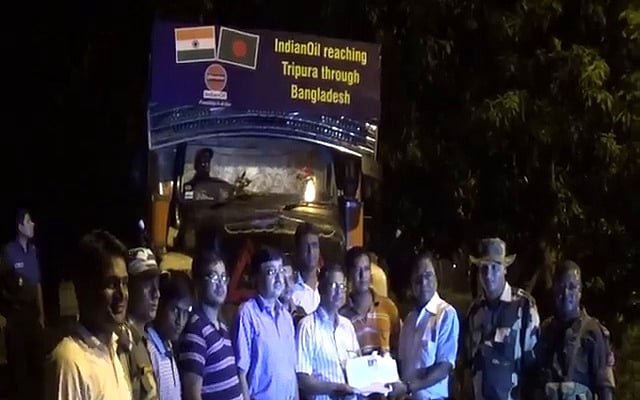
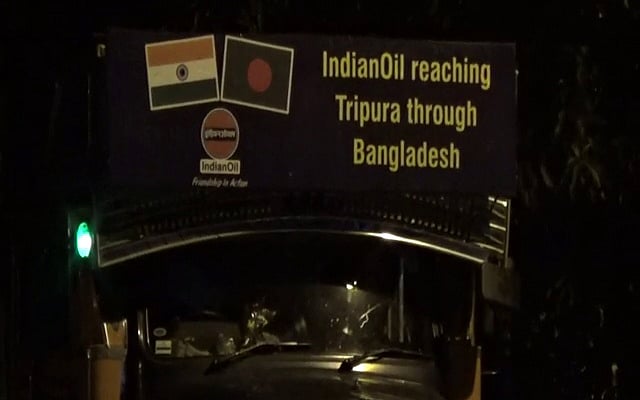
On New Delhi’s request Dhaka had allowed Indian Oil Company to transport fuel to landlocked Tripura, which is surrounded by Bangladesh from three sides, from Assam through surface transport.
Late on Saturday night, 10 vehicles including seven diesel, two kerosene tankers and one LPG bullet reached Tripura’s bordering town Kailasahar through Chatlapur check post in Bangladesh.
Tripura’s Industry and Commerce Minister Tapan Chakraborty, IOC Senior Deputy Manager R K Mohan Singh, Superintended of Police Ajit Pratap Singh and officials of BSF and state administration were present to welcome the drivers of the vehicles by organising a small programme at the Manu Land Customs.
The drivers said the security arrangements through Bangladesh were satisfactory and the alternative measure to address the fuel crisis in Tripura by transporting it through Bangladesh will be a great help.
Raj Kumar Debnath, one of the drivers, said, “We had entered through Meghalaya’s Dauki border and then after crossing Sylhet, Moulavibazar, Shamshernagar entered Kailasahar through Chatlapur check post of Bangladesh.
“It took around five hours travelling around 138 kilometres as we were moving slowly with police escort but still this road is much better than ours and we saved time and fuel.”
On Aug18, IOC, the Indian state-owned PSU under the guidance of petroleum ministry, signed a MoU with the Roads and Highways Department of Bangladesh at Dhaka.
The MoU enables IOC to transport petrol, diesel, kerosene and LPG from Meghalaya to Tripura via Bangladesh territory by road in tank trucks.
On India’s request for facilitation of the movement of IOC trucks carrying petroleum goods to Tripura through its territory, the Bangladesh government agreed to allow it until the end of this month.
Both sides have also agreed to extend the transit facility for a short period as and when required.
According to the MoU, trucks carrying the petroleum products will cross through the Dawki border in Meghalaya into Tamabil in Bangladesh and after covering some 135 km road, will again re-enter India through Chatlapur in Bangladesh to Kailasahar in Tripura.
They will avoid the hilly serpentine National Highway 44, lifeline of Tripura, a section of which has been badly damaged due to incessant rain and floods in Karimganj district of Assam.
The supply of petroleum products to Tripura has been severely affected by the developments.
Earlier, to ease the supply of fuel, RORO (Roll On-Roll Off), where the tank trucks carrying petroleum products and LPG Bullets loaded onto open railway wagons, was also moved to the state of Tripura.
Only last week, the Food Corporation of India transported a consignment of 2350 MT of rice from Kolkata to Tripura through Bangladesh riverways to avoid transportation hitches through the NH 44.
Earlier, Bangladesh had also allowed India to carry food grains and heavy machinery from different parts of India to Tripura over its territory.
The distance by road between Agartala and Kolkata via Guwahati is 1,650 km but it is just 620 km between Agartala and Kolkata via Bangladesh.













