SPECIALSmall in age, big in-deed
Dark is the world of the children drawn into illegal activities – more out of need that anything else. But there is a brighter side of their life, too.
bdnews24.com News Service
bdnews24.com
Published :
17 Jun 2011, 05:38 PM
Updated :
10 Aug 2022, 04:58 PM
Shegufta Hasnine Surur
bdnews24.com writer
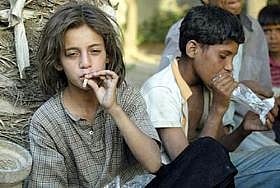
Dhaka, June 17(bdnews24.com) — They have tested all common brands of cigarette, inhaled cannabis, tasted and consumed alcohol and phensedyl, swallowed tablets, and helped smuggle and peddle all of these across the country and beyond borders.
And the one thing that has always bothered the law-keepers about them is their expertise as thieves!
Incidentally, the youngest of the lot is about seven and the eldest 15.
Al-Amin, 10, used to cross the Benapole border with large amounts of cannabis wrapped in polythene and tied to his body under overlarge shirts. He also smuggled other drugs through that border.
"I used to wear cricket pads, inside which I would stuff bottles of phensedyl, take a pair of Styrofoam blocks to support me as I swam through the creeks across the border," he said.
Sohag, 9, would smuggle cannabis and heroin into the city from Ajampur in Uttara. His employers would lend him clean school uniforms and schoolbag for the day. But the bag would be filled with cannabis.
"We'd jump into trains from Uttara and go up to the roofs. There we would cut and distribute the cannabis into smaller packages. Then we would get down near Khilgaon rail-crossing, go to an abandoned market in Gulistan where the cannabis would be sold."
All these boys are now harboured in a quiet sanctuary in Manikganj, called Apongaon, where a catholic runs a rehabilitation centre called Apon.
There are 47 young children at Apon, of whom 14 starting using drugs before six years of age, 26 during six to 10 and seven between 11 and 15.
Most of them are experienced in all kinds of drugs, know how to process them, and even made alcohol from fruits at their shanties.
"If you smoke ganja (cannabis), you don't feel anything when they beat you after you get caught stealing…so better…," one of the boys advised.
"I used to mix fruits and water, put them in a bottle and bury the bottle. In two or three weeks, it would become alcohol," Al-Amin said.
Brother Ronald Drahozal has picked up these boys over the years from Kamlapur Railway Station, Karwan Bazar, Mohakhali Bus Terminal and other busy areas of the city. Some of the boys are from as far as Chittagong.
"They come from diverse backgrounds. Some were born on the streets, some never knew any parents. Then there are some whose step-parents forced them out of homes once their parents separated and remarried.
"Some were lost, separated from parents, in crowds," brother Drahozal said with a sigh.
No matter how they end up in streets, children tend to concentrate around places where there are more people, such as bus terminals, launch terminals and such, he said.
"They have this practice of blood bonding where they cut each others hands and press them against each other to exchange blood. Then they call each other blood brothers, or blood friends. This is a very risky behaviour," brother Drahozal said.
When asked how they financed their craving for drugs, the boys spoke with enthusiasm about their many income sources.
Collecting scrap is the most common career for the street children of Dhaka, but it is hardly a bread earner. A kilogram of scrap that takes hours to collect will sell for a meagre Tk 25-30.
Stealing, however, is a much more profitable career.
"At noon, residential areas are empty, because people are sleeping or out for work. That is the best time to sneak into houses," Sohag explained.
"Once I sneaked into a house in Keraniganj where I found two brass pots. Brass sells for Tk 250 per kilogram. The pots weighed about three and a half kgs.
"We had a lot of fun with that money," he reminisced.
Brother Drahozal said it is a matter of concern how the boys glorify their criminal acts.
"They're not criminal-minded. They're very charitable in fact — when one earns say Tk 3,000 from a drugs haul, he gives his friends a feast, takes them to the movies, and spends generously."
A Department of Social Service projection says there will be 1,144,754 children lurking in the streets of Bangladesh by 2014.
In Apon alone, more than a thousand under-fifteens have gone through treatment for drug addiction since 1994.
Apon believes that medical detoxification is only the first stage of addiction treatment and by itself does little to change long-term drug use. It, therefore, focuses more on counselling and behavioural treatment for its patients.
As on the streets, the boys form a community when they come to the centre. They assess on a daily basis how each member is recovering, through a three-point voting system: good, average and bad.
The boys work hard to maintain the rich garden and vegetable patches that surround the centre and attend classes that give them basic education and skill training.
Whatever they reap from the garden belongs to them, they share the fruits of their labour with their brothers — just as they did on the streets.
Memories of the dark world they used to live in appear only as distant nightmares.
bdnews24.com/sh/nir/2323h