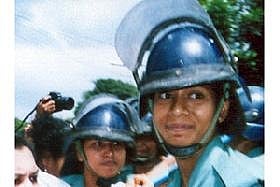
From Our BlogCan our police force ever translate to 'friend'?
The home minister has said that the police will be free from government interference, but the force must also discard a colonial era image of terror and intimidation to become a friend of the people and cultivate a proactive social role, writes Towheed Feroze
bdnews24.com News Service
bdnews24.com
Published :
21 Jan 2009, 07:29 AM
Updated :
12 Aug 2022, 12:28 PM
Towheed Feroze
The home minister has said that the police will be free from government interference, but the force must also discard a colonial era image of terror and intimidation to become a friend of the people and cultivate a proactive social role.
Think police and the first impression - unfortunately - is tarnished by relentless stories of bullying, bribery and blind political affiliation. Though the finger of blame has long been pointed at the force for its flaws, what has not been addressed from all dimensions is the reckless politicisation of the police that forms the foundation for most of the irregularities that plague its reputation.
During the political governments of the past, it was rare for politically linked criminals to be detained by the police because members of the force also need to maintain political connections for promotions and other facilities. As a result, killers were released, extortionists looked at incarceration as a short break and the common person put the police right next to the criminal.
To be frank, people in trouble often think twice before calling the police because, in their view, calling the police meant further complicating an already messy situation. 'Police daika ar bhejal baranor dorkar nai' (no need calling the police to make more trouble) is still a very commonly heard line.
We hear that the home minister has said that the newly elected government will not interfere with police work. We would like to believe this is not just post-polls rhetoric, which usually evaporates as 'trademark' politics takes precedence.
Of course, police must be allowed to operate freely, but first must come a series of efforts by the police to win back public approval and more importantly, respect.
The chief of police has said that the force needs to be given respect. But respect comes when a force is part of the general population and not an entity that is alienated from it. Our force is detached from the public, to say the least, by tactics of intimidation.
Perhaps the rationale for this maybe the outdated theory – maintain law and order by instilling fear. Well, that logic may have worked during British rule but today the world has changed radically. Also, we should not forget that the philosophy of colonial rulers was to ensure that the general people are kept at a distant from the power structure.
We live in a different world today and here, police have a much more social role to play. In other parts of the world, police are seen interacting with communities on prevention of drug abuse and juvenile crime and therefore, apart from the role of law enforcers, they also play a social role.
Regrettably, in Bangladesh we have failed to shed the colonial image of the police and when a top-level police official talks about respect without delving into its layers, it rings hollow.
Instead of just delivering lines, why not start ward-based community meetings by the police on a quarterly basis? And, how about putting up police complaint boxes in every ward and holding monthly police counselling on issues like home safety, trusting the police, drugs, construction regulations and other community-based issues.
Also, the association of 'police' with 'bribes' must stop. For that to happen, we need examples of honesty and integrity.
Admit it: most people will come up real life anecdotes in which they had to part with money in some police-related incident.
The low salaries of our police force doesn't help; if the government wants an efficient force that has a fairly spotless image then the pay scale has to see a rise, or there needs to be other legal ways through which members of the force will be able to make enough money to lead a comfortable life.
With that in mind, the priority should be in creating a 21st century police force with a 21st century ideology and a one that offers its members perks like land, good pensions, foreign trips and missions and regular incentives.
The home minister has said that the police will be modernised to tackle threats from extremists, militancy and terrorism, but perhaps these should be left to other branches of law enforcement, leaving our general police force to serve the public by overcoming deeply entrenched ideas and habits that separate them from the general population.
The police force is burdened under a heap of negativity accumulated over years of politicisation and to lose that reputation is not an easy task. The word "friendly" is sorely missing from our police force and without that they will never emerge from their cocoon of ignominy.
Towheed Feroz is assistant news editor. The views expressed are his own.