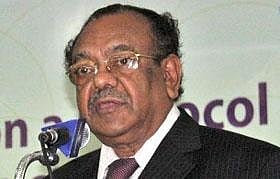
Ruhal wants end to blood-y business
Many private blood banks do not test blood before supplying them, posing 'serious health threat', says the health minister.
bdnews24.com News Service
bdnews24.com
Published :
20 Jul 2011, 04:36 PM
Updated :
10 Aug 2022, 05:08 PM
Dhaka, July 20 (bdnews24.com) – Many private blood banks do not test blood before supplying them, and that can pose 'serious health threat', health minister has said.
A F M Ruhal Haque, also a physician by training, said they had shut down many blood banks for 'not complying with the (safe blood transfusion) rules'. He, however, could not say the exact number.
"But that's (shutting down) not enough," he told journalists on Wednesday on the sidelines of a workshop in the capital, "People also ignore blood screening due to high screening charge."
"We (government) have 203 blood transfusion centres where we ensure mandatory blood screening. It's cheaper and sometimes free," the minister said. "Unscreened blood can prove a life-taking rather than a life-saving option."
The minister said the voluntary blood donation has failed to gain 'desired' momentum. He urged young people to come forward in this regard.
As there is no official statistics about the need of annual blood in the country, unofficial figures put the number at 500,000.
Of which still around 20 to 25 percent comes from paid donors.
Voluntary blood donation can meet only 25 percent of the demand while a major portion – 50 to 55 percent – of the demand is met with donors, who donate just once for their relatives finding no other option.
Campaigners say there is no concerted effort to motivate people in the voluntary blood donation.
Dr Manita Rajkarnikar, director, Central Blood Transfusion Service of the Nepal Red Cross Society, said there are no professional donors in Nepal.
She told bdnews24.com that 85 percent of their required blood comes from voluntary blood donation and rest is being managed by relatives.
"We have donors' motivation programme," she said, adding the government mandated the Nepal Red Cross Society to spearhead the programme.
"We have many techniques to encourage blood donors. We have school motivation programme to create future donors. Sometimes we also use religious sermons to motivate people."
"But all programmes are being run in a coordinated way," she said.
Some 12 countries, including Bangladesh, from WHO's South East Asia Region, African Region and Eastern Mediterranean Region, joined the five-day workshop that started on Tuesday.
WHO organised the inter-regional workshop on 'Leadership and Management of Blood Supply Systems.'
WHO's representative to Bangladesh Dr Arun Bhadra Thapa said the workshop would enhance the management capacities of the country's blood supply systems.
A healthy person above 18 and below 60 can donate blood thrice a year, doctors say.
bdnews24.com/nih/nir/2225h