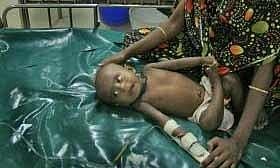
Rains dissipate diarrhoea
Experts say city dwellers should clean up their underground and overhead water tanks; WASA water found safe for consumption at the source point, Nurul Islam Hasib reports
bdnews24.com News Service
bdnews24.com
Published :
11 Apr 2012, 02:29 PM
Updated :
09 Aug 2022, 03:39 PM
Nurul Islam Hasib
bdnews24.com Senior Correspondent
Dhaka, Apr 11 (bdnews24.com) – The number of diarrhoea patients has dropped following a fall in mercury after heavy rains on Apr 6.
According to the International Center for Diarrhoeal Disease Research, Bangladesh (ICDDR,B), the number of patients has gone down from over 900 a week ago to below 600 on Wednesday.
The meteorology department says Dhaka's temperature was 35 degrees Celsius on Apr 5 which fell to 26 the next day when they recorded 62 millimetres of rain.
The temperature was below 30 degrees Celsius until Apr 10 but rose by one degree on Wednesday.
"We received 519 patients until 6pm," Dr Azharul Islam, a scientist at ICDDR,B, told bdnews24.com on Wednesday. "This time on Tuesday the number was 593."
He said since rains cooled off the atmosphere, people were less likely to take roadside food and water that are blamed for the disease.
"Even scarcity of water disappears due to rains," he said, adding last year in March and April they had a small number of patients due to rain.
However, water experts say city dwellers should clean up their underground and overhead water tanks as the Institute of Public Health (IPH) has tested WASA water safe for consumption at the source point.
The institute collected samples from Jatrabari, Gulshan, Badda and Tejgaon where the water-borne disease is widespread.
"So, the problem is in the connecting pipes or tanks where water is stored," said Dr Khairul Islam, country head, Wateraid Bangladesh.
The scarcity of potable water and lack of hygiene practices mean diarrhoea is quite common in Bangladesh around this time of the year.
To prevent diarrhoea, experts suggest boiling the water for drinking, avoiding roadside food and maintaining personal hygiene.
The health directorate's control room has recorded over 1.6 billion diarrhoeal cases in Bangladesh from 2005 to 2011, of whom 2,873 died.
bdnews24.com/nih/bd/2000h