


Published : 20 Jan 2018, 11:20 PM
Updated : 19 Oct 2022, 02:05 PM


Low physical activity is known as one of the leading risk factors for those non-communicable diseases or NCDs in the country.
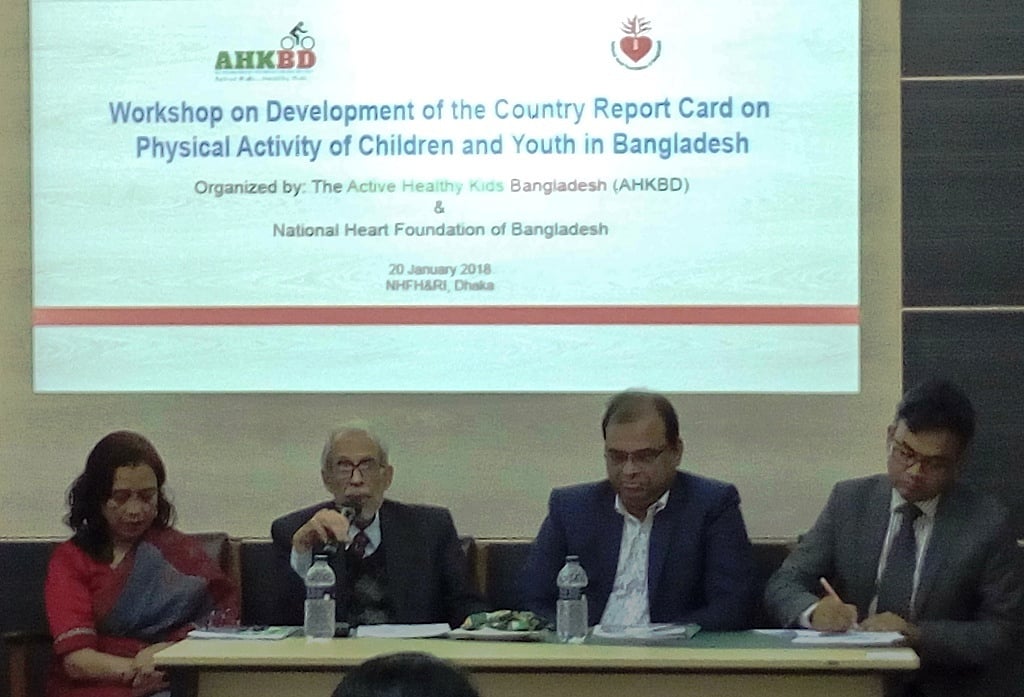
The Active Healthy Kids Bangladesh, an affiliate of the Active Healthy Kids Global Alliance, will try to influence government policies and strategies to promote physical activity among children involving all relevant stakeholders.
Globally, the Alliance uses a ‘Report Card’ as the vehicle to achieve its goals.
Prof Asad Khan, Chair of the Active Healthy Kids Bangladesh, says they are also working on preparing a country “Report Card” for Bangladesh to consolidate existing evidence of physical activity behaviours among the children and youths.
“This is not a research study or a new national survey,” he said while introducing the group and its activities at a workshop in Dhaka on Saturday.
“The Report Card will be a synthesis of the most recently available data on physical activity in children and youth in the country. It is an evidence-based communication and advocacy tool”.
In Bangladesh, NCDs, according to a WHO report in 2014, account for 59 percent of total deaths. Of these, cardiovascular diseases cause the highest 17 percent deaths followed by chronic lung diseases at 11 percent and cancer 10 percent.
The NCD Alliance in last October warned that those diseases are affecting the people of the Asian region including Bangladesh younger than the rest of the world.
The British medical journal the Lancet last year, ahead of World Obesity Day in October, indicated the rise in obesity rates in low and middle income countries.
In Bangladesh, it said, obesity among boys aged five to 19 years was found at 3 percent in 2016 which was only 0.03 percent in 1975. Among girls, the rate jumped to 2.3 percent from almost nil four decades ago at the same age group.
The global school-based health survey in 2014 showed that 59 percent of Bangladesh adolescents are “insufficiently active” and 79 percent had high recreational screen time.
Chaired by the National Professor Abdul Malik, Founder and President of the National Heart Foundation of Bangladesh, Saturday’s workshop was attended by experts from the government, non-government organisations, aid agencies, universities, research institutions, and media partners.
Prof Malik stressed the need for regular physical activities in managing non-communicable diseases with special emphasis on active lifestyle of the adolescents.
A retired brigadier, he underscored the need for “collective and collaborative efforts to meet the challenges of inactive lifestyle of our children and youth in Bangladesh”.
Prof Khan, chair of the Active Healthy Kids, said the Heart Foundation will help them in preparing the ‘Report Card’.
“The Report Card is also aimed at building research monitoring capacity and ecouraging more evidence-based physical activity and health policy,” he said.
“This will also help to promote and accelerate physical activity opportunities among children and youth.”
He referenced Canada where such Report Card is being released every year since 2005.
“It influenced government policy, strategy to promote activity. This also helped them to design child and youth action research project.
“This is also being used as a reference for activity advocacy and help to improve public awareness and education campaigns. This stimulated funding and investment decisions and inspired physical activity research,” he said.
The Report Card uses 10 indicators globally to understand the level of physical activity of the children.
“We need to promote physical activity as time has changed. We are now less active because of industrialisation, urbanisation, modernisation that have resulted in labour-saving technology, screen-based entertainments and motorised vehicles,” Prof Khan said.
“Children used to play outside. Now they play computer games at home. And low level of physical activity is the third leading risk factor for non-communicable diseases in adults in Bangladesh,” he said.
WHO expert in NCDs Dr M Mostafa Zaman, Prof Sohel Reza Choudhury of the National Heart Foundation Hospital and Research Institute, Dr Tara Mona Kessaram of WHO and Dr Khaleda Islam, Director of the Directorate General of Health Services’ Primary Healthcare, also spoke at the workshop, among others.
The Active Healthy Kids Global Alliance has so far helped prepare 52 Report Cards globally.













