Published :
22 Jul 2011, 07:41 PM
Updated :
10 Aug 2022, 05:09 PM
Dhaka, July 23 (bdnews24.com) – As Dhaka is ready to host the region's first-ever international conference on autism on July 25 and 26, the child psychologist who envisaged the high-profile meet regards it as a 'way forward for autism awareness'.
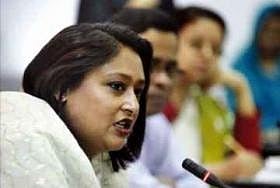
"We want to create public awareness through the conference," Saima Hossain Putul, daughter of prime minister Sheikh Hasina, told bdnews24.com social affairs editor Baby Moudud in an exclusive interview on Thursday.
Putul, a US-licensed child psychologist, decided to host the mega gathering drawing regional politicians and global experts on autism when she came across some parents, physicians and teachers of Bangladesh in July 2010 in the capital and learnt about the horrendous experiences of the families with 'special child'.
She drew attention of the global leaders in a major UN conference on April 6, 2011 where she presented the miseries of autistic children, particularly in resource-starved countries like Bangladesh.
"It's the first conference of its kind in this region. We want to create greater awareness of autism. They (autistic kids) are neglected in this region. And sometimes they are considered curse.
"We want to put an end to such mindset. Our target is to reach all members of the society, and open people's eyes," Putul said, adding there should be no more children locked up or put away in a doom."
Mother of an eight-year-old boy 'Alok' earlier told bdnews24.com that her husband left her when the baby was diagnosed as an autistic at two-and-a-half years of age.
She said she had to suffer a lot with her special child. But sometimes it becomes unbearable 'when people call my child mad'.
"He was once enrolled in a school of normal students, he was doing fine…but was forced to quit," the mother bemoaned.
"Teachers forced him to leave as he could not behave like normal students."
Putul, also the Bangladesh envoy of research-based global organisation Autism Speaks, the main organiser of the conference, said the aim of the conference is to change the negative perception about autism and motivate the society to 'accept children with autism'.
"Post-conference trainings for parents, teachers and physicians will also help in this regard," she hopes, adding that international experts would offer the training from July 27 to 29.
She laid emphasis on customisation of the autistic care services based on the culture and social expectations of countries such as Bangladesh.
At the April UN conference, Putul said it is important to customise the programmes based on the culture, social expectations, financial and professional resources, and existing infrastructures within Bangladesh.
Now she is optimistic. "Getting all the experts and regional leaders together will create enormous impact. But our efforts should be concerted."
Putul expects state patronisation for autistic kids. "Many individuals are working scattered. There should be a bridge between the government and private stakeholders to give impetus to the awareness campaign," she said.
The conference will hear from Bangladesh prime minister Sheikh Hasina, Indian National Congress president Sonia Gandhi, Pakistan National Assembly Speaker Fehmida Mirza, Sri Lankan first lady Shiranthi Rajapaksa and the Maldives second lady Ilham Hussain.
Representatives from Middle Eastern countries and the United Nations will also attend the conference.
"In the conference, we'll create a South Asian Autism Network that will help in creating awareness, exchanging views, training, workshops and research."
With different types of brain disorder, autistic children, unlike others, cannot pick up self-care tasks – dressing, self-feeding, using toilet and others – by watching and imitating.
Unofficial statistics in Bangladesh suggest 250 children per million suffer from such disorder, robbing them of their communication and behavioural skills and causing difficulty in connecting with others emotionally.
The disorder appears during infancy and symptoms become clear before the age of three.
Mostly boys are susceptible to autism, though scientists are yet to pinpoint the reason.
Psychologist Putul said proper medicare, education and socialisation can help the autistic kids become accustomed to the other normal kids.
"I've seen our special kids are more creative than many others in the developed world, but they need attention."
Experts say with proper attention an autistic child can develop skills in a particular area like paintings or music. They say earlier the intervention, the better the result.
New researches suggest they have special abilities to remember and draw in details.
But in Bangladesh there are only few special schools mostly based in the capital.
Putul said the conference is the beginning of much hard work. "It'll help us adopt a long-term plan."
bdnews24.com/nih/ssr/0130h