


Published : 20 Dec 2015, 04:21 PM
Updated : 23 Apr 2022, 01:23 PM


The project, taken up in three upazillas of Tangail district, is being seen as a huge step in revolutionising the healthcare delivery system for the poor by introducing insurance.
Poor people selected under certain criteria in the Upazillas Kalihati, Modhupur and Ghatail, will get a card to receive treatment for 50 diseases commonly found in them.
The treatment will take place in government health facilities of the district.
“This is the first such project in Bangladesh. We’ll gradually spread this across Bangladesh,” health minister Mohammad Nasim said on Sunday .
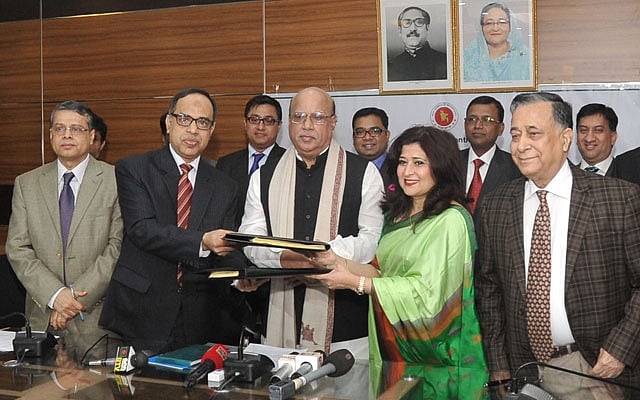
The Health Economics Unit of the Ministry of Health and Family Welfare along with Green Delta Insurance Company Limited signed the agreement for the pilot project.
The signing took place at the Secretariat.
UHC has become a buzzword in the health sector as the World Health Organisation and the World Bank are promoting this as a way of preventing people from falling into poverty due to heavy out-of-pocket expenditure during medical treatment.
The concept is that people should have access to healthcare without getting into financial trouble.
In Bangladesh, people have to spend about 64 percent of their entire health expenditure on their own, which pushes 5 percent of them into poverty every year.
This dismal picture prompted the government to devise a financing strategy, 2012-2032, to achieve UHC.
The success of the Tangail project will decide the launching of UHC across Bangladesh.
“This is just the beginning,” Md Ashadul Islam, Director General of the Health Economics Unit, said while explaining the pilot project at the signing.
He said they had already selected 100,000 poor families -- landless, having only a home for living, and being casual day labourers -- in those three Upazilas.
The government will give Tk 1,000 per family each year as the premium for a pool fund. One person will get Tk 50,000 treatment a year in the government facilities.
The government will give the premium for the pilot project. Later, premiums will be collected from the richer people as it scales up across Bangladesh.
The Director General Islam said the ageing population, changing disease patterns and newer technologies make the costs of treatment soar.
“It has become difficult for the government to offer free treatment for all. So, people pay out of their pockets and consequently face a financial catastrophe,” he said.
“We have introduced this small benefit package to see how it works. The government facilities will be able to provide the services for the 50 diseases we have identified for this package.
“If the Upazila cannot provide (treatment), then patients will be referred to the district hospital,” he said, adding that those hospitals would have a separate desk to handle the card holders.
He said there would be no ‘user fees’ in hospitals after the implementation of the UHC.
User fees -- extra money from service seekers -- were introduced a few years back to give incentive to service providers and thus maintain uninterrupted services at government facilities.
Under the UHC project, the insurance company will register the poor, encourage families to take services and make the services available to them.
Green Delta CEO Farzana Chowdhury said working on health insurance was “a milestone” for the whole insurance industry in Bangladesh.
Prime Minister Sheikh Hasina will formally inaugurate the project next month, the health minister said.













