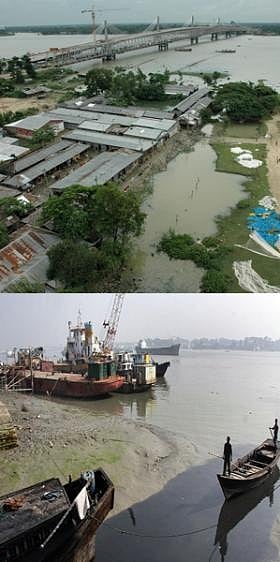
SPECIALKarnaphuli: Outlaws act, authorities plan
Given the fast deteriorating condition of the 'lifeline of Chittagong', authorities need to act now, writes Mintu Chowdhury.
bdnews24.com News Service
bdnews24.com
Published :
05 Jun 2011, 06:34 PM
Updated :
10 Aug 2022, 04:54 PM
Mintu Chowdhury
bdnews24.com Correspondent
Chittagong, June 5 (bdnews24.com) — Silt, waste and encroachment are choking river Karnaphuli, the lifeline of Chittagong.
Karnaphuli, the mouth of which hosts Bangladesh's main sea port, is losing its width every year due to illegal constructions.
At places, it has lost up to 270 metres due to encroachment in the last 20 years.
Karnaphuli is also losing its navigability as the silt flowing down from illegal hill cutting builds up in the river bed, more so due to inadequate dredging.
According to a survey of Chittagong port's Hydrographic Department, the river was 870 metres wide at Firingibazar in 1989-'90, which has reduced by 270 metres to stand at 600 metres in 2009-'10.
Again, at the mouth of Chaktai canal, the width of the river was 650 metres in 1989-'90, which has narrowed down to 600 metres.
The department conducts the survey in 28 kilometre area stretching from Kalurghat Bridge to the Bay of Bengal every year.
The surveys also say the size and number of shoals in the river have also increased in the last 20 years. In 1989, the shoal near Shah Amanat Bridge was 1.4 kilometre long. Now it is 2.2 kilometre long.
Illegal structures are creeping up the shoals, thus further narrowing down the river's chances of recovery.
Originating from the Lusai hills in Mizoram, India, the Karnaphuli river flows 270 km (170 miles) southwest through Chittagong Hill Tracts and Chittagong into the Bay of Bengal.
39 FACTORIES DUMPING IN THE RIVER
According to another survey conducted by the Department of Environment (DoE) last year, 39 private and state-owned factories, which had been constructed on the river bank illegally, were polluting the river.
Chittagong University Geography and environment department teacher Abdul Haque told bdnews24.com that the river should be allowed to flow in its own natural course.
"But the natural flow of the river faces obstacles due to sewerages, hill cutting and encroachment," he added.
Haque said if the illegal constructions on the two banks of the river were not demolished, it would become a 'dead river like the Buriganga'.
Chittagong DoE acting director Tajminur Rahman told bdnews24.com that it was not possible for the department alone to save the river.
That being the reason, he said, a committee headed by Chittagong deputy commissioner Faiz Ahmed had been formed to save Karnaphuli. Representatives from DoE, Water Development Board, port authority and other authorities concerned were appointed as members of the panel, he added.
Rahman said the department had prepared a list of the people and organisations responsible for polluting Karnaphuli. "Steps will be taken against them," he promised.
Deputy commissioner Faiz Ahmed said the work to demark the border of the river following a High Court verdict was underway.
"The survey has been finished. The government's property will be fixed after construction of the border pillars and CS survey is finished," he added.
"Any illegal structure will be removed," he assured.
CAPITAL DREDGING
Chittagong port authorities say navigability is not a prevalent problem in Karnaphuli. A capital dredging project has been initiated, which will cover a distance of 100 metre downstream from Sadarghat Jetty to 200 metres upstream of the Third Karnaphuli Bridge, according to them.
"The dredging will remove 3.6 million cubic metre of sand/silt from the river bed," port secretary Farhad Uddin Ahmed told bdnews24.com.
Besides, 2,615 metre of bank will be built under this project.
"If there is any illegal encroachment on the banks within this range, they will be removed," Farhad Uddin said.
bdnews24.com/mc/ost/nir/2210h