


Published : 02 Nov 2020, 11:58 AM
Updated : 08 Apr 2022, 02:48 AM


In Georgia, a rally for Democrats was cancelled shortly before it was scheduled to begin Sunday, with organisers worried about what they feared would be a “large militia presence” drawn by President Donald Trump’s own event nearby.
As the nation races toward Election Day, the tensions and acrimony surrounding an extraordinarily divisive campaign, coming on the heels of a summer of protests and racial unrest, are bleeding into everyday life and adding further uncertainty to an electoral process in which Trump has not committed to a peaceful transfer of power.
Sunday’s incidents came a day after a group of Trump supporters in Texas, driving trucks and waving Trump flags, surrounded and slowed a Biden-Harris campaign bus as it drove on Interstate 35, leading to the cancellation of two planned rallies. The FBI confirmed Sunday that it was investigating the incident.
On Saturday, Trump tweeted a video of the incident with a message, “I love Texas!” After the FBI announced it was investigating, he tweeted again, saying, “In my opinion, these patriots did nothing wrong,” and instead “the FBI & Justice should be investigating the terrorists, anarchists, and agitators of ANTIFA.”
In Graham, North Carolina, a get-out-the vote rally Saturday ended with police using pepper spray on some participants, including young children, and making numerous arrests. Organisers of the rally called it flagrant voter suppression.
“These people are afraid,” the Rev. Gregory B Drumwright, his eyes still burning, said as he assailed the police action in Graham. “There’s a climate of fear around this.”
And those were just the incidents that were caught on video. Kristen Clarke, executive director of the Lawyers’ Committee for Civil Rights Under Law, a voting rights group, said there had been many more. The group settled a lawsuit last month against officials in Graham who they accused of violating the First Amendment rights of protesters.
“We are very concerned about groups lurking and trying to intimidate voters in particular communities,” Clarke said. Her group’s election protection hotline received calls from nearly a dozen counties in Florida just over the past week, she said, reporting individuals or groups harassing voters at the polls.
“We want voters to know these sporadic incidents are being addressed, and we want them to be able to cast their ballot,” Clarke said.
Law enforcement authorities are increasingly worried, too — not just about what they have already seen, but also about what has been threatened, especially online.
Most of the internet threats have not migrated to the nation’s streets, according to a senior law enforcement official who has reviewed Homeland Security Department bulletins and warnings as well as online activity from instigators on the political right and left. But law enforcement officials fear that online posts by instigators could materialise into violent acts.
Trump supporters mounted a motorcade across the New York City region Sunday, waving flags and cheering for the president while clogging traffic on key arteries.
The supporters were spotted crossing the Mario M. Cuomo Bridge over the Hudson River in the city’s northern suburbs and bringing the busy Garden State Parkway in New Jersey at least partly to a standstill. Officials in New Jersey told a local newspaper that the motorcade stopped near the Cheesequake service area — about 30 miles outside New York City — and “backed traffic up for about 5 miles.”
Supporters waved Trump flags, leaned out of their vehicles wearing Make America Great Again hats and honked and cheered.
The Mario M Cuomo Bridge might have been a symbolic target for Republicans — it is named for the deceased father of Gov Andrew Cuomo, a Democrat who has quarrelled frequently with Trump.
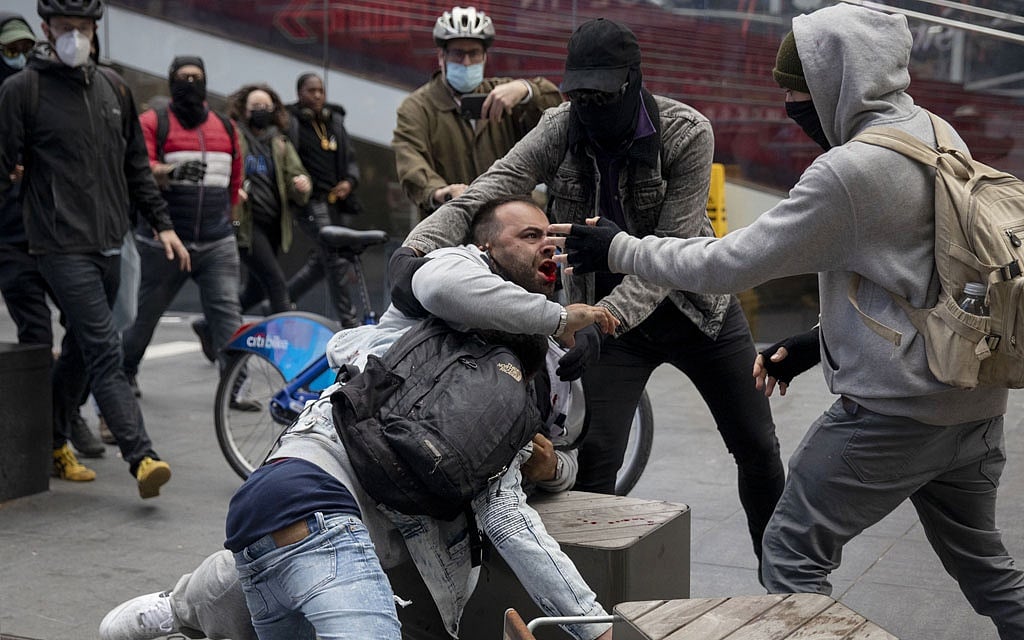
A separate set of anti-Trump protesters marched in New York City to counter the pro-Trump caravans, leading to some scuffles and arrests.
Groups that monitor voting have been preparing for intimidation at the polls at least since September, when protesters disrupted voters at a polling location in Fairfax, Virginia.
Of particular concern are militia groups like the Proud Boys and Oath Keepers, whose members have lurked on internet chat boards like 4Chan. “We are keeping an eye on them,” said Joanna Lydgate, national director of the Voter Protection Program, which works closely with law enforcement on voting issues.
Law enforcement officers can be a complicating factor in protecting voters. While their presence can be welcome to help calm tensions, they can also create anxieties. Ria Thompson-Washington, an executive vice president with the National Lawyers Guild, said she had been in Georgia since mid-October, when early voting began in the state, and had witnessed “a heavy police presence” at the polls.
All of this has created extraordinary uncertainty, with fears driven not only by the potential outcome of the election but by the tensions that might erupt in the days and weeks after Election Day.
“People are upset, and scared, and frustrated,” said Caitlin Foley, a physician in Philadelphia. “I think there will be unrest, regardless of whichever candidate is in the lead.”
Turmoil has defined 2020. More than 230,000 Americans have died of COVID-19; the economy has cratered, and racial tension has sparked unrest across the country.
Not all the political activity on Sunday was disruptive.
In Atlanta, from the virtual pulpit of Ebenezer Baptist Church, the storied congregation once led by Martin Luther King Jr, there was a call for calm and a plea for agitators to stay away.
“In the wake of an election, I say to the Proud Boys and to antifa and to other militias and armed groups, Atlanta does not want your foolishness,” the Rev Robert M Franklin Jr, a candidate in a runoff election to serve the final month of Rep John Lewis’ term in Congress, said in a sermon.
In Graham, North Carolina, a city of roughly 15,000 people between Greensboro and Durham, police said protest organisers had failed to coordinate with city officials in planning their rally, and that it became “unsafe and unlawful.” Officials disputed any accusations of trying to thwart voters from getting to the polls.
Police said that eight people were arrested on suspicion of resisting the officers and failing to disperse. One was charged with assaulting a law enforcement officer. The department also said officers fired a “mild irritant” on the ground and not directly at protesters.
Drumwright tried to preach a message of resilience Sunday. For generations, obstacles had stood in the way of voting for African Americans. And this, in his view, was the latest iteration.
“We’re still having to march, to protest, to petition, to speak out, to demonstrate, to activate,” Drumwright said. “We are shaken,” he added. “But we are not broken.”
© 2020 The New York Times Company













