


Published : 07 Nov 2020, 03:45 AM
Updated : 17 Oct 2022, 11:15 AM


Biden, who was winning the popular vote by more than 4 million votes and has already won 253 electoral votes, pulled ahead of Trump in Pennsylvania by more than 13,000 votes Friday afternoon. If his lead holds — and it is expected to — the state’s 20 electoral votes would vault him past the threshold to win the election. In Georgia, his lead was so narrow that state officials said a recount was inevitable.
In Arizona, Biden maintained his lead as election officials continued to plow through tens of thousands of ballots from Phoenix and its sprawling suburbs. His advantage shrank slightly, but not by as much as Republicans had hoped. In Nevada, Biden nearly doubled his lead Friday to around 20,000 votes.
Biden had already begun to project the image of a man preparing to assume the mantle of office Thursday, meeting with his economic and health advisers to be briefed on the coronavirus pandemic.
He also urged the public Thursday to show a “little patience” as the vote counting in battleground states continued.
“Democracy is sometimes messy,” he said. “It sometimes requires a little patience as well. But that patience has been rewarded now for more than 240 years with a system of governance that’s been the envy of the world.”
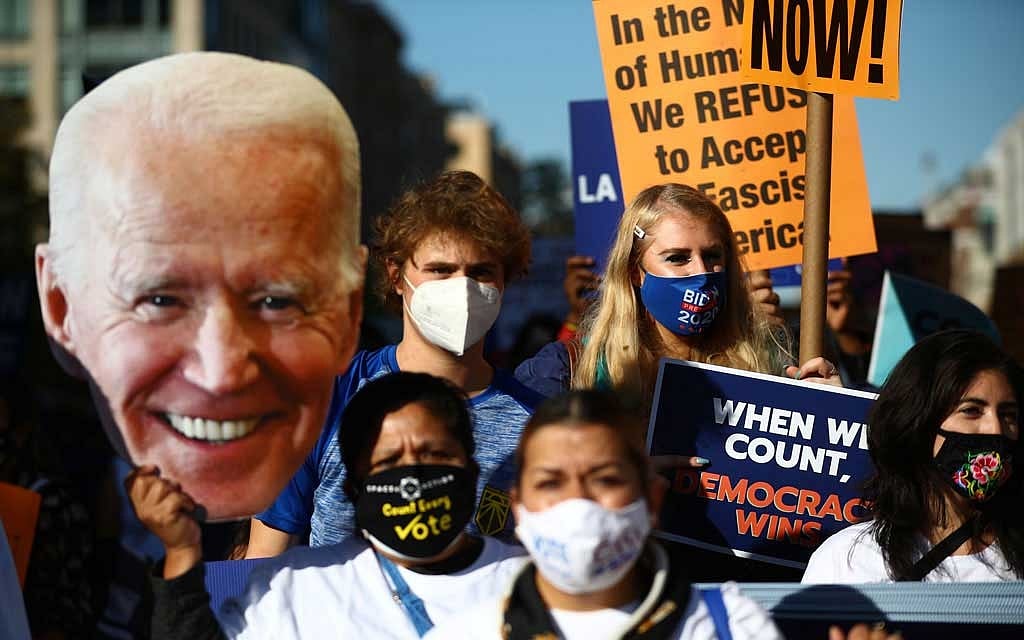
Biden planned to make an address Friday during prime time, a campaign official said. He kept a low profile Friday morning. But outside the Westin Hotel near his home in Wilmington, signs of celebration were afoot. Someone passed out Biden-Harris signs and attached them to a security barrier near a stage bedecked with American flags where Biden was expected to speak.
Thomas Kunish, 40, of Mechanicsburg, Pennsylvania, 100 miles away, said he had driven in to show support with his 5-year-old son, spending the night in the car. The last time he voted, he said, was for George W. Bush in 2000.
“It was interesting, the past four years,” Kunish, who works in the defence industry, said of Trump’s presidency. “There was hope when he got elected, things maybe would change.” Instead, he said, the Trump administration was marked by “turmoil.” He and his son were hoping to see fireworks Friday night.
Biden’s appeal to let the process play out contrasted with that of Trump, who took the lectern in the White House briefing room to falsely claim that the election was riddled with fraud, as part of an elaborate coast-to-coast conspiracy by Democrats, the news media and Silicon Valley to deny him a second term.
As the number of outstanding ballots slowly dwindled, Trump was left increasingly with only legal challenges to forestall defeat, while Biden was betting on the steady accumulation of mail-in ballots to keep him on top in Pennsylvania.
Biden’s wins in the Midwestern battleground states of Michigan and Wisconsin put him in a strong position, with multiple paths to victory, depending on what happens in the states yet to be called. Trump needed a victory in Pennsylvania.
The process was agonising for partisans on both sides, though for the most part, fears of widespread unrest did not materialise. Officials reported few instances of problems with the vote-counting process.
The candidates’ differing reactions hinted at how they are likely to handle the coming days and weeks as the counting gives way to legal challenges, calls for recounts and a potentially turbulent transition.
Biden’s pivot to policy issues seemed intended to create an air of inevitability about his victory. His briefing on the pandemic was a reminder that the United States reported a record 121,200 new infections Thursday.
— KATIE GLUECK, MARK LANDLER, MARC SANTORA and MICHAEL COOPER
With a lead in Pennsylvania, Biden nears victory in the state and the election.
PHILADELPHIA — Joe Biden took the lead over President Donald Trump in Pennsylvania on Friday morning as Democrats grew increasingly confident that he would win the state and with it the presidency: The state’s 20 electoral votes would put Biden, who has 253 electoral votes, past the 270-vote threshold for victory.
By late Friday morning, after more votes were counted from Philadelphia and other counties that have supported Biden, he led Trump by more than 13,000 votes.
Biden had steadily erased Trump’s early lead in the state — at one point, the president led by half a million votes — as ballots, mostly absentee and mail-in votes, were counted over the past few days. Most of the remaining uncounted votes in the state are in Democratic-leaning areas.
At a news conference Friday afternoon, Philadelphia elections officials said that they would have another update of 2,000 to 3,000 ballots Friday afternoon, and that they had about 40,000 ballots left to count in the city.
The remaining ballots “generally fall into one of three categories: those that require a review, provisionals and US military overseas ballots,” said Lisa Deeley, one of the city commissioners in Philadelphia in charge of elections. “I would estimate there’s approximately 40,000 remaining to be counted.”
“We can also tell you that it may take several days to complete the reporting of that,” Deeley added.
On Thursday, Kathy Boockvar, the Pennsylvania secretary of state, told CNN that the “overwhelming majority” of the state’s remaining votes would be counted by Friday.
Pennsylvania Democratic officials have said their analysis of the uncounted votes gave them confidence that Biden would win the state by a substantial margin.
“We believe when the votes are counted, it’s pretty clear that Joe Biden’s going to be president of the United States, because he’s going to win Pennsylvania,” said state Sen. Sharif Street, the vice chair of the state Democratic Party, on Thursday.
Trump has baselessly insisted that post-Election Day tallies showing Biden leading in battleground states, including Pennsylvania, were the result of fraud, and has vowed to challenge them in court. His campaign showed no sign of an imminent concession Friday morning.
“The false projection of Joe Biden as the winner is based on results in four states that are far from final,” a lawyer for the Trump campaign said in a statement.
Mayor Jim Kenney of Philadelphia dismissed those accusations Friday.
“While some including the president continue to spew baseless claims of fraud, claims for which his team has not produced one iota of evidence, what we have seen here in Philadelphia is democracy, pure and simple,” Kenney said.
Andrew Bates, a spokesman for the Biden campaign, said that if Biden won the election and Trump refused to concede, “The United States government is perfectly capable of escorting trespassers out of the White House.”
— NICK CORASANITI and KATIE GLUECK
Biden’s lead grows in Nevada, putting him near victory there.
Joe Biden widened his lead over President Donald Trump in Nevada on Friday from about 11,000 votes to about 20,500, and moved closer to victory there, as his advantage over Trump grew to nearly 2 percentage points.
Nevada has six electoral votes and its entire Election Day vote has been counted; the late mail and provisional ballots that remain lean Democratic. About 9% of the state’s votes have yet to be tabulated.
Final results might not be made public until Saturday or Sunday, elections officials have said.
The Trump campaign has already identified Nevada, which allows any losing candidate to request a recount, as one of the battleground states where it hopes to use the courts and procedural manoeuvres to stave off defeat in the Electoral College. Less than 24 hours before Election Day, a Nevada judge rejected a lawsuit filed by Republicans who had tried to stop early vote counting in Clark County.
Since Hillary Clinton beat Trump in Nevada by 2.4 percentage points in 2016, the state has turned a deeper shade of blue, with Democrats controlling the governor’s office and Legislature, both Senate seats and all but one House seat. It was not widely expected to be a battleground state this year.
But while recent polls consistently showed Biden ahead of Trump in Nevada, Democrats worried that the pandemic would make it difficult to create a robust election turnout operation. The state has reported more than 104,000 coronavirus cases.
— MIKE IVES, JENNIFER MEDINA and DAVE PHILIPPS
As Biden takes the lead in Georgia, state officials say a recount is inevitable.
ATLANTA — As former Vice President Joe Biden took a narrow lead over President Donald Trump in Georgia, Georgia’s secretary of state said Friday that the presidential race there was so close that a recount was inevitable.
As of late Friday morning, Biden led Trump in Georgia by about 1,600 votes.
“With a margin that small, there will be a recount in Georgia,” the secretary of state, Brad Raffensperger, said Friday morning at the state Capitol.
He added: “The final tally in Georgia at this point has huge implications for the entire country. The stakes are high and emotions are high on all sides. We will not let those debates distract us from our work. We will get it right, and we will defend the integrity of our elections.”
Gabriel Sterling, an official with the secretary of state’s office, said that a pool of about 4,200 ballots — most of them absentee ballots — remained to be tallied in four counties: Gwinnett, Cobb, Cherokee and Floyd. The largest tranche to be counted was in Gwinnett County, which contains Atlanta suburban communities and has gone from leaning Republican to leaning Democratic in recent years.
The state must also deal with ballots from military and overseas voters, which will be counted if they arrive in the mail before the end of business Friday and were postmarked by Tuesday.
Sterling said that the unofficial tally of the votes could be completed by the end of the weekend.
Flipping Georgia, a state last won by a Democrat in 1992, and where Trump won by more than 200,000 votes four years ago, would represent a significant political shift this year, but the state has shown signs of trending blue. When Trump defeated Hillary Clinton in 2016, he did so by 5 percentage points, a far slimmer margin than Republicans had enjoyed in previous presidential elections.
Biden’s late surge in this year’s count, thanks to his dominance in Atlanta, Savannah and the increasingly Democratic-friendly suburbs around both, transformed the competition in a traditionally Republican-leaning state into one of the closest contests in the nation.
As the count narrowed and it appeared that the two candidates would be separated by the slimmest of margins, Democrats urged voters in the state to fix ballots that had been rejected because of invalid or missing signatures before the deadline Friday evening.
Those who voted absentee — a group that this year has been heavily Democratic — can check online to see whether election officials have accepted or rejected their ballots. Absentee ballots are often rejected when the voter forgets to sign or uses a signature that does not match the one on file with the state, in some cases because the filed signature is many years old. Election officials are supposed to contact voters in such cases but are not always able to do so.
Voters have until 5 p.m. Friday to submit an affidavit form to “cure” such ballots. With Georgia hanging in the balance as the last votes are counted, national Democrats — including Rep. Alexandria Ocasio-Cortez of New York — are amplifying the message in hopes of salvaging every vote possible.
— STEPHANIE SAUL, MICHAEL CROWLEY and GLENN THRUSH
Both Georgia Senate races appear headed for runoffs as Senate control hangs in the balance.
With control of the Senate hanging in the balance, Republicans and Democrats began positioning themselves Friday for a pair of high-stakes January Senate runoffs in Georgia that could serve as a referendum to cement or upend the results of Tuesday’s election, even as one of the races remained uncalled.
Sen. David Perdue, a Republican, was narrowly leading his Democratic opponent, Jon Ossoff, in the uncalled race. But as protracted counting dragged on, he fell below the 50% threshold needed to win outright. He was not expected to clear that bar with many of the remaining votes coming from Democratic counties.
Georgia’s special Senate election has been destined for a runoff since Tuesday, when the Rev. Raphael Warnock, a Democrat, and Sen. Kelly Loeffler, a Republican, emerged as the top two vote-getters in a crowded field vying to replace the retired Sen. Johnny Isakson.
Democrats would need to win both seats Jan. 5 — a steep task in a state with deep conservative roots — to draw the Senate to a 50-50 tie, but they were riding a wave of liberal enthusiasm and demographic change that appeared poised to deliver victory in Georgia to a Democratic presidential candidate for the first time since 1992.
If former Vice President Joe Biden prevails in winning the White House, his vice president could cast tie-breaking votes to give the party de-facto control.
Facing such extraordinarily high stakes, both parties were quickly preparing themselves for a nine-week year-end sprint that some estimated could ultimately cost at least another $100 million and put Georgia at the center of the nation’s political fray just two weeks before Inauguration Day.
Democrats around the country were already mobilising to use the contests to complete Biden’s victory and make possible the liberal agenda on health care, the economy and the environment he ran on.
“Change has come to Georgia,” Ossoff said in a rally in Atlanta on Friday. “And Georgia is a part of the change coming to America.”
Republicans were ready to try to harness the grievance among Trump’s most ardent supporters, hoping that the president’s baseless claims of fraud and a backlash to his potential loss could power them to a win in January. Over the last 24 hours, Loeffler has repeatedly tweeted support for the president, who is falsely claiming that the election is being illegally stolen from him.
Loeffler said that she donated to a fund fighting for the president’s cause.
“Praying for four more years of @realDonaldTrump!” she wrote in another message.
With Trump defying the election results, it was hard to predict how involved he might be in the Senate races. But early Friday morning, he insinuated in a tweet that Democrats were still trying to claim power through nefarious means so they could reverse Republican policies.
“Would End the Filibuster, ‘Life’, 2A, and would Pack and Rotate the Court. Presidency becomes even more important,” he wrote. “We will win!”
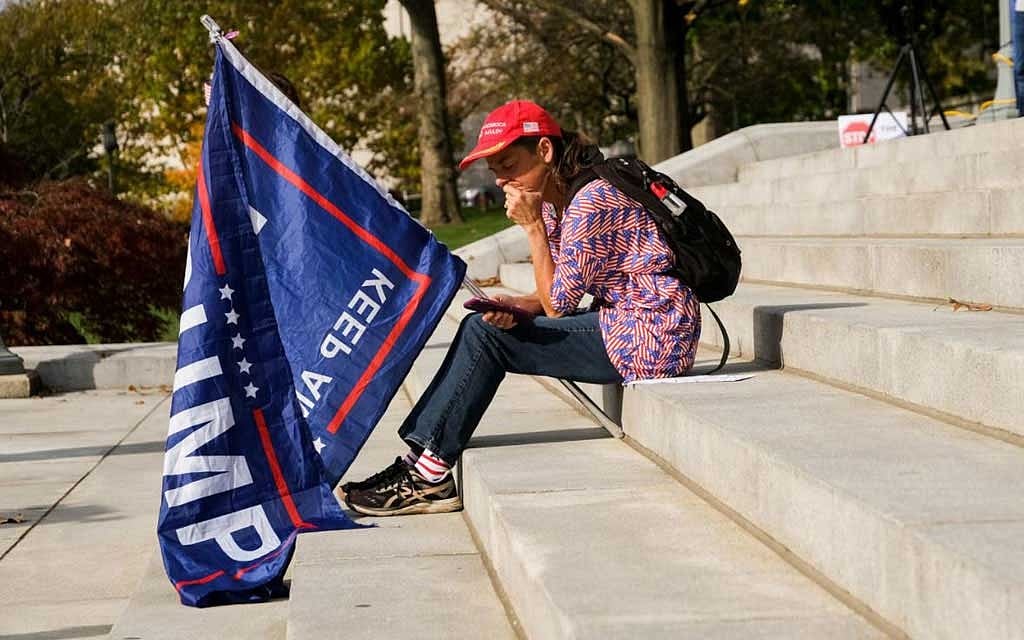
Sharon Ogilvie, 53, takes a break from protesting the ongoing ballot counting with supporters of President Donald Trump at the Capitol of Pennsylvania in Harrisburg on Thursday, Nov. 5, 2020. Attention shifted on Thursday to a handful of states where the presidential result remained too close to call. (Gabriela Bhaskar/The New York Times)
The Electoral College is close. The popular vote isn’t.
As the presidential race inches agonisingly toward a conclusion, it might be easy to miss the fact that the results are not actually very close.
With many ballots still outstanding in heavily Democratic cities, former Vice President Joe Biden, with nearly 74 million votes, was leading President Donald Trump by more than 4.1 million votes nationwide on Friday afternoon. His lead is expected to expand, perhaps substantially, as officials finish counting.
This means more Americans have voted for a Democrat for president than for a Republican in each of the past four elections, and seven of the past eight, the exception being 2004, when President George W. Bush beat John Kerry by about 3 million votes. But, depending on the outcome this year, only four or five times in those eight elections have Democrats gone on to occupy the White House.
It looks likely that Biden will secure an Electoral College win. But the days of nail-biting over close races in individual states, in contrast to the decisive preference of the American public, have crystallised some Americans’ anger at a system in which a minority of people often claim a majority of power.
“We look at a map of so-called red and blue states and treat that map as land and not people,” said Carol Anderson, a professor of African American studies at Emory University who researches voter suppression. “Why, when somebody has won millions more votes than their opponent, are we still deliberating over 10,000 votes here, 5,000 votes there?”
Biden’s current popular vote lead is larger than the individual populations of more than 20 states. It is also more than a million votes larger than Hillary Clinton’s already large popular vote advantage four years ago. Clinton beat Trump in the popular vote by nearly 2.9 million votes, or 2.1 percentage points; Biden is currently ahead by 2.8 points.
The outcome could give new fuel, at least temporarily, to long-shot efforts to eliminate or circumvent the Electoral College.
John Koza, chairman of National Popular Vote Inc., which lobbies states to pledge their electors to the winner of the national popular vote, said his group would intensify efforts next year in Arizona, Minnesota, North Carolina and Pennsylvania, among others.
There are similar structural issues in the Senate, where the current Democratic minority was elected with more votes than the Republican majority and where by 2040, based on population projections, about 70% of Americans will be represented by 30% of senators.
“It’s not that the states that are represented by the 30% are all red, but what we do know is that the states that are going to have 70 senators are in no way representative of the diversity in the country,” said Norman Ornstein, a resident scholar at the American Enterprise Institute.
“The more this happens, the more you get the sense that voters don’t have a say in the choice of their leaders,” he said. “And you cannot have a democracy over a period of time that survives if a majority of people believe that their franchise is meaningless.”
©2020 The New York Times Company













