Published : 24 Dec 2015, 02:14 PM
Updated : 19 Oct 2022, 07:06 PM


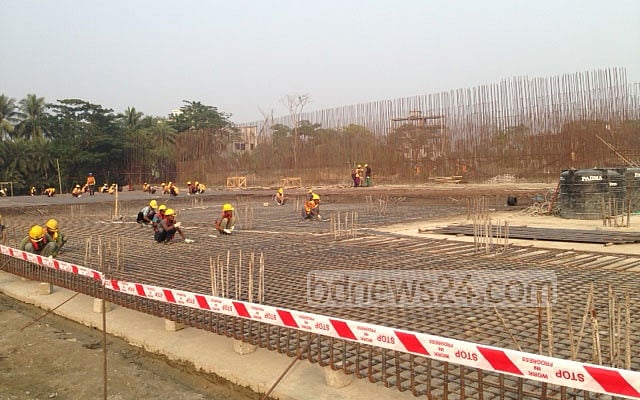
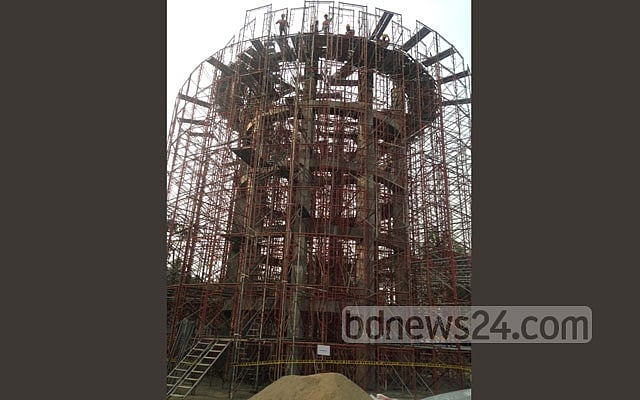
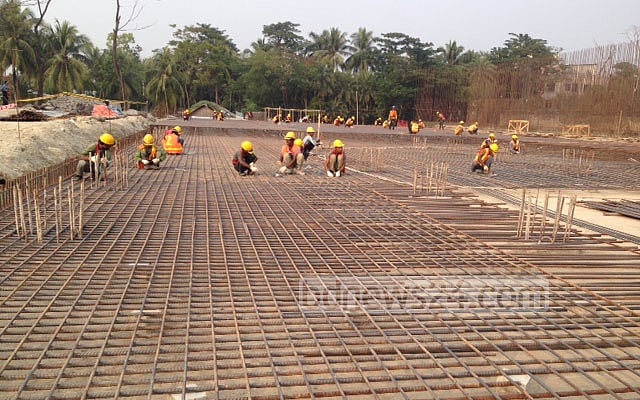
Thirty percent work has been completed on the Tk 25 billion project, which aims to ensure smooth supply of drinking water for the people of Khulna city..
The project is likely to be completed by 2016—a year before the 2017 deadline.
Water supply will begin in the early 2017, project officials hope.
Khulna Water Supply and Sewerage Authority (WASA) is implementing the project, jointly funded by Asian Development Bank (ADB), the Japan International Cooperation Agency (JICA) and the Bangladesh government.
With rising sea level due to climate change, salinity is increasing in the coastal areas, creating a scarcity of drinking water there, said Khulna WASA’s Project Director Khan Selim Ahmed.
This climate compatible project has been undertaken to find a sustainable solution to this problem in Khulna, he added.
Once completed, the project will come as a blessing for the 1.5 million people of the city, says Anisur Rahman Biswas, acting mayor of Khulna City Corporation.
“Salinity in groundwater is a major problem for us. We are soon going to get rid of this,” he told bdnews24.com.
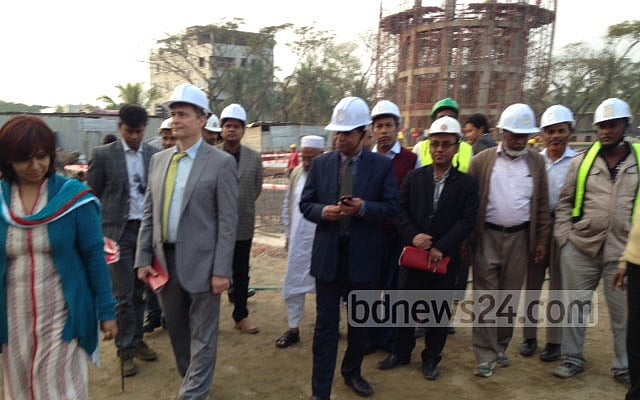
An ADB delegation went to Khulna to visit the project sites on Dec 17.
“We are happy with the progress. We hope it will be completed by the stipulated time,” said ADB Deputy Country Director Oleg Tonkonojenkov.
The project cost was estimated at $365 million, of which $75 million comes from the ADB, $183 million from the JICA and $107 million from the Bangladesh government, according to Elma Morsheda, senior project officer (urban infrastructure) of the ADB.
Against the current daily demand of 240 million litres of drinking water, Khulna WASA can now supply only 110 million litres of groundwater, says Project Director Kamaluddin Ahmed.
Increase of salinity and indiscriminate dumping of industrial waste has made the water of the Bhairab and the Rupsha rivers impossible to treat for human use, he says.
“Khulna needed a sustainable water supply system that would be unaffected by the impact of climate change. And this is exactly what is being done through this project,” he told this correspondent.
Water of the Modhumati River, 71km from the city, will be treated and supplied to the people living in Khulna city, said Project Director Mohammad Abdullah.
The water from the river will be first piped 33km to Samonto Sena where there will be a facility to purify 110 million litres of water every day.
Besides, a reservoir with a capacity of 775,000 cubic metres is being built there to store untreated water to be used if and when the river water turns saline, he said.
Ten distribution reservoirs and 10 overhead tanks also are being constructed inside the city.
The ADB is paying for carrying the water to Samonto Sena from the Madhumati while the JICA is funding the infrastructure development cost for piping the treated water from there to the city, Elma Morsheda said.
The cost for everything else will be paid by the government, which cleared the project in June 2011.