


Published : 10 Jun 2022, 04:03 AM
Updated : 25 Oct 2022, 09:54 AM


Just one example illustrates the growing economic pain: surging global prices will cost Bangladesh an additional $8.2 billion in 2022 just for importing nine essential commodities, including fuel oil, fertiliser and soybean oil.
Finance Minister AHM Mustafa Kamal unveiled a Tk 6.78 trillion national budget on Thursday for the fiscal year starting July 1, refocusing on development goals.
He was upfront in his speech, admitting that ballooning subsidies on fuel, electricity, gas and fertiliser, which will be 1.9 percent of the total GDP in the new year, compared to 1.7 percent now, would pose a challenge to the budget management. But he did not chart a clear path out of the looming storm.
“Overall, there is uncertainty and instability in the economy and around the world,” said Ahsan H Mansur, director of the Policy Research Institute, a think-tank.
“As a result, there are no definitive answers in this budget. The government will have to monitor the situation and take action partway through the year.”
“The budget is a routine one. Then again, all budgets have an element of routine to them.”
MAJOR CHALLENGES TO OVERCOME
Bangladeshis, apparently a victim of the ongoing ‘geopolitical crisis’, have been struggling to manage their household finances as of now as inflation has soared to a new high in the last 18 months.
The upsurge in prices of essentials, which could not be tamed with subsidies, has been putting additional pressure on the foreign exchange reserves. The official value of the taka is dropping like a sack of flour almost every day, even with a floating exchange rate in place.
Along with inflation, Kamal has highlighted six major challenges for the next fiscal year in his budget speech.
Those are-
- Containing inflation and enhancing domestic investment.
- Financing additional subsidies required for the increased price of gas, power and fertiliser in international markets.
- Utilising funds available through foreign assistance and ensuring timely completion of high priority projects of ministries/divisions.
- Ensuring timely completion of projects in the education and health sectors
- An increasing collection of local Value Added Tax and raising the number of individual taxpayers.
- Maintaining stability in the exchange rate of taka and keeping foreign exchange reserves at a comfortable level.
While addressing the parliament, he said: “We have to be very pragmatic in addressing these six challenges for the next fiscal year as any failure to address them may shake up the macroeconomic stability.”
“Our major strategy would be to enhance the supply while reducing the growth in demand. Therefore, import-dependent and less important government expenditures will be stopped or reduced.”
"The priority of this year’s budget would be to improve the livelihood of people at all levels, continue with uninterrupted economic development and employment generation, and contain inflation in parallel to addressing economic effects originated from Covid-19 and the Russia-Ukraine conflict."
In the new budget, the finance minister has paid special attention to measures needed for the elevation of Bangladesh as a developing nation, new job creations, removing red tapes to increase investment, protection and growth of local, export-focused and heavy industries, so that the “Made in Bangladesh” slogan stick.
The Tk 6.78 trillion budget will see a 17 percent increase in development outlay, which stands at Tk 2.59 trillion. This includes an allocation of Tk 2.46 trillion for the Annual Development Plan, which has been approved already.
NBR UNDER TREMENDOUS PRESSURE
The draft budget, equivalent to 15.23 percent of the national GDP, is Tk 5.9 trillion or 14.24 percent higher than the revised outlay for FY22.
The National Board of Revenue, or NBR, will have to bear the brunt of it as the finance minister hopes to pay for at least 64 percent of the total expenditure from the total revenue collection in the next fiscal year.
Kamal has set a target of Tk 4.33 trillion for revenue collection, which is 11.31 percent higher than what was in the revised budget in the previous year.
Tax-wise, the finance minister hopes to collect Tk 3.7 trillion, a 54.56 percent of the total expenditure plan, which is an overall 12 percent increase in the target for NBR to make up from the last fiscal year.
Exactly like previous fiscal years, the collection of the value-added tax will mostly be under the spotlight as the finance minister hopes to receive Tk 1.41 trillion in VAT, around 10.67 percent higher than what was in the revised budget in the last fiscal year.
Economists termed these targets “highly ambitious” and “not achievable”.
“NBR already is going to close the book for the outgoing fiscal year with Tk 400 billion on the red. To achieve the proposed revenue target, they [NBR] have to set mechanisms in place to increase the revenue collection by 30 percent so that they can make up for the outgoing fiscal year as well. In their history, NBR had never achieved a 30 percent growth in revenue collection in a single fiscal year,” Policy Research Institute’s Ahsan H Mansur said.
Zahid Hussain, the World Bank’s former lead economist in Dhaka, was blunt when he said he sees a lack of vision to achieve the revenue collection target the finance minister has set.
“I don’t see any efforts in the proposed budget to generate more revenues except for bullying people to submit their tax return,” he said.
Moreover, to discourage imports and to put a leash on the soaring inflation, the minister has proposed imposing sizable duties on many import items, which may hurt NBR’s revenue collection mechanisms too, he said.
The finance minister may have discovered a new technique for revenue collection to cover the massive expenditure plan for the next fiscal year.
Non-resident Bangladeshis will no longer enjoy a tax holiday.
Rather, Kamal has introduced a three-tier tax rate for them and specified that Bangladeshi authorities will give an NRB taxpayer a clean chit if they pay taxes as per the following structure-
- 15 percent on tangible assets
- 10 percent on intangible assets
- 7 percent tax on remittance
Selim Raihan, the executive director of South Asian Network of Economic Modelling or SANEM, sees this proposal as an acknowledgement of money laundering.
“This is the first time a budget proposal has introduced a measure to bring back some of the money that had been laundered already. Logically, this should have been the second step. The first step should be to plug the holes, which are allowing Bangladeshis to launder money, by setting adequate monitoring systems in place.
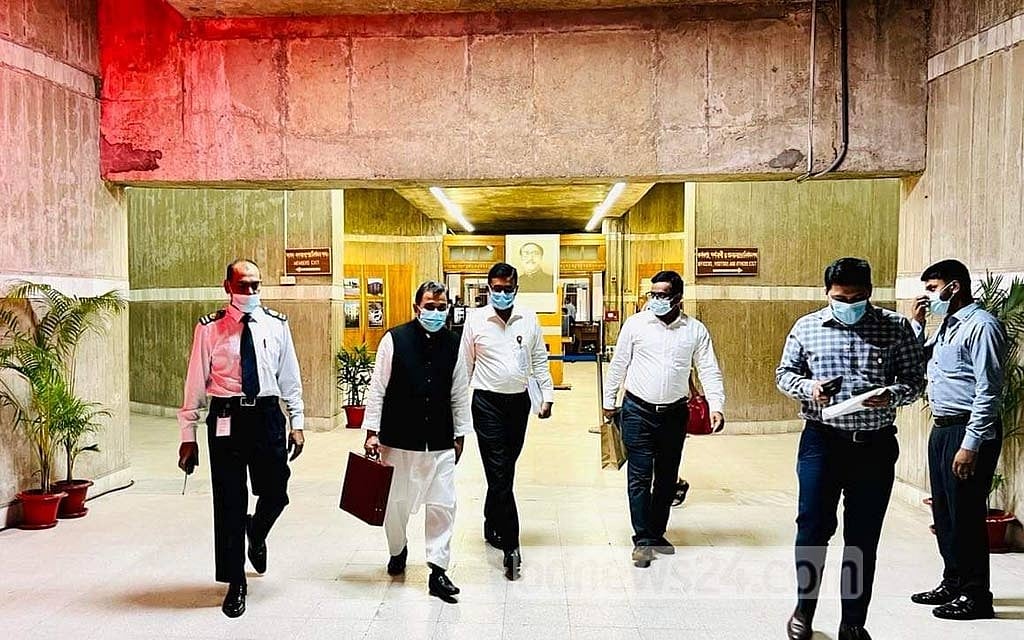
Finance Minister AHM Mustafa Kamal arrives in parliament with the budget he made for 2022-23 fiscal year in a briefcase on Thursday, Jun 9, 2022.
The investment target has been cut to 31.5 percent of GDP from 31.68 percent in the revised budget for the outgoing fiscal year.
The allocations for education, power and energy sectors have decreased from last year in proportion to the size of the budget.
“If you take these into account, raising growth target while cutting investments does not seem realistic to me,” said Binayak Sen, director general at the Bangladesh Institute of Development Studies.
Kamal has been criticised for a lack of realistic steps to control inflation, the most watched index amid global price rises. Despite repeated calls from economists to prioritise the production of food, the allocation for the sector has decreased in proportion to the size of the budget.
The finance minister tried to compensate for the lack of measures to keep food inflation down by cutting duty on imports of farm tools and raising subsidies for fertilisers.
The 23.82 percent increase in subsidies for fertiliser in the proposed budget can become the most effective tool in tackling food inflation, believes Zahid Hussain.
Binayak, however, is not much convinced by these moves. “These are not enough to keep inflation in check.”
Selim Raihan of SANEM thinks the approach to boost supply and suppress the growth of demand is wrong. “Because the ongoing inflation is cost-push, not demand-push. It hasn’t happened due to an increase in growth.”
He sees a lack of steps to help the people, who lost their purchase capacity during the pandemic.
The Centre for Policy Dialogue said it had proposed that taxes be lifted from various necessities, but “little has been done”. “It isn’t enough,” said Dr Fahmida Khatun, the CPD’s executive director.
“Only the tax on wheat was waived – we proposed a waiver on several necessities, including rice.”
Zahid thinks implementing the social safety net will be challenging. “Allocation of Tk 1.13 trillion [in the proposed budget] is huge, regardless this is only a 5 percent increase over the last budget.”
Delivering this to the beneficiaries corruption-free and on time is and was always a challenge, he said.
Selim Raihan, however, criticised the social safety net plans of the government.
“Many allowances in the social safety net programmes have remained unchanged between Tk 500 and Tk 700 for years. These do not reflect inflation or price rises. These must be readjusted.”
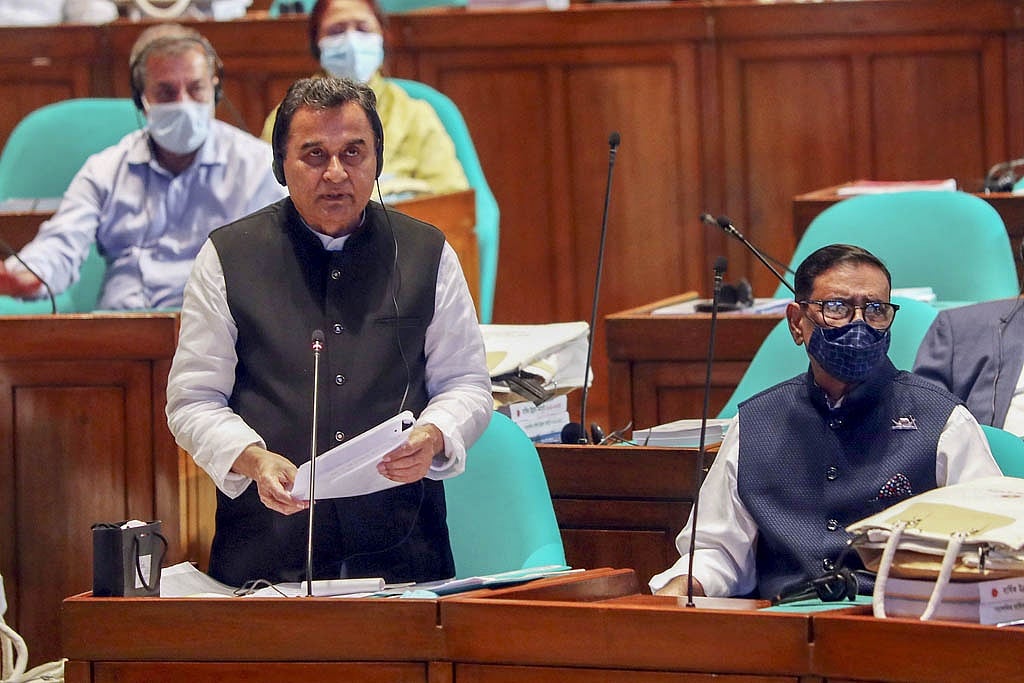
Finance Minister AHM Mustafa Kamal presents the budget for the financial year 2022-23 in parliament on Thursday, Jun 9, 2022. Photo: PID
Economists are saying more than a 2.5 percent reduction on corporate taxes may come as a breath of fresh air for the holistic efforts to encourage investment Kamal has proposed in the budget.
“We can now say that the corporate tax rate has finally come down to a reasonable rate, which will encourage investment” economist Zahid Hussain said.
BORROWING TO RISE, MAKES BUSINESSMEN UNHAPPY
The finance minister aims to get Tk 1.06 trillion from the banking sector, Tk 350 billion from selling savings certificates, and Tk 50 billion loans from other domestic sources in the upcoming budget.
At least 38 percent of the Tk 6.78 trillion budget has to be managed from loans in the FY23 budget. The finance minister shared the plan to get Tk 987 billion from foreign sources and Tk 1.46 trillion from domestic sources.
In the past few years, Bangladesh has borrowed more from foreign sources for its mega projects. But it has to spend dollars from its foreign exchange reserves to pay the interest on such loans. Forex reserves are currently under pressure as the dollar price has surged with the onset of the Ukraine war.
The government, therefore, adopted a policy to discourage the imports of luxury goods and to delay the financing of non-emergency projects. Focusing on local sources for loans rather than foreign ones also suggests the government’s effort to save dollars.
This, however, does not bode well with the businessmen.
“Private sector will suffer if the government borrows heavily from the local banks. We recommend the government should focus more on bringing in foreign currency,” Md Jashim Uddin, the president of FBCCI president said in an immediate reaction.
SANEM’s Selim Raihan does not see anything ‘uncomfortable’ in Bangladesh taking foreign loans but suggests the government be more cautious in the future while taking loans.
“We need to see if the loan is being used in productive sectors and what result it brings,” he said.













