


Published : 21 Aug 2020, 11:57 PM
Updated : 08 Apr 2022, 02:40 AM


“But they [health ministry] don’t care about what we say,” said a disenchanted Professor Nazrul Islam. He is a member of the government’s National Technical Advisory Committee on COVID-19.
“The health ministry isn’t listening to us,” said Prof Rashid-E-Mahbub, a former president of Bangladesh Medical Association.
The two city corporations in Dhaka had planned to clamp lockdowns on areas marked as ‘red zones’ with high infection and death rates after experimental restrictions in Wari and East Rajabazar yielded some results.
“But the plan stalled due to Eid-ul-Azha. And lockdown is not solely our issue. Many ministries and agencies are involved in it,” said Mominur Rahman, chief health officer of Dhaka North City Corporation.
The health ministry has not held fresh discussions on lockdowns in Dhaka or outside the capital, Health Services Secretary Abdul Mannan told bdnews24.com.
“Only the health minister [Zahid Maleque] knows whether fresh lockdown is necessary,” Mannan said.
Maleque did not take bdnews24.com phone calls for comment.
He had recently announced the end to daily COVID-19 briefings, saying these are not necessary as the novel coronavirus “is on its way to leave Bangladesh”.
Experts disagree.
They say immediate steps are essential because the situation is taking such a turn that sparks concerns.
Bangladesh recorded a total of 290,360 confirmed coronavirus cases with 3,861 deaths until Friday, though a recent study suggested the number of infections could be 10 times higher.
The government enforced a 66-day nationwide lockdown after detecting the first cases in March.
Later, it decided to lock down particular areas based on zone-wise infection rates. It flagged dozens of areas in Dhaka, Narayanaganj, Chattogram, Gazipur and other districts as high-risk red zones.
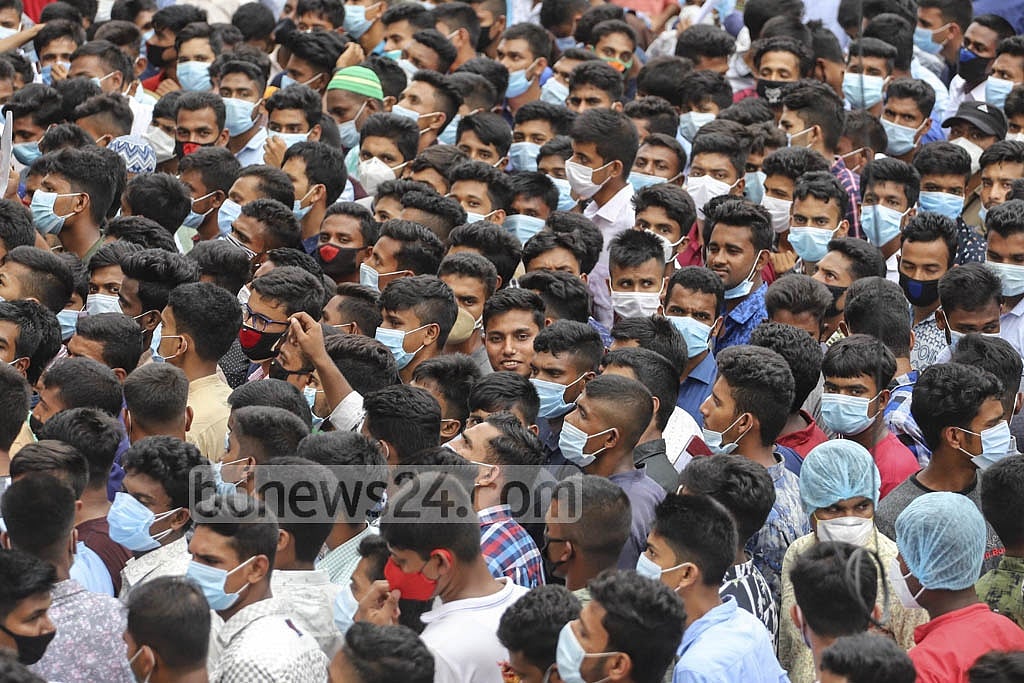
The national daily infection rate, however, still hovers around 3,000 with around 30 deaths as the zone-wise lockdown decision has not been implemented while the rate of tests has gradually dropped.
INFECTIONS RISE AFTER LOCKDOWNS
Experts had earlier warned that locking small areas down would not contain the outbreak.
Tolarbagh, Wari and East Rajabazar, areas where lockdowns have been lifted, are seeing rising infection rates.
Tolarbagh in Mirpur was the first area in Dhaka to go into lockdown with 24 confirmed COVID-19 patients on Mar 23.
It had no confirmed coronavirus case when the lockdown ended on May 10.
The residents of the area had continued following the health protocols well for some days after the lockdown.
As normal life returned, Tolarbagh reported 31 active coronavirus cases on Aug 14, according to the government’s disease control agency IEDCR.
“People get angry when we speak about restrictions to curb the spread of the virus. They want to save their livelihoods first,” said Murad Hossain, the local city corporation councillor.
In Wari, as many as 24 of the 51 residents who had given sample tested positive when the lockdown began in the area in early July.
Amid the lockdown, the area reported 95 coronavirus cases after testing samples from 289 people as the residents showed an apathy towards the restrictions.
On Aug 14, the number of infections in Wari was 269.
“The people of the area even joined social events amid the lockdown. Coronavirus cannot be controlled in this way,” said local ward councillor Sarwar Hossain Alo.
The number of coronavirus cases rose to 144 on Aug 14 from 60 during the lockdown in East Rajabazar.
Local councillor Faridur Rahman Khan expressed helplessness. “What can we do if people don’t try to understand the need for the restrictions?” he asked.
RAPID TESTING
As Bangladesh has surpassed France and Italy, which had been the epicentre of the epidemic once, in number of coronavirus cases, health experts have emphasised fresh lockdown and more sample testing in order to stem the outbreak.
Prof Nazrul, former vice-chancellor of Bangabandhu Sheikh Mujib Medical University, is not happy with the way the authorities in Bangladesh are enforcing the lockdown.
The virologist says the authorities can ask the residents of an area to stay at home on a particular day and collect samples from the suspected patients.
Those who will test positive and their families can be quarantined while the other residents of the area will be allowed to step out of home.
“It’s meaningless to harass everyone in the name of lockdown,” Nazrul said.
The virologist emphasised rapid antibody testing to understand the spread of the virus in an area.
The government, however, has not yet approved any antibody testing for the novel coronavirus SARS-CoV-2.
Former BMA chief Prof Mahbub, who now chairs the National Committee on Health Rights Movement, also sees the need for rapid testing.
“We recommend rapid test because it would be easier to fix the duration of a lockdown if the level of infection can be found out. The hotspots should be spotter first,” he said, noting that the number of RT-PCR tests has dropped while it is taking more time to get the results.
Public health expert Prof Mushtuq Husain, who is advising the IEDCR on tackling COVID-19, emphasises involvement of the communities in the process.
“The members of a community know the best about the situation inside that community. If public representatives, teachers, students and others can be included in the process, they can tell us which area requires lockdown,” he said.
The former IEDCR chief scientific officer also said officials should arrange delivery system for food and other commodities after imposing lockdown.
“And only testing won’t work. The patients need to be isolated and the authorities need to follow up on [contact tracing],” he added.













