Madrasa students 'to study tech'
The National Education Policy formulation committee has put together a draft policy. bdnews24.com education correspondent Mustak Ahmed in a series of reports describes the various recommendations of the committee. The third story focuses on those for madrasa education.
bdnews24.com News Service
bdnews24.com
Published :
14 Jul 2009, 09:38 AM
Updated :
12 Aug 2022, 01:27 PM
Mustak Ahmed
bdnews24.com correspondent
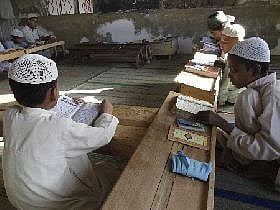
Dhaka, July 14 (bdnews24.com)—The madrasa education regime will also focus compulsorily on information technology, vocations and ethics alongside religious studies, the draft National Education Policy 2009 recommends.
The recommendations aim to make the traditional madrasa education system more open to the contemporary schools of learning without compromising its religious biases.
Dr Quazi Kholiquzzaman Ahmed, the co-chair of the National Education Policy formulation committee, told bdnews24.com about the draft policy which is due to be finalised on July 21 and submitted by end-August.
Students in the general education stream have to compulsorily study Bangla and English in both secondary and higher secondary levels extensively and take public examination tests carrying 200 marks each.
But the madrasa students happen to study less and take tests carrying 100 marks each.
The draft policy indicates that under the recommended madrasa education system, students will have to acquire knowledge and skills in different vocations, sciences and technologies in addition to the Islamic studies.
To achieve this, specific subjects common to other education streams with their curricula unaltered will be taught in the madrasas.
In the 'Ibtedayee' or primary level, the madrasas will teach ethics, Bangla, mathematics, Bangladesh studies, climate change concepts, environmental orientation, information technology and sciences.
In the 'Aleem' stage, the madrasa students will study Bangla, English, mathematics, IT and train in vocations.
Md Yousuf, chairman, Madrasa Education Board, has no objections to the planned introduction of teaching subjects with unchanged curricula in the madrasas.
"We don't object to teaching certain subjects without changing their SSC or HSC curricula," he told bdnews24.com on Tuesday.
"We propose to do that with adaptations such as we will ask our students to wish everybody saying 'assalamu alaikum' instead of 'good morning', the word 'God' will be replaced by 'Allah' and things like that."
He said some of the recommended subjects are already being taught in the madrasas.
The draft policy suggests that evaluation of performance in the public examinations for the subjects outside Islamic studies will be done by the secondary and technical education boards or the recommended IT, technical and vocational councils.
The Islamic studies evaluation will be carried out, like it has always been, by the madrasa board.
Similar to general education, the tenures of madrasa education also have been recommended to be recast.
The Ibtedayee (primary) stage will be an eight-year span and the Aleem will consist of four years.
There will be no Dakhil or secondary level of the current days. The Fazil or degree stage will be a three-four years spell and Qaamil should consist of one or two years, the draft policy suggests.
The present Ibtedayee level is a five-year span, Dakhil five years, Aleem two years and Qaamil another two-year business.
The Madrasa board chairman said that he did not want to comment on the recommendations as those involved top-level policy formulation exercises.
On April 8, education minister Nurul Islam Nahid officially announced the formation and kicking off of the National Education Policy formulation committee headed by the national professor Kabir Chowdhury.
The 16-member committee includes writer-science teacher Dr Muhammad Zafar Iqbal and Kholiquzzaman, the Bangladesh Economic Council chief.
The committee has met on a number of occasions before putting the draft policy together.
bdnews24.com/ma/mi/wz/bd/1349h.