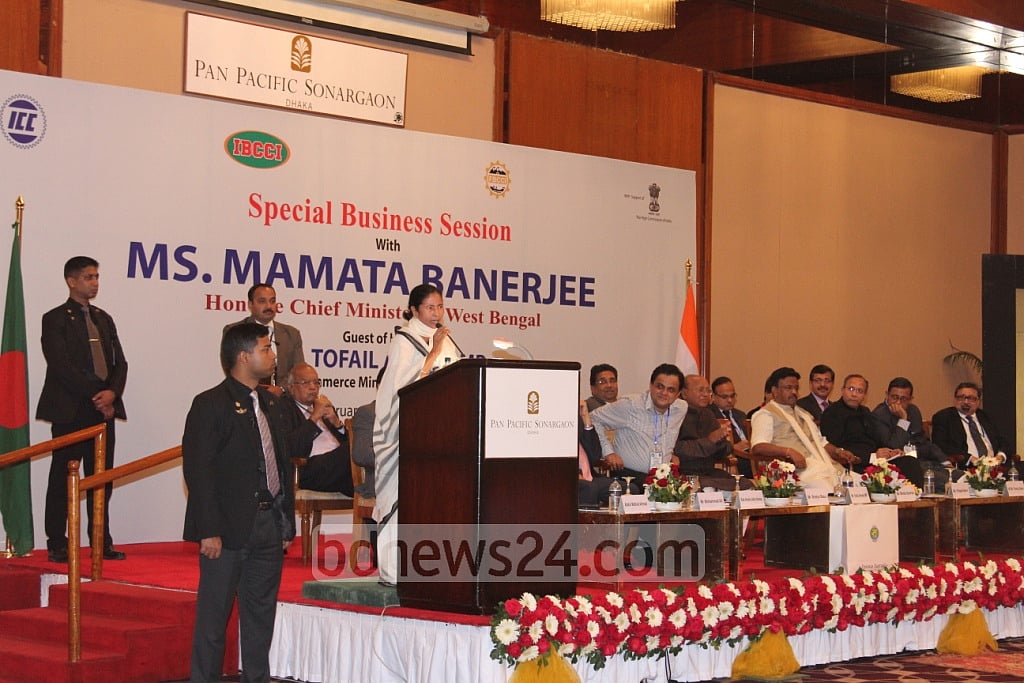
Boosting hope of settling outstanding bilateral issues, she asked both sides to “think about solutions, and not problems”.
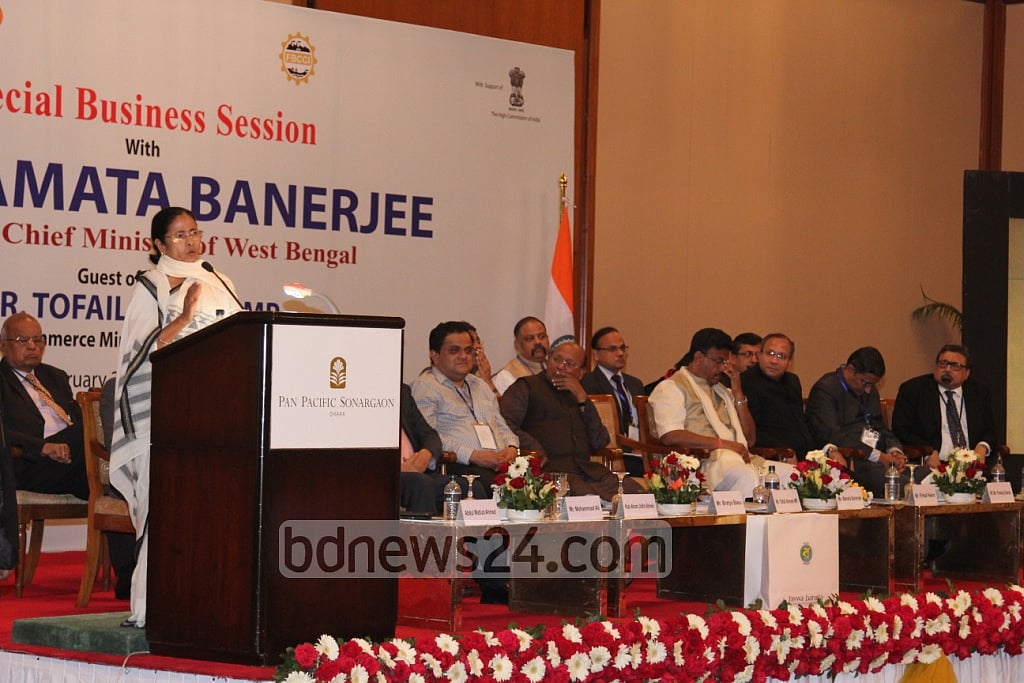
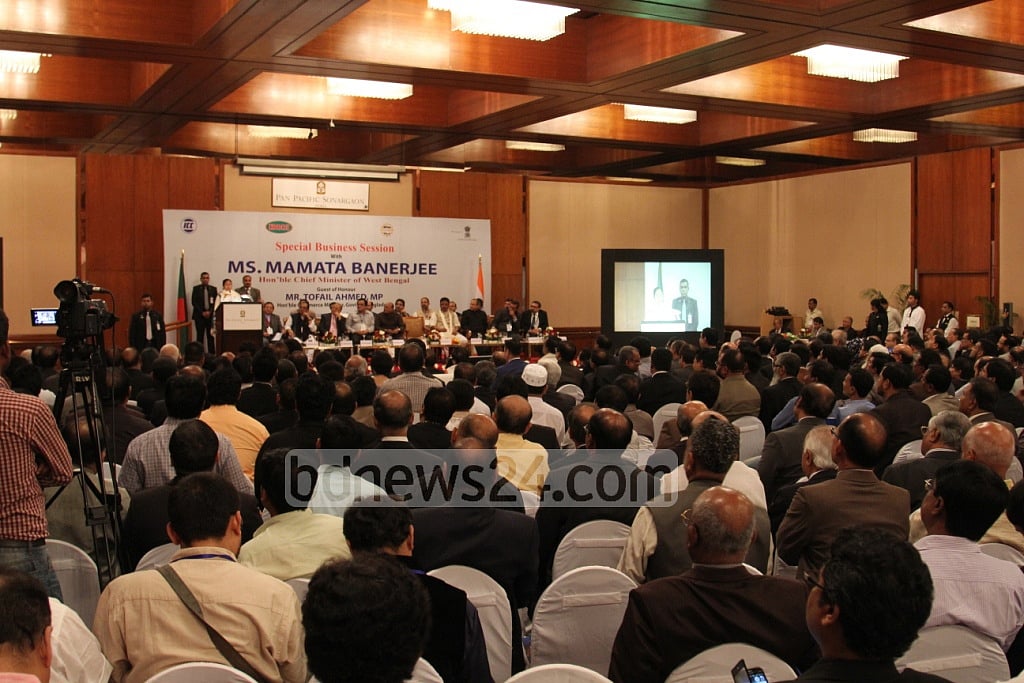
“Let us work together,” she told a meeting of business leaders of India and Bangladesh on Saturday, the last day of her three-day Dhaka visit and the first as West Bengal chief minister.
Bangladesh’s business leaders pointed out some non-tariff barriers and infrastructure bottlenecks that they said stood in the way of increasing their exports.
They also raised the unresolved issues of ratifying land-boundary agreement (LBA) and inking Teesta water sharing deal that could not be signed four years back due to her opposition.
Mamata has already given her nod to Delhi for the LBA ratification and has indicated her support for resolving the Teesta issue during her interactions in Dhaka.
She once again urged all “not to worry” about the problems as she found lot of similarities and very little difference between the two neighbours.

“We love each other in a way that there is no difference between India and Bangladesh,” she said.
“Don’t think about problems, think about solutions,” she said.
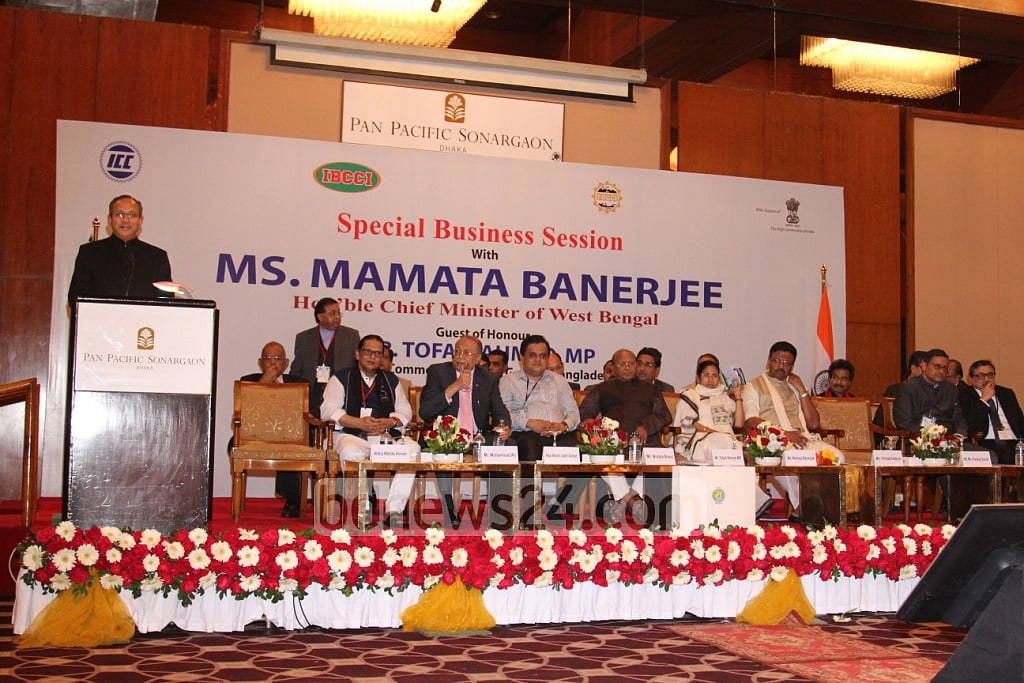
India-Bangladesh bilateral chamber, IBCCI, and Indian Chamber of Commerce (ICC) jointly organised the interactions with the business community.
Commerce Minister Tofail Ahmed, President of Bangladesh’s apex business body, FBCCI, Kazi Akram Uddin Ahmed and Indian High Commissioner in Dhaka Pankaj Saran were present among others during the interactions.
Mamata brought a business delegation with her and the interactions had been organised to give her a clear idea of the bilateral trade and the obstacles.
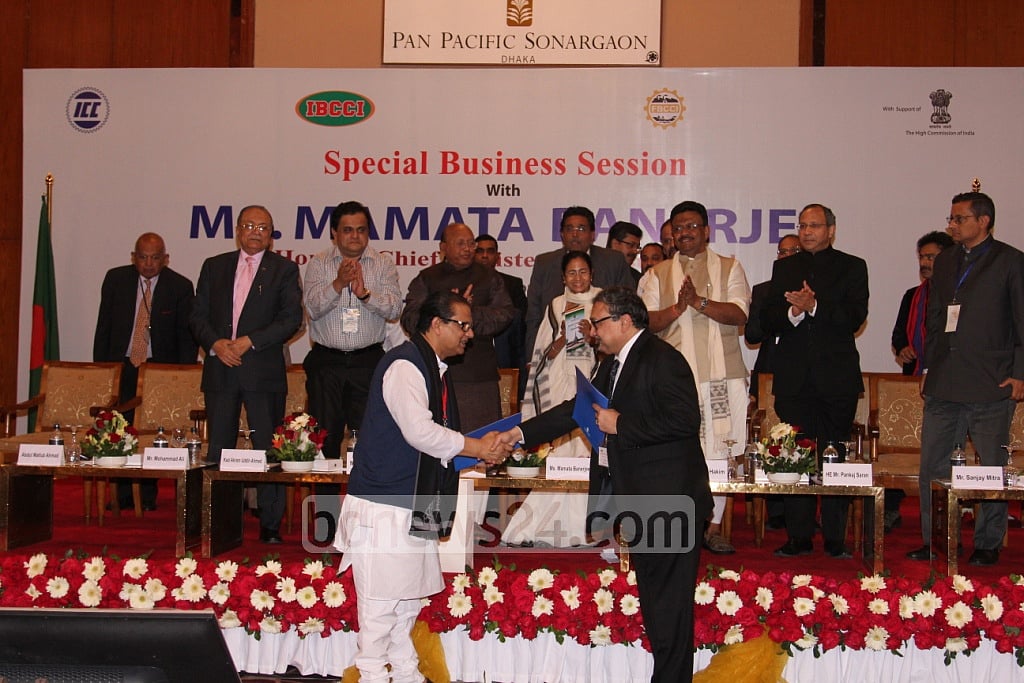
The ICC and IBCCI signed a MoU in presence of the Chief Minister to conduct a joint study to identify bottlenecks for business.
ICC President Roopen Roy said they would detail them for both governments.
India-Bangladesh bilateral trade is close to $6 billion, though Bangladesh exports less than $500 million, despite enjoying duty-free market access for the last five years.
Business groups say there is tremendous scope for trade with West Bengal state with which Bangladesh shares more than half of its border with India.
Petro-chemicals and downstream industries, electronics and information technology, iron and steel, metallurgical and engineering, leather and leather products, food processing, medicinal plants, palm oil and tea are some of the areas that business group found viable for bilateral trade between Bangladesh and West Bengal.
Roy said better connectivity could help increase trade since West Bengal and Bangladesh share 2,217-kilometre border.
Mamata addressing the commerce minister suggested forming “a joint committee” that would help tackle the barriers between the businesses.
“You will solve my problem, I’ll solve your problem,” she said.
FBCCI President said, “We can resolve the problems, if we have a heart and the right attitude”.
“We want to work together so that we create a win-win situation for doing business,” he said.
Mamata also replied questions raised by the business leaders.
Replying to a question she once again said there were no barriers for Bangladeshi television channels to broadcast in Kolkata.
She also suggested creating an India-Bangladesh joint venture business channel.
Bangladeshi businessmen complained about inadequate infrastructure on the other side of the border and called for her support.
Since many of the border issues are up to the central government to resolve, Indian High Commissioner Saran said, “both sides have problems in border infrastructure”.
He highlighted the steps both governments have taken to address those issues that include joint customs and border haats.
Mamata also promised to give stalls in “concessional” rates for the women entrepreneurs who go to Kolkata fairs as one of the women business leaders drew her attention to the problem.
She said she had come here “to strengthen the relations”.
Mamata gave an emotional touch to the proceedings when she recited the immortal lines of Ekushey February --- “Amar Bhaier Rokte Rangano Ekushey February, Ami Ki Bhulite Pari” and the first line of Bangladesh’s national anthem “Amar Sonar Bangla, Ami Tomai Valobashi”.
She also recalled Bangladesh war of independence in 1971 when India supported Bangladesh and said “our relations are very emotional”.
“Relations have to be felt,” she said, “Relations do not grow on give and take”.
“Don’t limit the relations to one issue,” she said apparently referring to Teesta water sharing issue as whoever she interacted during her visit raised this issue.
“There are many things to get from us,” she said without providing details, though she said both Bangladesh and West Bengal can work together in many aspects from culture to businesses.
She said she enjoyed “personal” relations with Prime Minister Sheikh Hasina for long. “I call her didi (elder sister)”.
She quipped about her lunch with Prime Minister Hasina when she said, “We are not getting Ilish (Hilsha fish). She (PM) said how Ilish can be given if you do not give Teesta water.
“I said we don’t want Teesta Ilish, we want Padma Ilish. Padma Ilish is very tasty,” she said.
“See, how good our relations are,” she told the audience.
“We have to work together. We have to join our legs,” she told the business leaders.
She said the LBA issue has been solved. “It was a big problem”.
“On Teesta, talks have begun. Let us talk. We’ll solve it”.
“It’s not that I’ll not come again,” she said.
She highlighted geo-strategic locations of both Bangladesh and West Bengal and said both can work as a gateway.
West Bengal is a gateway for Bangladesh to rest of India while she said Bangladesh is a gateway for India to reach its north-eastern states, she said.
The Commerce Minister thanked her for visiting Bangladesh. “She is our much-expected guest,” he said.
He also called India-Bangladesh relations “emotional”.