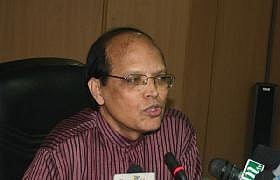
Surplus reserves to boost investment: BB
The central bank announced its July-December monetary policy on Sunday with a provision to utilise surplus foreign exchange reserves to boost local investment. Bangladesh Bank governor Atiur Rahman termed it a 'pro-active accommodative' policy, that targets six percent GDP growth for FY2009-10, and expects the annual consumer inflation rate will stand at 6.5 percent by the end of the fiscal year.
bdnews24.com News Service
bdnews24.com
Published :
19 Jul 2009, 02:52 PM
Updated :
12 Aug 2022, 01:28 PM
Dhaka, Jul 19 (bdnews24.com)—The central bank announced its July-December monetary policy on Sunday with a provision to utilise surplus foreign exchange reserves to boost local investment.
Bangladesh Bank governor Atiur Rahman termed it a 'pro-active accommodative' policy.
"It accommodates both the government and private sectors' loan demands to reach the growth target," he said.
The central bank releases a monetary policy statement twice a year.
The new one targets six percent GDP growth for the just-starting FY2009-10, while it forecasts the annual consumer inflation rate will stand at 6.5 percent by the end of the fiscal year.
Rahman said the policy's main goal was to support a sustainable and productive growth, keeping inflation in check.
"We want to achieve desired GDP growth by boosting production and creating new jobs," Rahman told reporters in the capital.
The central bank aims to ensure more credit flow to potentially productive sectors including agriculture and SMEs, he said.
The policy also aims to maintain the upward curve of remittance inflow and export growth in the shadow of global recession.
At the same time, it keeps an eye to maintaining the Taka's competitive exchange rate, said Rahman.
Regarding flow of funds from the central bank's surplus foreign reserves, the governor said, "Our main target is more investment. We don't believe in having money, but not utilising it. So the central bank must supply money if there is good investment opportunity."
"If necessary, funds will be supplied from the central bank's foreign reserves," he said.
Asked what amount of reserves would be invested as 'surplus', the central bank's senior adviser and former deputy governor Allah Mallick Kazemi replied, "A large chunk of the very satisfactory foreign reserves will be surplus even after meeting necessary import costs."
"The surplus can be invested in productive sectors."
Bangladesh's foreign exchange reserves have hit new highs in recent months. A country's reserves are seen as healthy if they can meet three months' import costs at any time.
Bangladesh Bank figures show reserves stood at $7.45 billion (Tk 745.55 crore) on Sunday, enough to meet six months' import costs.
Contacted, a top official of the central bank, said there will not be any problem in the process of investing surplus reserves. "It will be used for investment as credit," he said.
The governor also said, if necessary, Bangladesh Bank will continue with mandatory directions instead of suggestive ones to keep lending rates reasonable and to keep financial service charges down.
The bank's new policy statement also identified the gas and power crises as major deterrents to desired growth.
bdnews24.com/arh/khk/rah/2105h.