Published :
03 Apr 2013, 09:01 AM
Updated :
09 Aug 2022, 10:28 AM
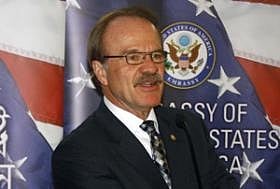
“Bangladesh simply cannot afford such losses month after month. This must stop,” he said while speaking at the Dhaka Stock Exchange on Wednesday.
“The strikes, violence and turbulence of the past several months have stymied growth, driven away both domestic and international investment, created greater risk, and undermined prospects for success.”

Trade, investment deal first priority: Mozena
Trade, investment deal first priority: Mozena
He was visiting the stock exchange even as the market index was falling.
Citing his ‘analyst friends’, he said the recent fall in the DSE’s general index was ‘largely because political unrest had undermined investor confidence’.
The US ambassdor has often spoken of Bangladesh’s ‘potential to be Asia’s next tiger’, but on Wednesday he said: “but Asian Tigers don’t emerge from vapour.”
“Rather Asian Tigers can emerge only from an environment that fosters growth, that promotes investment, that encourages risk, that produces success,” he said.
Citing media reports, the ambassador said, there were only nine regular working days in March.
“Buyers and investors reasonably are taking their businesses and investment dollars elsewhere … this is not the way to build an Asian Tiger.”
He said political differences can be resolved in ‘an open and constructive fashion’ that promotes dialogue.
He said in America, Europe and around the world, “consumers, governments, and buyers are increasingly concerned about working conditions, especially fire safety, and labour rights in Bangladesh’s factories in the RMG and household textile sectors and beyond.
“In America, these concerns are manifested in the on-going review of whether Bangladesh is qualified to receive trade benefits under the Generalized System of Preferences or GSP.”
Citing last week’s hearing in Washington, he urged the government and industry “to engage deeply over coming weeks”.
“Before the actual review discussions begin in late May … to institute needed reforms of the labour law, to take concrete measures to ensure safe working conditions, to accord workers their rights to freely associate and organise, to protect the rights of those individuals and organisations seeking to help workers exercise their rights, among others.”
He once again mentioned that the loss of GSP would send ‘negative message’ around the world and could prevent Bangladesh benefiting from duty free or quota free access to the American market if the on-going WTO negotiations conclude ‘successfully’.
Since its founding nearly 60 years ago, the DSE has grown along with Bangladesh’s business community, listing more than 280 companies with a combined market capitalisation of nearly $30 billion.
The ambassador said he believed that “more can be or must be done to attract greater domestic and foreign investment into Bangladesh’s capital markets.”
“The key to attracting these investments in Taka and Dollars is confidence.”
Citing America’s steps after the collapse of the financial institutions in 2008, he said Bangladesh, like America, “needs a strong regulatory framework that provides effective oversight to the financial sector and capital markets.”
DSE President Rakibur Rahman was present with other bourse officials during his visit.