Over half of package in support of farmers
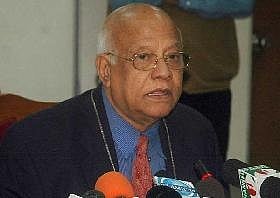
Finance minister AMA Muhith rolled out a Tk 3,424 crore support package on Sunday for the last quarter of the current fiscal year to shield farm, power and export sectors from the effects of the global recession.
bdnews24.com News Service
bdnews24.com
Published :
19 Apr 2009, 02:25 PM
Updated :
12 Aug 2022, 12:57 PM
Dhaka, Apr 19 (bdnews24.com)—Finance minister AMA Muhith rolled out a Tk 3,424 crore support package on Sunday for the last quarter of the current fiscal year to shield farm, power and export sectors from the effects of the global recession.
Muhith also laid out an extensive policy support plan for exporters, manufacturers, investors and the labour market.
Agriculture received the bear's share of the funds, with direct subsidies to the sector jumping to Tk 5,785 crore from Tk 4,285 and an extra Tk 500 crore under recapitalisation of farm loans.
The rest will go to increase subsidies in power and raise the rate of cash incentives for recession-hit exporters in the remaining few months of FY 2008-09.
The government divided its recession package into two parts, an immediate allocation for the current year and one for 2009-10, said the minister.
"The package will be executed in two phases—an emergency step (FY 2008-09) and a medium to long term programme to be implemented in 2009-10."
The amended budget for FY 2008-09 will require the additional allocation of Tk 3,424 crore for the first-phase package, said Muhith.
The current budget for the power, agro and export sectors will be revised to Tk 14,554 crore from Tk 11,130 crore, he added.
"We have also adopted policy support along with incentives to keep the Bangladesh economy vibrant in the face of the global crisis."
The breakdown
Among other measures, agricultural subsidies will see a rise of Tk 1,500 crore and subsidies in the power sector will be doubled to Tk 1,200 crore from Tk 600 crore under the first-phase package package.
Agricultural loans will also be recapitalised to Tk 1,500 crore from Tk 1,000 crore. Social safety net programmes (food) will go up to Tk 4,569 crore from Tk 4,195 crore.
For the export sector, cash incentives for jute and jute goods will be raised to 10 percent from 7.5 percent, for leather and leather goods to 17.5 percent from 15 percent and for frozen fish to 12.5 percent from 10 percent. The total allocation for these sectors will rise to Tk 1,500 crore from Tk 1,050 crore with the new rates.
Incentives for export of locally-produced textiles, agricultural commodities (vegetables and fruits) and processed foods will also remain, said Muhith.
The measures taken under the package for the current fiscal year will be carried into the next year as well and essential allocation will be ensured on regular evaluation, the minister said.
Under the changed global perspectives and on the basis of suggestions from the recession taskforce, extensive policy measures will be taken in the coming budget, he added.
Policy support
The government will amend the regulations for export sectors to get the cash incentive without hassles. Thirty percent of the incentives will be released immediately after primary scrutiny and the remainder after final audit.
The finance minister said the foreign and overseas employment ministries have moved to find new labour markets and step up diplomacy with the countries that have the largest numbers of Bangladeshi workers.
Exporters and textile manufacturers will be able to reschedule bank loans on easy down payment conditions until September this year.
In case of export credit, Bangladesh Bank will ask the commercial banks to refinance. The central bank will also ensure that any recession-hit industry gets support from banks and financial institutions.
Bangladesh Bank's export development fund has been increased to $150 million dollar, from which the loan limit will be riased to $1.5 million dollar, $0.5 million more than before.
Efforts are on to lower licence or licence renewal fees for captive power plants to a reasonable level.
The government will give special stress on agriculture, rural development, fuel, industry and infrastructure sectors to boost investment, the package papers reads.
Departments have especially been asked to attract foreign investment in fuel and infrastructure sectors.
Muhith also said the Planning Commission and IMED have been asked to take administrative measure to fast-track ADP implementation.
The package also named a number of measures, taken or to be taken, to offset the recession impacts on the economy.
The government will keep an eye on the foreign exchange rate so that exporters do not lag behind in global competition, banks do not suffer from liquidity crisis and internal credit flow is used in productive sectors.
The government will also re-fix the repo, reverse repo and SLR to lower lending rates.
The prime minister's finance adviser Moshiur Rahman, Bangladesh Bank governor Salehuddin Ahmed, finance secretary Muhammad Tareq, commerce secretary Feroz Ahmed, NBR acting chairman Nasiruddin Chowdhury and ERD secretary Mosharraf Hossain Bhuiyan were also present for the announcement of the package at the finance ministry.
Mixed reaction
The apex business body said the financial package will upset readymade garment exporters. The FBCCI president, Annisul Huq, himself an RMG exporter, told bdnews24.com it would have been better if the package had raised cash incentives for the export-focused sector.
The two major garment exporters associations, BGMEA and BKMEA also expressed grievances.
But a senior economist said the package aimed to boost domestic spending to tackle the effects of global recession.
"The government's aim is to heighten internal demand through a huge increase in agriculture subsidies," said Zaid Bakht, senior research director of Bangladesh Institute of Development Studies.
bdnews24.com/arh/su/khk/rah/bd/1956h.