


Published : 17 Jan 2016, 06:46 PM
Updated : 08 Aug 2022, 03:32 PM


All that has changed in just five years.
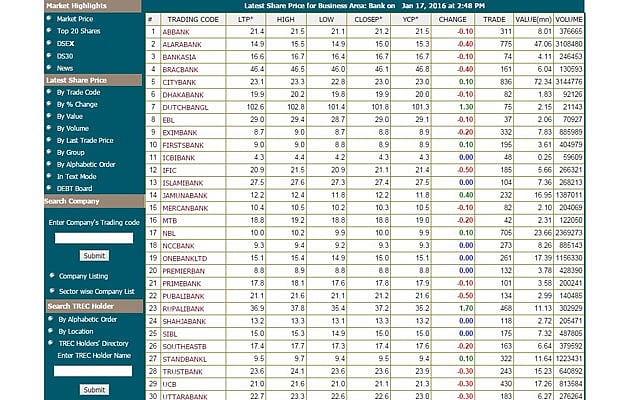
EXIM Bank shares were being traded for over Tk 100 in 2010, when the indices of Bangladesh markets were skyrocketing.
But for the last one year, the price has been hovering under its face value of Tk 10. On Sunday, it was traded at Tk 8.70.
This one instance encapsulates what has gone wrong with the funds poured into banking shares when the market was on a bull run.
The ICB Islamic Bank share is faring worse; it changed hands for Tk 4.30 on Sunday.
Of the 30 bank shares, six are now trading below their face value.
They are ICB Islamic Bank, EXIM Bank, Premier Bank (Tk 8.80), First Security Islami Bank (Tk 9), NCC Bank (Tk 9.30) and Standard Bank (Tk 9.50).
National Bank, which was being traded at Tk 9.90 on Thursday, managed to get back to its face value of Tk 10 after Sunday’s trading.
Before the 2010 market crash, these shares used to be traded 10 to 12 times the current price.
The former chief of market regulator BSEC, AB Mirza Azizul Islam, says poor governance has dented confidence in the industry.
“Investors now do not dare to place their money on these shares,” said Mirza Aziz, who has also served as finance adviser in the last caretaker administration.
It is not that the market is on a downslide like the bank shares. There are companies, whose shares are being traded at prices higher than what they were before the 2010 crash.
Investors who had bet on banks, deeming them as ‘stable scrips’, are now left with burnt fingers, especially those who invested in the six banks that now trade below their face values.
Slumping banking sector
Before the 2010 crash, banks accounted for almost 30 percent of market capitalisation, but that is no more the case.
On Sunday, ICB Islamic Bank traded the lowest banking share at Tk 4.30 while Dutch Bangla Bank was the highest at Tk 102.
Only two banks are now being traded between Tk 30 and 50; and 10 between Tk 20 and 30.
Shares of 11 banks now hover between Tk 10 and 20 while those of the remaining five are below Tk 10.
In 2014, the banking sector’s contribution to market capitalisation was 20 percent but in 2016 it has come down to between 15 and 16 percent.
Pharmaceuticals shares have replaced those of banks with 16.21 percent market capitalisation.
In 2007, the market’s price-earning (PE) ratio was at 23.58 and for banks it was 26.
A PE ratio is a company's current share price compared with its earnings per share.
It is an indicator of how much investors pay for a share compared with the earnings a company generates per share.
The higher the PE ratio, the more the market is willing to pay for each taka of annual earnings.
The market’s PE ratio now stands at 15.93 while for the banking sector it is 8.06, which means investors are now willing to pay Tk 16 in shares for a Tk 1 profit, while for banks they only will pay Tk 8.
Poor governance in banking
Banking shares, often dubbed as scrips with ‘fundamentals’, was market analysts’ favourite example of ‘good investment’ a few years ago.
But after counting losses for the last few years, investors find no reason to go with these shares.
“Banks are going through a crisis of image as prices are not going up despite several stimuli being available.
The overall scenario has dented investors’ confidence in banks.
Former finance advisor Mirza Aziz says there are too many banks in Bangladesh compared with how businesses grew in Bangladesh, which is why good governance is ‘absent’.
“Banks are not complying with the rules and regulations. There are also questions about the stakeholders’ (of the banks) honesty.”
Mirza Aziz says banks do not disclose all information to their shareholders, which is a major obstacle to ensuring good governance.
“The meagre amount of dividends banks gave in the last few years did not even make up a tiny portion of the losses incurred by shareholders.”
Meanwhile, sponsors and directors of the seven banks, whose shares now trade below face values, are known to be close to the ruling party.
EXIM Bank commenced its operations in 1999. Its chairman Md Nazrul Islam Mazumder was once an activist of the ruling Awami League’s student front.
Mazumder has been heading the Bangladesh Association of Banks (BAB) for quite some time now.
The bank’s vice-chairman, Abdul Mannan, is an Awami League MP from Bogra.
Standard Bank Chairman Kazi Akram Uddin Ahmed is a member of the ruling party’s Advisory Council. He has served as president of Bangladesh’s apex trade body, the FBCCI.
HBM Iqbal, a former Awami League MP from Dhaka, is the chairman of Premier Bank. Other board members of the bank are also known to be closely linked with the ruling party.
Zainul Haque Sikder and members of his family hold the majority of National Bank (NBL) shares.
The Sikder family has been known for its close ties with the Awami League.
One of the independent directors of NBL is AKM Aminul Haque Shamim, a former president of the ruling party’s student affiliate.
Mohammad Saiful Alam, whose S Alam Group is among the top business conglomerates in Bangladesh, chairs the board of First Security Islami Bank.
He is known to have good relations with the highest quarters of the government.
There has been a flurry of rumours to the effect that such close links have made it possible for him to buy Ekushey TV, Bangladesh’s first private TV station.
NCC Bank Chairman SM Abu Mohsin is not directly involved with the Awami League, but it is said that he maintains ‘good relations’ with ministers and party leaders.
The ICB Islamic Bank, which is the worst in terms of performance, has however no links with either the government or the Awami League.
The controlling shares of the bank, which was earlier known as Oriental Bank, were bought by the Malaysia-based ICB Financial Group Holdings AG in 2008.
In 2006, the Bangladesh Bank took over Oriental Bank and appointed an administrator for it after a loan scam came to light.
The bank was rechristened as ICB Islamic Bank in 2009.













