


Published : 17 Oct 2022, 10:30 PM
Updated : 17 Oct 2022, 11:46 PM


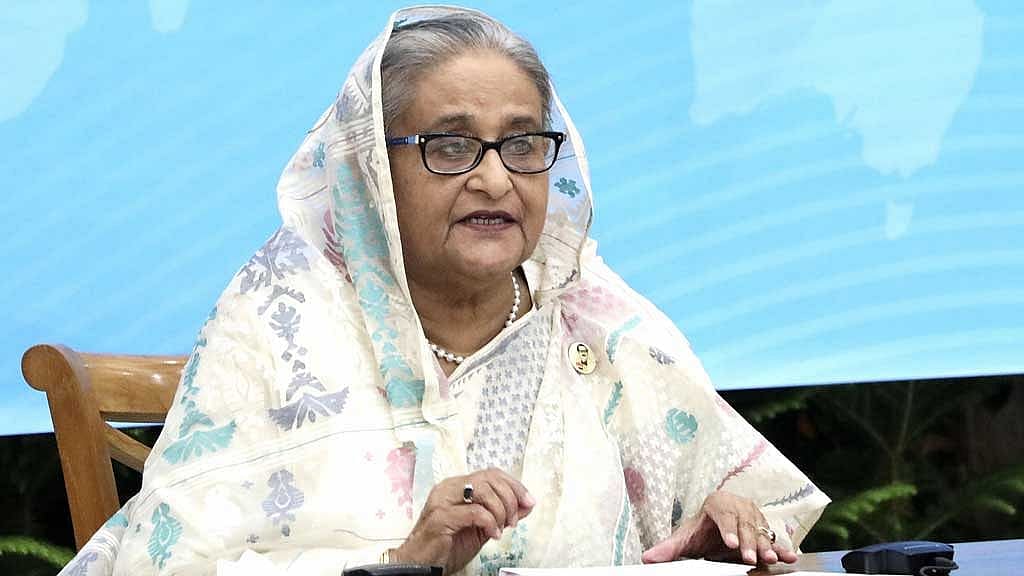
Prime Minister Sheikh Hasina has called on the international community to stop war and waste of food highlighting how a fraction of what is spent on weapons manufacturing can end world hunger.
Speaking at the opening ceremony of the World Food Conference 2022 on Monday, Hasina said the Ukraine-Russia war is taking place at a time when countries in Africa, South Asia and the Middle East are struggling with droughts in the post-pandemic world.
“Estimates indicate more than 800 million people or 10 percent of the world’s population regularly go to bed hungry. Things have now become worse with the Ukraine war, and subsequent sanctions and counter-sanctions, which have disrupted global food supplies and raised the cost of food,” Hasina said.
“This deprivation is most unfortunate in our world of abundant resources which is boosted by remarkable contributions of science and technology.”
She mentioned that the planet does not lack food and the scarcity is “simply manmade”. Politics and business interests with food, challenges of climate change, and pest and disease attacks are all putting pressure on our agri-food systems.
“If, on the other hand, a fraction of the money invested in manufacturing weapons was spent on food production and distribution, no one would go hungry in this world.”
“So I plead to the international community to stop wars, stop politics with food, and stop wastage of food. Instead, please ensure food supply to areas of food shortage, and famine,” she added.
She finished her speech by quoting Bangabandhu Sheikh Mujibur Rahman from the 1974 United Nations General Assembly.
“Let us together create a world that can eradicate poverty, hunger, war and human sufferings and achieve global peace and security for the well-being of humanity.”
She recalled how the Father of the Nation found Bangladesh in the midst of a grappling food crisis following its independence in 1971 and subsequently focused on food production. He then led Bangladesh into FO to modernise the agriculture of the country.
The Bangabandhu’s assassination on Aug 15, 1975, along with most of his family stagnated all fields of development, including the agriculture programme he undertook and remained that way for several decades, she said.
The Awami League was elected 21 years later in 1996 and formed a democratic, secular government. It followed the footsteps of Mujib and gave agriculture the top priority for the welfare of the people, she added.
Hasina said her government found the country in shortage of 4 million tonnes of rice in its first term and turned it into 26 million tonnes in surplus at the end of the term.
“In the current term, the total rice production was increased to 38 million tons last year from 28.9 million tons in 2008,” she said, mentioning that her government’s “pragmatic policies and robust incentives” made it possible.
She also underscored the government’s efforts to modernise the agricultural sector in the welfare of the farmers.
“Despite it all, Bangladesh’s agricultural sector is challenged by climate change and natural calamities. Bangladesh, after all, is one of the most climate-vulnerable countries in the world.”
“And, climate change is a major threat to sustainable agriculture. Yet Bangladesh and her resilient people have continued to move ahead tirelessly to attain self-sufficiency in all spheres of life.”
She also highlighted Bangladesh’s success in boosting production of vegetables, fish and other agricultural goods. “Bangladesh is today ranked second in jute and freshwater fish production, third in rice and vegetable, fourth in tea production and first among eleven Hilsa fish producing countries.”
Hasina then said Bangladesh will showcase in the Investment Forum on Tuesday and present attractive opportunities.
“We shall also focus on the growth potential of our agricultural sector and highlight other business opportunities.”
“Bangladesh is now an attractive destination for foreign direct investment. Our policies are liberal and laws are conducive to investment. This includes fiscal policies related to FDI, tax benefits, incentives for exports, and other inputs such as technology and competitive labour. Bangladesh has good potential for agro-processing industries.”
“I would especially like to invite foreign investors to invest in this agro-sector,” she said.
Hasina thanked the United Nations Food and Agriculture Organization for delivering continuous assistance to transform the country from lacking food to self-reliant on food.
“I hope FAO will continue to do so, especially in the areas of agri-food system transformation, nutrition and livelihood of smallholder farmers.”







