Published : 25 Aug 2018, 07:29 PM
Updated : 19 Oct 2022, 02:18 PM



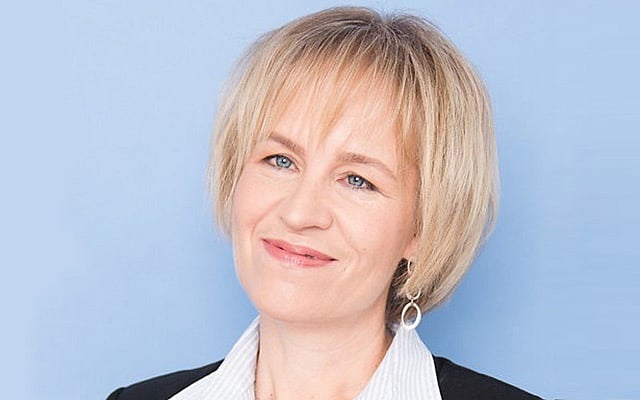
In an exclusive interview on the anniversary of the last year’s Rohingya exodus, Mia Seppo said it is important to use every opportunity “to keep the spotlight on” to make sure no-one forgets the crisis.
Seppo also called upon the rich countries that host refugees to share the burden with Bangladesh that hosts the world’s most densely populated camps in Cox’s Bazar.
She agreed with the ICRC’s call for a mid-term plan to engage Rohingyas for livelihood activities as she said it is difficult to mobilise funding to continue response for a million people in need of humanitarian aid for long. It is not dignified for Rohingyas also, she said.
But Seppo said the mid-term plan should happen in parallel with continued pressure on Myanmar to find a solution and continued pressure to create conditions for their return and putting an international human rights accountability mechanism in place.
“Rohingyas have a right to return and that should never be forgotten. One million Rohingya in Cox’s Bazar should not become a new normal.”
‘SHARE THE BURDEN’
The UN resident coordinator who joined Dhaka Office in October, two months into the crisis, said she had seen “enormous” humanitarian response -- the government-led response where UN agencies, international NGOs and local NGOs are supporting.
“It’s remarkable what have been achieved. Actually there has been no significant loss of lives [in camps]. There has been no major disease outbreak. We have managed to avoid a major disaster also during the monsoon season so far,” Seppo said.
“This is absolutely commendable,” she said, adding that the camps are “better organised” now.
“The government is really starting to get a grip on the management of the camps.”
But she said the camps are still far from international humanitarian standards. She also stressed education and skills development for young people and adolescents so that they can have a better future whatever the place is.
“This is something requires continued urgent attention. One of the big challenges in meeting standards for these camps is that those are unbelievably congested. That congestion makes it very difficult to solve all the problems whether its water and sanitation or roads or enough space for people to live in.”
“All of these are challenged by fact that this is one of the most densely populated refugee camps in the whole world.”
Bangladesh did the right thing by keeping the border open, Seppo said. “The story that we heard from the people in Cox’s Bazar is really heart-breaking on the one hand and also heart-warming and encouraging in terms of a display of human compassion and empathy.”
“Now Bangladesh needs to get much more support from the world,” she said, adding that countries that are hosting refuges really need to “step in and step up” to share the burden.
She said the discussion of the burden sharing should start now.
“The first thing is that this is a problem that needs to have solutions in Myanmar. So that requires a continuous focus. The other option we think of global compact of refugees and other models [burden sharing] we can consider and those discussions should start now.
“And that should obviously not happen at the expense of keeping pressure on Myanmar which is the country that needs to find a solution for the crisis.”
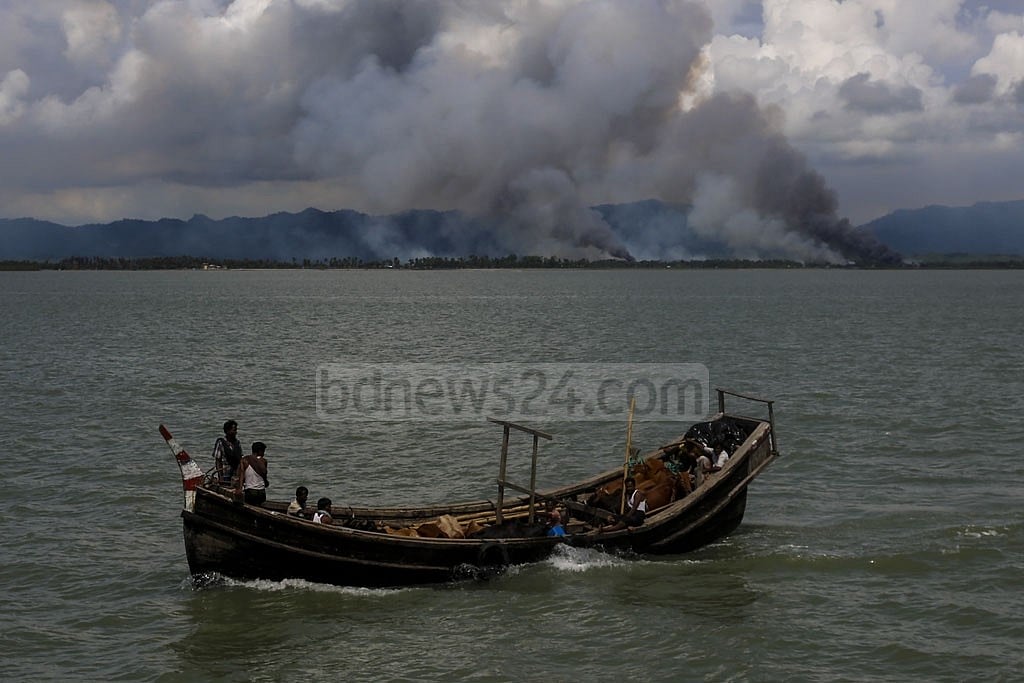
Rohingya refugees rush from Teknaf’s Hariakhali toward the refugee camps on Sept 12, 2017. Photo: mostafigur rahman
But she said this relocation would not solve all the problems in terms of congestion. It could be one in many of options. “It’s not a sufficient solution.”
NEVER GIVE UP
Bangladesh says it is trying utmost to solve the crisis peacefully -- from signing deals with Myanmar to remaining engaged with the international community.
The UN Security Council, which is divided on Myanmar, later sent, for the first time, a delegation to Bangladesh to hear their plight.
As the latest measure, Bangladesh responded to the International Criminal Court’s letter saying that the Hague-based court has the jurisdiction to try Myanmar for the atrocities committed against Rohingyas, despite the fact that the Southeast Asian country is not a party to the court.
But there have not been any return of Rohingyas from Bangladesh so far.
On the contrary, Myanmar continues to blame Bangladesh with the latest comment coming from government leader Aung San Suu Kyi from an event in Singapore.
Seppo said Bangladesh has done very well in using the international mechanism including the UN to push for a solution and keep the spotlight on the crisis.
“You have had the Security Council discussed this crisis many times. You have had the joint visit of the UN secretary general and the World Bank president. The special envoy of the secretary general has also visited and you have taken the issue to OIC and other mechanisms also.
“I think we have to recognise that it’s impossible to talk about return while people continue to flee.
“Both the secretary general and the High Commissioner for refugee have been very clear that the conditions are not conducive for return.
“But we need to pressure Myanmar to create conditions conducive for return and support where we can in order for conditions to be created so that Rohingyas can return voluntary, with dignity and safety.”
“And something goes beyond building houses – it’s also about reconciliation and about the root causes of the crisis as described by the Rakhine advisory report led by Kofi Annan.”
Bangladesh also knows very well that this crisis did not break out on Aug 25 only, she said.
“This crisis has been going on for a long time. There are a lot of complexities. It’s not a one-year crisis. It’s a much older crisis than that. We should never give up efforts.”
“As has been seen in other complex emergencies and crises, it may take time, but solutions need to be done.”
As there has been not decisive role from the Security Council, a senior official of the government told bdnews24.com that they are finding new options and one of them would be the IIIM option in the UN system which is being used for Syria to collect and preserve evidences to assist any future criminal proceedings in any court.
Seppo said the UN special rapporteur on Myanmar during her visit to Dhaka recommended the IIIM mechanism.
“I think when you look at the three tracks – there has been commendable achievement in meeting humanitarian needs. But that needs a bit of transformation and more sustainable approach.”
“There might be disappointment in terms of how we have seen political solutions. When it comes to human rights accountability, I think the month ahead would be very interesting.
“The fact finding mission of the UN will release its report, there will be discussion in the Human Rights Council and then there will be discussion at the General Assembly (in September) where the world leaders will come together and this crisis will be discussed as well.”
“Out of this report, hopefully, there will be an agreement on the mechanism on accountability for human rights violations and IIIM is one of the mechanisms considered and recommended by the special rapporteur. So we have to wait and see the recommendations of the fact-finding mission.”
KEEP SPOTLIGHT ON
“I am hopeful all this will lead to a justice mechanism,” Seppo said, adding that “the world should never forget why they have crossed the border, and that’s why the human rights accountability is very crucial.”
“I also think it is really important to keep the spotlight on Myanmar. The world’s attention moves fast because we have a world, unfortunately, in which we see one complex emergency after the next,” Seppo said.
“It’s important to use every opportunity to keep the spotlight on to make sure no-one forgets there is a crisis and its evolving and the scale and magnitude of the crisis being new and that requires funding and also requires global political commitment and a way to find a solution.”