Published :
11 Mar 2013, 01:34 PM
Updated :
09 Aug 2022, 10:21 AM
Jamaat-e-Islami guru Ghulam Azam’s defence said prosecution witness Muntassir Mamoon, a noted historian and Dhaka University professor, could not answer even basic questions about the sub-continent’s history.
When asked whether Zulfiqar Ali Bhutto, head of the Pakistan People’s Party in the 1970s, had been one of the contenders for his ‘2 PM proposal’, the professor answered he could not say.
Defence counsel Mizanul Islam referred to a number of the questions he had put to the professor during cross-examination of the first prosecution witness against the Jamaat leader and said he severely doubted the professor’s acumen as a researcher and teacher.
The defence lawyer said that the noted historian and researcher had on 213 occasions said, ‘I don’t know’, ‘I cannot say’, ‘I cannot answer that without looking at the papers’, ‘No I did not feel it was necessary to look into it’ about his testimony and publications.
The three-judge International Crimes Tribunal – 1, set up to try crimes against humanity during the 1971 Liberation War, indicted former Jamaat chief Ghulam Azam for five war crimes charges including complicity, incitement and conspiracy.
The defence counsel also referred to certain documents that the researcher said he never felt needed to be verified.
Mizanul Islam, who has been handling all the trials of Jamaat leaders at the first tribunal, said he would be summing up the defence case for the fifth charge against Ghulam Azam, which relates to the execution of 38 people at Brahmanbaria Jail allegedly despite his knowledge that were about to be killed.
The defence counsel will also discuss testimonies of prosecution witnesses 1, 2, 3, 13 and 16.
The closing argument is expected to resume on Tuesday.
Jamaat Guru in ICT-1
On Dec 12, 2011, the prosecution brought a 52-point charter of charges against Azam and appealed for his arrest. Later, following the tribunal order, charges were re-arranged and presented to the tribunal on Jan 5.
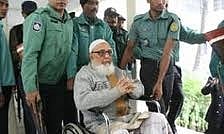
He was produced before the tribunal on Jan 11 and sent to jail the same day. Since that evening, the 90-year-old former Carmichael College professor has been kept at the prison cell of the Bangabandhu Sheikh Mujib Medical University for better treatment considering his delicate health.
Ghulam Azam’s indictment hearing began on Feb 15 and the court charged him on May 13.
A former chief of Jamaat-e-Islami, arguably the largest Islamist organisation in the subcontinent, Azam is allegedly among the key people who pioneered anti-liberation efforts in 1971 colluding with the Pakistani military junta of that time.
He is widely perceived to have been among the core group of right-wing supporters of the Pakistani Army, who came out strongly in support of a united Pakistan.
Ghulam Azam, then chief of Jamaat, was instrumental in setting up the infamous Peace Committee at the national level. The Razakars, an auxiliary force set up mainly to actively thwart the liberation forces, are said to have been mobilised through the Peace Committees across Bangladesh.
Among the most notorious vigilante militia are the Al Badr, whose membership is said to have been mainly dominated by the Jamaat's student wing called the Islami Chhatra Sangha at that time.
The Al Badr is alleged to have spearheaded execution of the intellectual elites of Bangladesh just days before the victory on Dec 16, 1971.
Azam also spoke in favour of Pakistan to the Middle Eastern countries during the war, according to the prosecution.
He stayed in London for seven years after 1971 and returned to Bangladesh in 1978 during BNP founder Ziaur Rahman's rule. Having led Jamaat for long, Azam retired from active politics in 1999.
His party remains a key ally of the main opposition BNP. Two Jamaat leaders, also behind bars for war crimes charges, have even served as ministers during the BNP's last tenure in government between 2001 and 2006, when Azam's party was part of the ruling coalition.
Azam was indicted on five charges — 61 counts — including incitement, conspiracy, planning and complicity on May 13, 2012.