


Published : 16 Aug 2018, 06:27 PM
Updated : 08 Apr 2022, 03:16 PM


Liaquat is a former president of Lakhai wing of the ruling party Awami League in Habiganj.
They were accused of committing mass killing, murder, abduction, torture and loot during the Liberation War of Bangladesh in 1971.
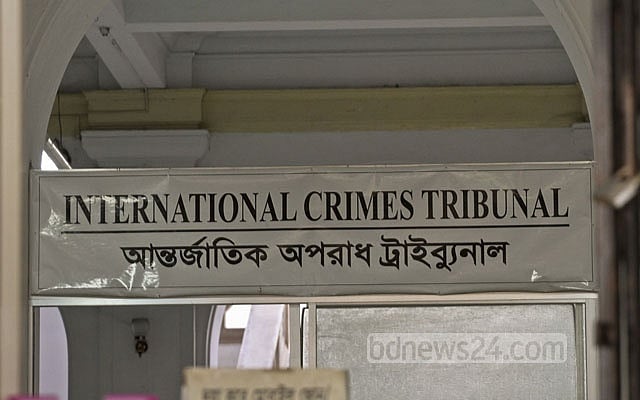
A three-member bench of International Crimes Tribunal led by Justice Md Shahinur Islam has kept their verdicts pending after completion of arguments on Thursday.
Prosecutors Rana Dasgupta and Rezia Sultana Chaman represented the state while Gazi MH Tamim stood for the absconding suspects.
“The trials of accused Liaquat Ali and Aminul Islam began two years ago. Both sides have completed their arguments. The court kept the verdicts pending and expected any day,” said prosecutor Rezia Sultana Chaman.
According to the prosecution, Liaquat was an activist of Conventional Muslim League prior to 1971 while Aminul was a member of its student organisation.
The tribunal pressed charges against them on Oct 1, 2015. The court began to take testimonies on Dec 4.
Liaquat was a former president of Lakhai wing of Awami League from 2003 to 2013 while being accused of war crimes in 2010.
The investigation agency had submitted its report on the case in 2015.
According to the probe report, both accused committed several crimes in Lakhai Upazila in Habiganj, Nasirnagar Upazila in Brahmanbaria and Austagram Upazila in Kishoreganj during the Liberation War.
The tribunal had issued arrest warrants for two of them on May 18, 2016. A notice was also published in newspaper as the accused could not be arrested. Finally, the court decided to continue the trials in their absence.
THE SEVEN CHARGES
According to the first charge, Liaquat and Rajab, supported by Pakistani soldiers, committed mass killing and looting in Krishnapur village under Lakhai Upazila in Habiganj on Sept 18, 1971.
Forty-three persons from the Hindu community were shot dead during their raid.
The second charge is of mass murder and loot in Chandipur village, the third of mass killing and looting in Gadainagar village, and the fourth of murder in Sadanagar village -- all in Lakhai Upazila.
The fifth charge involves abduction and killing of two persons in Fandauk village under Nasirnagar Upazila in Brahmanbaria, the sixth and seventh for murder in Sabianagar village in Kishoreganj’s Austagram.
TWO SUSPECTS
According to the prosecution, Liaquat was a student of Brahmanbaria College in 1971. As a member of the anti-liberation Muslim League, he joined the Pakistani militia Razakar and led it in Fandauk union.
He had gone into a long hiding after independence. He joined the Awami League when he resurfaced and subsequently became the president of the party’s Lakhai Upazila unit.
Rajab Ali, hailing from Alinagar village in Austagram, became president of the Bhairab Haji Asmat Ali College unit of the Islami Chhatra Sangha in 1970.
According to the prosecution, Rajab received arms training at the Pakistani Army camp in Bhairab and later formed the local unit of Al-Badr militia once he returned to his neighbourhood.
It is reported that freedom fighters caught Rajab after independence and he was jailed for life in three cases filed under the Collaborators Act, 1972.
Freed in 1981, Rajab authored a book on Al-Badr Bolchhi.
The prosecution pointed that Rajab’s statements in the book proved the war crime charges against him.













