ASP Helal's cross-examination deadlined
ICT-1 orders it wrapped up by Aug 8 as it drags on and on Full report
bdnews24.com News Service
bdnews24.com
Published :
02 Aug 2012, 11:37 AM
Updated :
09 Aug 2022, 04:05 PM
Tanim Ahmed
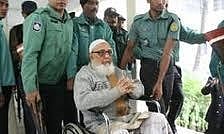
Dhaka, Aug 2 (bdnews24.com) —The International Crimes Tribunal -1 on Thursday ordered that cross-examination of Jamaat-e-Islami leader Delwar Hossain Sayedee's war crimes investigator be completed within Aug 8.
While the court observed that ASP Mohammad Helal Uddin had been at the stand for "over 40 days", the investigator faced the defence for the 42nd time on Thursday. His deposition had begun almost four months ago on April 8.
Set up to deal with crimes against humanity during the 1971 Liberation War, the first war crimes tribunal indicted Sayedee on Oct 3 on 20 counts including murder, rape, arson and loot.
Appearing as the 28th witness for the prosecution, investigation officer Helal Uddin was deposed over eight days followed by the cross-examination.
The tribunal Chairman, Justice Mohammad Nizamul Huq, had indicated on Wednesday that he expected the cross-examination to be wrapped up by the end of Thursday's proceedings.
It had not. And the defence counsel leading the trial had indicated as much.
After much discussion, with the defence trying to dissuade the tribunal from passing an order and the tribunal insisting that an order in this regard had become imperative, Justice Huq passed the order setting a time limit, which he said would be helpful to the defence as well as the prosecution.
Time limit order
Justice Nizamul Huq noted in the tribunal's order that the investigation officer has was being cross-examined for 40 days. "Sometimes we saw that he was too tired."
The tribunal added that the defence counsel leading the cross-examination, Mizanul Islam, also seemed tired at times.
The tribunal expressed its satisfaction with the order stating that cross-examination had been progressing smoothly. The order said that time limit for deposition and cross-examination had been working smoothly. "We are of the view that time-limit should be imposed although nobody should be prejudiced."
Justice Huq noted in the order that counsel Mizanul Islam had pleaded for another three-four days' time for completing the cross-examination.
Although there were no time limits for the investigation, deposition of witnesses or their cross-examination, the tribunal said it felt that it would be better for everybody to limit the cross-examination time. And not just for the lawyers and the tribunal since there were indications from outside that the cross-examination was going on for too long.
The order said while there were no irrelevant questions "some questions might have been avoided by not being asked".
The tribunal then directed the defence counsel to complete cross-examination positively by Wednesday, that is Aug 8. "We hope this will serve the purpose of the defence and the prosecution also."
Discussion
The cross-examination had been halted as the tribunal disagreed with a suggestion put to the investigator by the defence counsel. Mizanul Islam said that since he could not put the question to the witness, whose statement had been received as evidence, he should be allowed to ask the question.
The defence counsel pointed out that the witness had not been produced for cross-examination and as such, in his opinion, he had all the right to put those questions to the investigator that he would have, to the witness.
The tribunal Chairman said that the court would include this in the records but decide on the question's legality later.
The tribunal chair himself then suggested how the question should be phrased and the defence counsel expressed his agreement.
It was at the end of this discussion, at just about 3pm, that Justice Huq said, "Now let's come to the point. I had said we expected the cross-examination to be concluded by today."
Mizanul Islam: But that did not seem to be a mandatory order, my lord.
Justice Huq: We feel that we should give an order in this regard.
The defence counsel, like previous times, began seriously pleading the court against such a measure, as that would preclude flexibility to a great extent.
He said, "Please don't give an order. There is the case against Matiur Rahman Nizami (Jamaat chief) and then there are the applications for Sunday."
Justice Huq: There won't be anything else except for the camera trial, which will be a short thing.
Mizanul Islam: But please let this matter be. I give you my word this cross-examination won't linger beyond next week.
Justice Huq: But it won't do without an order. Or we can't do anything about it.
Mizanul Islam then elaborated on the material he had cover in his cross-examination. "The investigation officer's deposition went on for eight days, probably seven full days but it continued over eight days. There were 27 witnesses and the 15 statements that came in."
He said, "There were 1200 pages worth of documents and records, not to mention the books as well as four websites. You know in regular trials there is one charge and witness cross-examination continues for two-three days and here there are 20 charges."
The defence counsel then told the court that he was certain question-answers constituted only a fourth of the time that the investigator has been at the stand. "Most of that time had been spent in other matters besides perusal of records, which was of course necessary."
The counsel also said he had not asked irrelevant questions.
Justice Huq: We appreciate all that. But now we are going to give an order. Or it would be said that the tribunal is 'all bark and no bite' — that he say things but don't really mean it. It does not seem that mere words are effective.
Mizanul Islam: Of course they are! You had set a limit on SP Mahbub's cross-examination (the second prosecution witness against Jamaat guru Ghulam Azam) and we did conclude it within the time limit you had set without any orders. It is not true that words don't work.
Justice Huq: I feel that we should give an order or the newspapers would write that the court had not said anything although it hinted otherwise the day before.
Mizanul Islam: And I say don't bother reading the newspapers. Ignore them!
Justice Huq: But we should give an order to maintain the dignity of this court.
It was perhaps due to Justice Huq's indication that he would like to see the cross-examination concluded by Thursday's end, that Jamaat's chief counsel Abdur Razzaq, representing the top leadership of his party at the tribunal, joined the proceedings close the end of the day. He stood up to address the court from the second row and Justice Huq requested him not to. "Please don't say anything. Do sit down, Mr Razzaq."
Abdur Razzaq, however, began in his typically eloquent manner. "If there is an agreement between the bar and the bench then it would be best left to the counsel, your lordship."
Justice Huq: But then it will be said that the tribunal said something and at the end of the day did not really do anything.
Abdur Razzaq: I say your lordship should not pay heed to what is said.
Justice Huq: The proceedings are going on smoothly and if see that they are going on smoothly we can also change the order upon consideration later.
Abdur Razzaq: Of course you can.
Justice Huq: Then why are you so worried. Do sit down!
But Razzaq persisted. "May I point out that there have been no irrelevant questions."
Justice Huq: I accept. Do sit down!
Abdur Razzaq: Of course. Could I remain standing if you ordered me to sit down?
Mizanul Islam sought to the court's leave before the laughter had died down following Razzaq's exchange with the tribunal.
He said, "The tribunal has not imposed any time limit at any time of this trial. Be it investigation, be it deposition or be it cross-examination of the witnesses."
Mizanul Islam went on to ask the tribunal that it not impose a time limit at this point either.
Justice Huq: We want to start a system and leave a trail. We have the opportunity to introduce a good system.
Abdur Razzaq rose for the final time. "I only plead that the order must not go against the interest of justice."
Justice Huq: We are more concerned about it than you are. Leave it to us. We shall look after that.
The tribunal then got down to business and passed the order imposing time limit for the first time in Sayedee's case.
Previously, the tribunal had given a similar order in BNP MP Salauddin Quader Chowdhury's case but as the defence counsel was unable to finish, the tribunal extended the original time limit to the satisfaction of defence counsel Ahsanul Huq.
First case to trial
Sayedee's is the first case to proceed to the trial stage at the war crimes tribunals. The prosecution on Sep 4, 2011 proposed framing of charges against him on 31 counts of crimes against humanity and genocide.
The tribunal also sent Jamaat's former chief Ghulam Azam to jail on Jan 11. His indictment hearing began on Feb 15 and the court charged him on May 13.
Jamaat chief Matiur Rahman Nizami, Secretary General Ali Ahsan Mohammad Mujaheed and assistant secretaries general Mohammad Kamaruzzaman and Abdul Quader Molla are also behind bars on war crimes charges. Jamaat financier Mir Quasem Ali has been recently arrested for war crimes charges too as investigation continues into allegations against him.
BNP MP and standing committee member, Salauddin Quader Chowdhury, also behind bars, was indicted for 23 charges on Apr 4.
Former BNP lawmaker and minister Abdul Alim is the only one out on bail. All cases have already entered the trial phase.
bdnews24.com/ta/bd/2103h