



Published : 18 May 2015, 07:31 PM
Updated : 23 Apr 2022, 12:43 PM


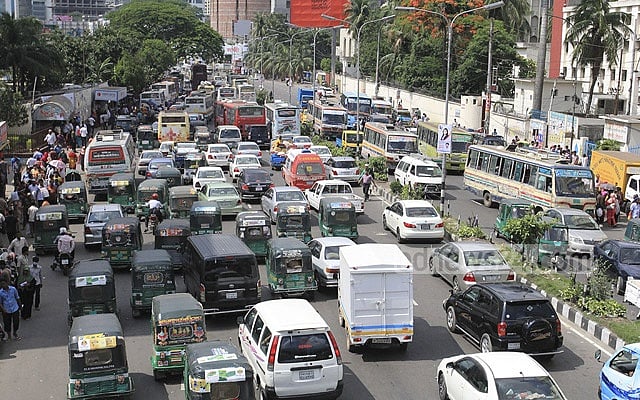
Police said the snarl was caused as motorists failed to adapt to the time-controlled automated traffic signal lights, which were made operational, replacing traditional manually operated system, on experimental basis.
Even the guests attending the 26th Commonwealth Parliamentary Seminar were caught in the gridlock.
The programme started half an hour late
Speaker Shirin Sharmin Chaudhury, Chairperson of Commonwealth Parliamentary Association, told the guests that it was not a regular phenomenon.
“The temporary problem was caused as the traffic division experimented with traffic light system,” she said.
A police officer, who was caught in the gridlock, said it took him about one-and-a-half-hour to reach the headquarters from Uttara.
“It took less time as it was a police vehicle,” he said.
Traffic in several areas including Farmgate, Shahbagh, Panthapath, Mohakhali, Dhanmondi, Rampura and Uttara came to a standstill in the morning.
Police said Monday morning’s traffic jam was caused due to Dhaka’s failure to cope with modern traffic signal system.
“Dhaka traffic came to a grinding halt in the morning after we tried to control traffic with automated signal lights,” Khan Md Redwan, deputy commissioner of Dhaka Metropolitan Police Traffic (south) zone, told bdnews24.com.
“It was stopped at the [DMP] commissioner’s order,” he said adding that they controlled traffic manually after 9:30am.
Twelve experimental ‘time counter signals’ were installed between Kakali and Shahbagh on Friday.
Redwan said the city corporation engineers had developed the structure with the DMP’s assistance.
City corporation authorities had blamed police’s lack of cooperation for the failure of earlier attempts to introduce the automated system.
After new administrations took charge of the two city corporations, a fresh initiative was taken to reintroduce the system.
The World Bank in 2001-02 financed the installation of 70 modern traffic signal lights under ‘Dhaka Urban Transport’ project at a cost of about Tk 250 million to curb gridlock.
In November 2009, automatic signal system was introduced but police claim they were forced to revert to manual traffic control as the lights were damaged.
However, many blamed a ‘conflict’ between police and the DCC for the problem.
In 2010-11 fiscal year, the World Bank financed solar panels and timer countdown at 64 intersections in Dhaka.
Kuddus Amin, deputy commissioner of Dhaka traffic police’s north zone, said the use of signal lights caused Monday’s severe gridlocks.
He said police did not make any prior announcement of the plan before experimenting with the system. “It’s the city corporation’s responsibility,” he maintained.
Newspapers reported about the plan several days ago, he said when asked if they had made any prior announcement about reviving the system.
“In all modern cities traffic is controlled through automatic signal lights and not manually by police. We wanted to introduce the same system here,” Amin said.













