Published : 16 Jun 2016, 10:36 PM
Updated : 11 Apr 2022, 09:59 PM


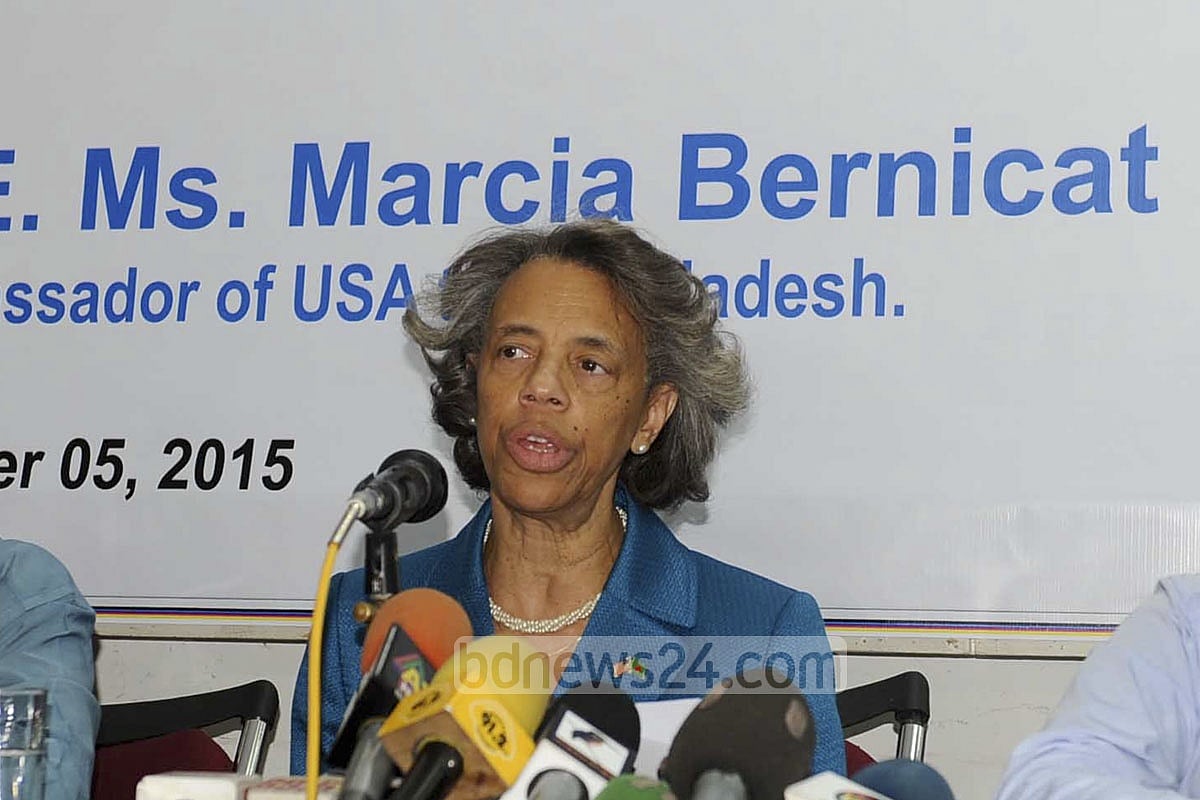
“ISIL is everywhere,” Marcia Bernicat said, days after the terror attack that left 49 people dead and many more injured at a nightclub in Florida.
“If I log on to my computer, I can be reached by somebody in ISIL or I can find somebody in ISIL and communicate with them, then they are present in my life and they can distort my life, or they can take my life. Asking whether ISIL is present isn’t really the right question to ask,” she said.
The ambassador was interacting with a group of journalists on the upcoming partnership dialogue between the US and Bangladesh in Washington.
The fifth episode of the annual dialogue, on June 23 and 24, would discuss all aspects of bilateral relations aimed at advancing “the robust and growing bilateral relationship and provide it strategic direction”.
This dialogue generally features three working groups – security cooperation, development and governance cooperation, and trade and investment. Issues of regional and global interest are also discussed.
This year the event came on the heels of the Florida incident for which the ISIL claimed responsibility.
Many of the recent murders in Bangladesh were also reportedly claimed by ISIL. The government, however, rejected such claims.
The ambassador said security would top the agenda as always as “citizens’ security is always number one priority of a government”.
She said the current situation called for a strong collaboration to win the battle against the radical forces.
“They (ISIL) are everywhere. They have universal reach, so that is our collective problem,” she said.
The US was recently criticised by some of the politicians in Bangladesh for talking about the country’s internal security issues.
The ambassador, without naming any, said, “if anyone says that we don’t need to help each other, that person has no idea what transnational terrorism is.”
“Even we, the US, cannot say we don’t need Bangladesh or we don’t need Russia,” she said, insisting that fighting terrorism was a “collective responsibility.”
She extolled Prime Minister Sheikh Hasina’s letter to President Barack Obama after the Orlando attack and said her words were “as compassionate as they were strong”.
“We are really touched by the PM’s letter to the President,” she said, adding that: “We need to be compassionate”.
She also lauded the PM’s stance against terrorism and said she rightly said “terrorists have no boundary and they have no religion.”
“Terrorism is a global phenomenon. They are not bound by boundaries or laws. But we are bound by law and sovereignty. So we have to fight back together.”
The ambassador also said religion had nothing to do with the fight against terrorism."
Someone born and brought up in the US can become radicalised and violent and commit a terrorist act for many reasons.
“He was a ‘bonafide home-grown terrorist’ born and brought up in the US. He studied in the US,” she said, referring to the Orlando attack that she said gave many lessons to the world.
“The strong message is that he found it useful to link the attack with ISIL.”
She also urged rejecting the “false narrative” of labelling a government anti-Islamic because it is secular and it promotes free speech.
Asked, she said, they were still grappling with how to counter violent extremism. The US, India and Bangladesh all agree on the need to fight terrorism, said the ambassador.