


Published : 10 Feb 2013, 06:52 PM
Updated : 09 Aug 2022, 10:12 AM


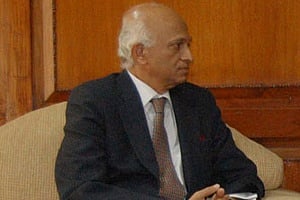
“We are unwavering in our commitment to reach a satisfactory conclusion within the shortest possible timeframe,” Ranjan Mathai said at a joint press briefing in Dhaka.
“We are determined to go ahead and reach the agreement to which our government has committed itself,” he said at the Ministry of Foreign Affairs.
He, however, would not say if it will be done within this year, the last year of the two governments. “We don’t have in fact to wait for one full year. We will do it as soon as it is feasible.”
Asked whether there was any possibility of resolving the issue during Prime Minister Sheikh Hasina’s August visit, he said: “Our commitment isn’t linked with any calendar. Our commitment is to do that as soon as it is feasible.”
“We’re still, of course, discussing dates when we would be honoured to receive the Prime Minister of Bangladesh,” Mathai who is in his capacity also the chief foreign policy adviser of India said.
Bangladesh and India have inked many deals during the last nearly four years, but issues like a deal on equitable sharing of Tessta waters remained unresolved mainly due to opposition of the West Bengal’s Mamata Banerji government.
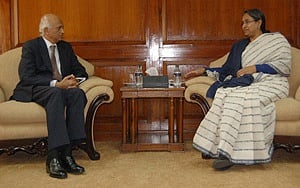
The Foreign Secretary arrived in Dhaka on Saturday on a three-day visit and discussed bilateral issues at the foreign secretary-level talks on Sunday. He also met the Prime Minister, Finance Minister Abul Maal Abdul Muhith and Foreign Minister Dipu Moni.
A Memorandum of Understanding (MoU) on cooperation has been signed between the Bangladesh Foreign Service Academy and Indian Foreign Service Institute.
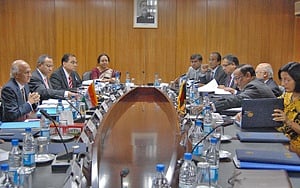
Briefing journalists after the meeting, Foreign Secretary Md Shahidul Haque said they had discussed security matters, land boundary related issues, water resources, trade and commerce, connectivity, and power sector.
“We welcome recent signing of extradition treaty which has put in place for comprehensive mechanism for cooperation on security matters.
Asked about the border killing, Secretary Mathai said it was ‘a matter of serious concern not only for Bangladesh but also for India.’
Citing reports he said, 10 Indians were also killed on the border last year... we must follow the policy of zero tolerance to ensure that border guard enforces exercise maximum restraint.
“But this has to be seen in the context of decriminalisation of the activities on the border. The reports we have received are that extremely well-armed criminals are in operation on the border.
“That’s why our two governments decided to have a coordinated border management plan which include night curfews, joint patrolling of those areas which are considered as vulnerable.
“All the activities leading to unfortunate deaths are in fact in night almost all during armed confrontations,” he added.
He said the two democracies were moving ahead with a spirit of cooperation which was ‘at its best’.
“India attaches the highest importance to its relations with Bangladesh. Our regular and intensive engagement over the previous three years has led to significant progress in our bilateral cooperation encompassing a wide range of areas,” he said recalling the visits of two premiers.
He said the bilateral meeting had provided them the opportunity to prepare for the second meeting of the Joint Consultative Commission at the level of the Foreign Ministers.
The Indian Foreign Minister Salman Khurshid is expected here on Feb 16 to attend the meeting.
The senior most Indian diplomat fondly recalled his days as a university student during the 1971 Bangladesh Liberation War and congratulated Bangladesh on its process of trying suspected war criminals.
He, however, said they had not started any formal talks with Bangladesh on financing Padma bridge, but added that Bangladesh could use the grants in $1billion credit line for any projects it wished.
Also Read:
India supports trialsAlso Read:
Will use Indian credit for Padma: MuhithAlso Read:
India non-commital on Padma






