Published : 21 Oct 2026, 05:10 PM
Updated : 21 Oct 2026, 05:10 PM


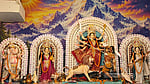
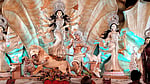
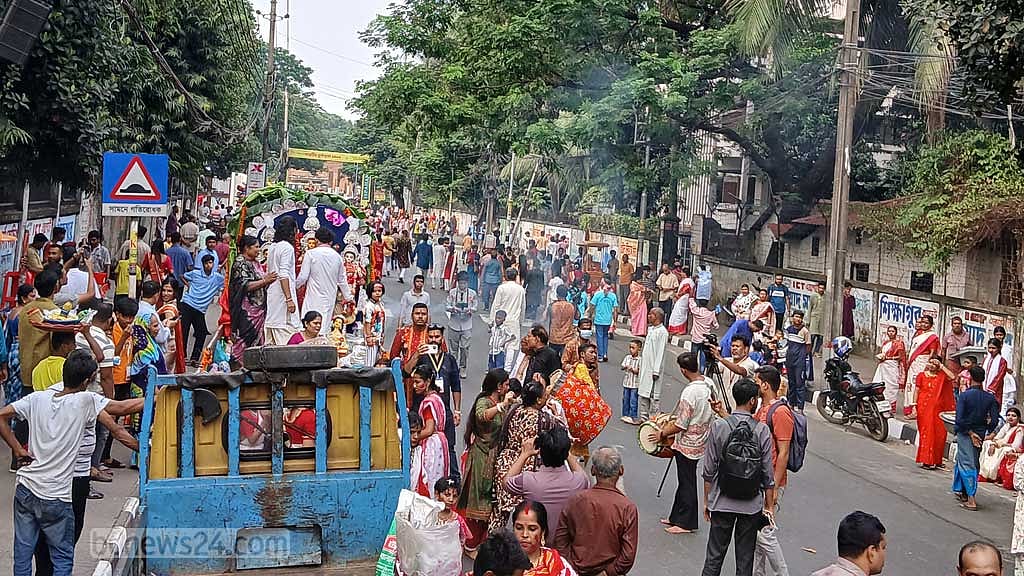
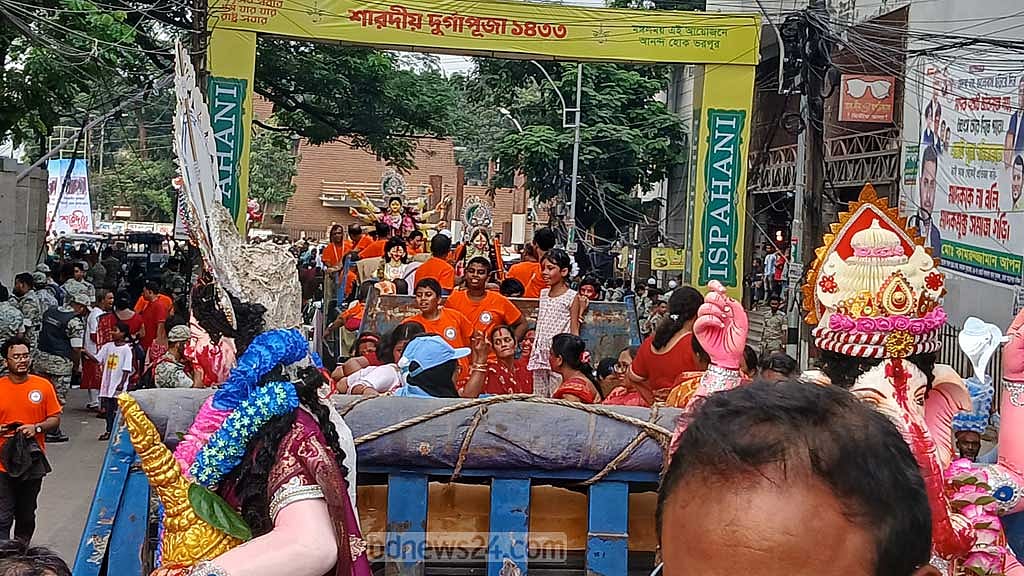
A colourful procession to bid farewell to Goddess Durga has begun at Dhakeshwari National Temple in Dhaka, marking the final chapter of this year's Durga Puja celebrations amid a mix of joy and sorrow.
Accompanied by conch shell blasts, ululation, rhythmic drumbeats and chants of “Bolo Durga Mai Ki Joy”, the procession began from the temple at Palashi Mor at 4pm on Wednesday.
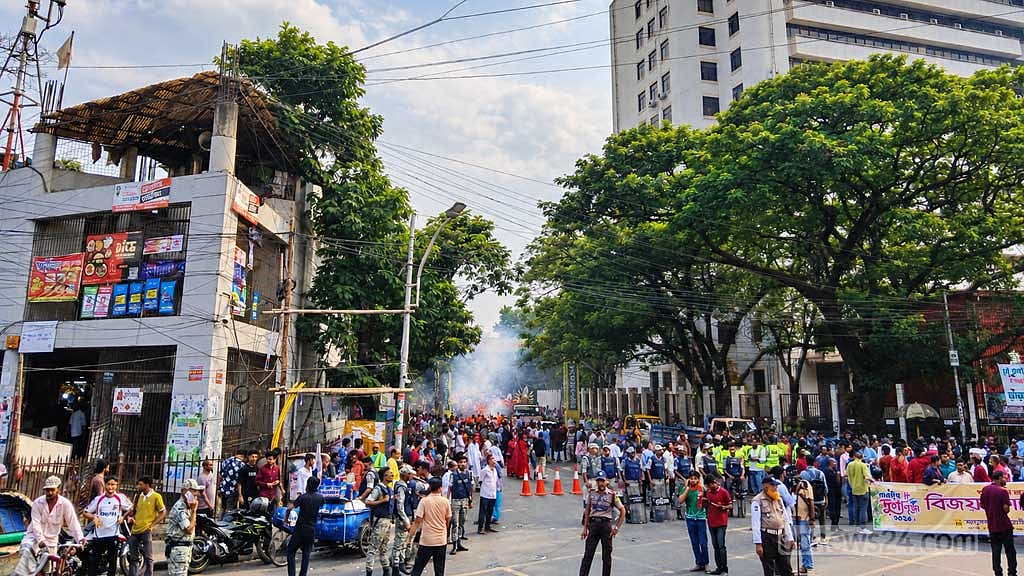
Idols brought from puja pavilions across the capital are scheduled to travel through Jagannath Hall, Doel Chattar, Gulistan intersection, Nawabpur Road and Raisaheb Bazar before reaching Wiseghat on the Buriganga River for immersion. It is expected to reach its destination by 10pm.
According to Hindu beliefs, Goddess Durga descends to the mortal world in the form of a daughter on Mahalaya and returns to her husband’s abode on Mount Kailash on Dashami after five days of worship. The day is celebrated as Bijoya Dashami, marking the goddess’s victory over evil, but her departure also leaves devotees with a sense of sorrow.
Dashami Rituals and Sindoor Khela Mark the Farewell
The farewell rituals began earlier on Wednesday with the prescribed worship for Bijoya Dashami in the morning, followed by Sindoor Khela, the traditional vermilion-smearing ceremony for married Hindu women.
The Dashami Puja began at Dhakeshwari National Temple at 7am. The scriptural rituals concluded with Darpan Bisarjan, or the symbolic immersion of the goddess’s reflection, at 9am. Sindoor Khela, one of the main attractions of Bijoya Dashami, took place from 11am to 1pm.
Married women offered vermilion at the goddess’s feet, praying for their husbands’ long lives and well-being. They then smeared vermilion on one another’s foreheads and cheeks amid celebration.
Bangabhaban Greetings and a Call for an Inclusive State
A reception was held at Bangabhaban from 11am to noon on Wednesday for members of the Hindu community to exchange Bijoya Dashami greetings with the president. Around 100 members of the Dhakeshwari Temple Puja committee attended.
Shubhashish Kumar Biswas Sadhan, general secretary of the Mahanagar Sarbojanin Puja Committee, told bdnews24.com that the community wanted to preserve the bonds of harmony and build a Bangladesh founded on goodwill and communal amity.
“We want to preserve the bonds of harmony that have developed among us. Building on these ties, we want to build a Bangladesh of goodwill and communal harmony in the days ahead,” he said.
Calling for equal rights for all citizens, he said that while religious festivals had become universal celebrations, the state had yet to become equally inclusive.
“We have been saying, ‘Religion is for individuals, the state belongs to everyone.’ This time, we also thank Prime Minister Tarique Rahman. He has said, ‘Religion is for individuals, the state belongs to everyone’ and ‘Everyone has the right to security, regardless of religion.’ He has expressed the pain we feel,” he said.
Biswas expressed hope for an inclusive state where people of all nationalities, religions and ethnic backgrounds could live together in harmony.
He said the Hindu community had gained renewed hope as, for the first time in Dhakeshwari Temple’s history, both the head of state and the head of government had visited to exchange greetings.
Medical Services and Blood Donation Promote Communal Harmony
Durga Puja celebrations extended beyond religious rituals. The Mahanagar Sarbojanin Puja Committee organised a free medical camp on the temple premises, offering treatment to people regardless of religion or ethnicity.
The temple also held its traditional blood donation programme on Wednesday afternoon, continuing a practice maintained for nearly 50 years.
Biswas said around 50,000 people had received Mahaprasad, or consecrated food, on Nabami night.
“It is rare in the world for people of other religions to help ensure that a religious festival is held smoothly and successfully. Our Muslim brothers, in particular, and leaders of different political parties have supported us,” he said.
He added that people from other religious communities were involved in various aspects of the celebrations, from decorating Dhakeshwari Temple and arranging sound systems to operating stalls outside the premises.
Devotees and Artisans Share the Emotion of Farewell
A sombre mood mixed with celebration among devotees and artisans as the idols prepared to leave the pavilions.
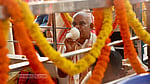
Chandan Chandra Das, a resident of Wari in Old Dhaka who made an idol with his own hands, said Goddess Durga was their revered deity and the source of all power in the universe.
“Mother Durga is our revered goddess. She is the source of all power in the universe. Today, she will once again leave the mortal world, returning from her divine form to an earthly representation. We bid her farewell with the prayer that all evil forces in the world will be destroyed,” he said.
Shraboni Das, a resident of Lalbagh, said she had enjoyed this year’s celebrations more than last year’s.
“I feel a little sad today. I will see Mother again after another year,” she said.
She also expressed regret that personal difficulties had prevented her from taking part in Sindoor Khela this year.
Teacher Seema Rani Pal was joining the immersion procession on a truck for the first time. Comparing celebrations in urban and rural areas, she said festivals in the city had become a shared occasion.
“Alongside members of the Hindu community, Muslim colleagues and their children also come to see the Puja at night. That is why the bond of communal harmony is stronger in the city,” she said.
Dhakeshwari's Distinctive Immersion Tradition
The immersion of idols marks the formal end of Durga Puja, but Dhakeshwari Temple follows a distinctive tradition: its principal idol is not immersed every year.
Biswas said Goddess Durga herself was believed to reside at the temple. Under a tradition dating back to the temple’s establishment, the main idol is preserved for a year and immersed before the next year's Puja.
Instead, the banana plant known as Kola Bou, installed on Saptami as a symbolic representation associated with the goddess, will be immersed this year.
A total of 11 river ghats on the Buriganga and Turag rivers have been designated for the immersion of idols from different pavilions in the capital this year.
Durga Puja was held at 33,851 pavilions across Bangladesh this year, including 258 in Dhaka city.