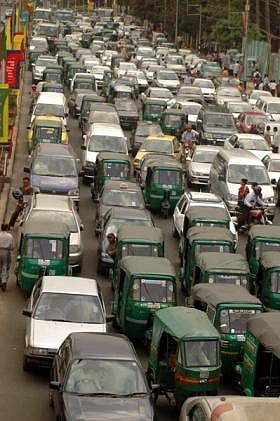
SPECIALCars turning curse for city roads
Experts say putting private cars before public transport and rickshaws has unfortunately backfired on Dhaka's traffic planning, Mamunur Rashid reports.
bdnews24.com News Service
bdnews24.com
Published :
28 Jun 2011, 10:02 AM
Updated :
10 Aug 2022, 05:01 PM
Mamunur Rashid
bdnews24.com correspondent
Dhaka, June 28, (bdnews24.com) — Despite many city roads going out of bounds for the slow-moving rickshaws, it has helped little in clearing the city's nagging traffic jams, thanks to private cars, occupying 54.2 percent of the road space.
In fact, removing rickshaws has helped only to a negligible degree in decongesting the city roads, as shown in a government study nearly a year ago.
Dhaka Urban Transport Network Development Study (DHUTS), a 2010 study by Dhaka Transport Coordination Board (DTCB) showed that a rickshaw carries 50-60 passengers on average a day, while a private car, though 2.5 times larger than a rickshaw, carries only 3-4 passengers.
While experts are unanimous that regulating private cars is the only way to reverse the situation, authorities still insist that the environment-friendly three-wheelers are the culprits.
"Rickshaws and violation of traffic rules are the main reasons behind the vexing traffic jam in the city," additional commissioner of Dhaka Traffic Mahabubur Rahman told bdnews24.com.
DHUTS also shows that a car is driven 10 percent of the time, while remains parked for 90 percent of the time somewhere on the city road, occupying space.
The drive to eliminate rickshaws began in 2002 with the launching of the Dhaka Urban Transport Project (DUTP) sponsored by the World Bank, banning the slow-moving three-wheelers on the Mirpur Demonstration Corridor (Russel Square to Gabtoli). Gradually, other major roads were made off-limit to non-motorised vehicles.
DUTP's after-project study shows that before the ban, non-motorised vehicles, especially rickshaws, used to occupy 43.5 percent of the roads, completing 59.4 percent trips, while private cars 29.9 percent space completing only 5.5 percent trips.
Four years after the ban, private cars complete only 8.52 percent of trips while eating up 54.2 percent space, which is more than half of the roads.
SMALL TRIPS WIND LONG
DHUTS says the number of trips in Dhaka has risen by 2.5 times -- from 8.5 million in 1994 to 20.5 million in 2010 every day -- in the last 16 years.
It also says long trips (longer than 5 kilometres) are only a quarter of all of Dhaka's trips and the rest are 2.76 kilometres on average.
"Though the overall traffic scenario improved for a while after banning rickshaws on major city roads, it worsened soon afterwards as these non-motorised vehicles had been replaced by private cars," said A S M Mahabubunnabi, a professor at the Bangladesh University of Engineering and Technology's (BUET) Urban and Regional Planning (URP).
In Dhaka City Corporation areas, the DHUTS says, 38.7 percent trips are done by rickshaws, while 28.5 percent by public buses, 19 percent by walking and 5.2 percent by private cars.
Mahabubunnabi said, "Using private cars for short trips contributes to traffic jam. At least 40 percent of the trips done by private cars are useless. Some middle-class families are forced to buy cars because of the increasing restrictions on rickshaws to ply majors city roads.
"Vehicles on Dhaka city streets have an average speed of 6 miles -- in some places only 4 miles. Had the restrictions on rickshaws been able to bring this speed up to 12 miles it would have made sense," he added.
CAR RAMPAGE
Mahabubunnabi told bdnews24.com he had never heard of a city in the world tackling its traffic problems without controlling private cars.
Private cars in Dhaka grew at a rate of 8.99 percent in 2005, Bangladesh Paribesh Andolan (Bapa) secretary Iqbal Habib told bdnews24.com.
"In 2009, it grew at an alarming rate of 39.5 percent," he said. "But public buses have hardly increased."
DCTB additional executive director Salahuddin Ahmed said it was impossible to control private cars without arranging public transit first.
He suggested creating 54 new roads in the city in the next 20 years to solve the crisis.
International transport expert Mahabubul Bari, currently an advisor to Rwandan communications ministry and formerly transport advisor to Croydon city, UK, thinks other wise.
"If the number of private cars increases uncontrollably, no matter how many roads the government makes, the traffic problem will never go," he said.
Iqbal Habib said the tendency to use cars would eventually decline if the public transit improved. He suggested increasing taxes on cars and permitting those proportionate to the number of roads fit for cars.
He also said the work on the STP-proposed (Strategic Transport Plan) dedicated bus routes from Gazipur to Shahjalal Airport and from the airport to Sadarghat should begin as quickly as possible.
STP advisor and DCTB senior advisor Tanvir Newaz told bdnews24.com work on the $ 180-million bus route may begin next year.
Mahabubunnabi recommended controlling private cars on at least 25 percent of the city's 250 km streets to facilitate the better movement of buses.
He also suggested colour-coding rickshaws to limit them within zones. Iqbal Habib and Salahuddin Ahmed also welcomed the suggestion.
bdnews24.com/mmr/mi/sh/sam/1530h