SPECIALBanking on the February frenzy
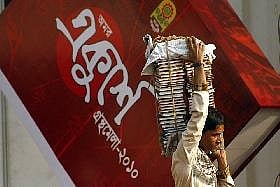
The Bangla Academy grounds teeming with book lovers do not suggest that business is getting dull by the day for publishers, as they claim. But February is special; this is when books sell and everybody is in for a little bit of Ekushey action. Rohan Ziad writes
bdnews24.com News Service
bdnews24.com
Published :
02 Feb 2010, 02:13 PM
Updated :
10 Aug 2022, 08:56 PM
Dhaka, Feb 2 (bdnews24.com) - Chittaranjan Saha had truly blazed the trail and not just as far as the Amar Ekushey Book Fair is concerned.
He had gotten together a band of writers in 1971 during Bangladesh's Liberation War and managed to publish 32 books on his beloved country as it was still going through the throes of a violent birth. And thus began Muktadhara in Kolkata, later relocated to Dhaka after liberation.
Along with Punthighar—also run by Saha—Muktadhara was the first house to set up shop selling books to mark February's Ekushey (literally meaning '21st' in Bengali), a date immortalised by Bengalis, in 1952, who braved a Section 144 and died for the right to speak their mother-tongue.
Compared to the present scenario, Saha's repertoire of 32 books during the 9 month-long liberation war was no mean feat, considering that today all Bangladesh's publishers together publish less than 2,500 hard-bound books annually under the 'non-fiction' and 'creative fiction' categories.
With 366 publishers at the book fair this year, that is just about 7 books per house.
Sheikh Jahangir Yousuf, who runs publishing house Shuchipatra, estimated that the book fair saw around 2,000 new books in hard-cover, apparently the most popular format.
"That is of course keeping aside the matter of text-books."
Yousuf is planning to bring out at least 10 books this month. Seven have already hit the stalls.
But Yousuf had serious doubts about sales during rest of the year.
"I doubt if it is even 100 new titles with all the major publishers put together."
Almost 90%, if not more, of the books are published targeting the book fair that now runs throughout February and undoubtedly, marks the high point of the local publishing industry.
After Saha's initiative had caught on and a number of other publishers joined efforts with him, the Bangla Academy took over the charge in the 1990s and began organising the book fair, which has come be regarded as part of national heritage and cultural expression.
From Saha's two publishing houses in 1972, the fair has increased to just over 500 stalls in 2010. But this 250-fold growth is rather deceptive, say publishers.
They think it is quite alarming that the entire industry concentrates its efforts on just one month.
But it is not just the 'fair factor'. There are other issues too. Costs seem to be rising every year, especially for paper. There is also a dearth of bank loan facilities. Then of course there is the rat-race for getting one of the more popular writers to publish with them.
Tyebur Rahman, a paper importer, said the cost of paper increases an average of about 10% every year. "And some years, as was the case a few years ago, it jumped up by about 15 or 20 per cent."
The international prices are also significant as most publishers avoid locally produced paper for their books, especially during February.
While publishers agree that international prices go up every year, they also blame the importers for exploiting the frenzy around February.
"Importers always raise their prices just before the book fair when bulk of the production is underway," said a manager of Charulipi Publications.
The rising prices mean that publishers remain on their toes and are in a constant state of re-evaluating their production costs.
Lutful Hossain, who works with the Amir Publications, said the rising prices could be managed with decent volume of sales.
"In that case costs come down significantly."
But there are only a few good writers, who are sure to fetch business and only a few houses boast several of them.
For Mizanur Rahman, of Anannya, a publishing house boasting the major best-sellers for several years, it did not seem to be a problem though.
"It is no risk if you can publish books by popular writers."
"But if you venture out then there is always the risk of running into serious losses."
Like any other industry, investment is vital for publishing, but the sector is deprived from any kind of bank financing.
Return on investment takes a long time in this industry as books could virtually sell for years, said Rahman.
"So banks are not interested. And publishers can hardly go for big projects without financing."
Regardless of the risks, publishers are putting on a bold face as long as the February frenzy lasts.
bdnews24.com/rhn/ta/1943h