


Published : 20 Sep 2015, 12:26 PM
Updated : 08 Aug 2022, 04:59 PM


"Bangladesh has not been sitting around waiting for the world to save us. We are fighting for our own future, albeit with limited resources and technologies," said Hasina in a blog published in the Huffington Post.
The HP ran a series in conjunction with the United Nations' Sustainable Development Goals (SDGs) that will be adopted soon after discussions.
"Bangladesh is one of the most densely populated countries in the world (1,218 people per sq km), with the lowest quantity of per-capita arable land (0.05 hectares).
"Although we made considerable progress on the Millennium Development Goals (MDGs), climate change in the form of extreme-weather events, tidal surges, and erratic rainfall has negatively impacted agricultural production, industrial development and social structures," said Hasina.
She said "The goal of combating climate change and its impacts is crucial, as we are on the frontline of this global threat."
Quoting studies, Hasina said that a metre rise in global sea level would submerge one-fifth of Bangladesh's land and displace 30 million people.
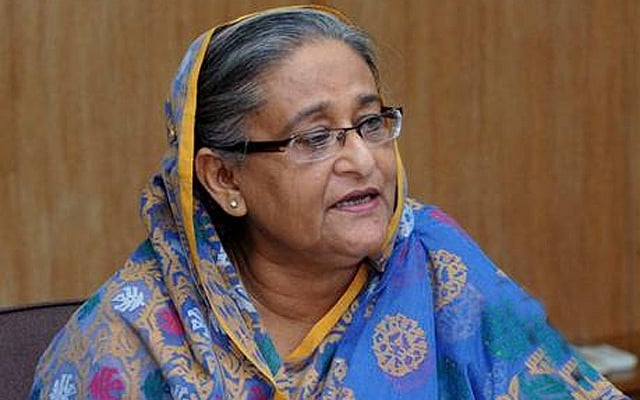
File Photo
"That is why we are keen to see the Sustainable Development Goals (SDGs), and the upcoming climate agreement in Paris, adopted and moving into implementation," said Hasina.
The prime minister listed some steps taken by her government to fight climate change.
* 2011 Constitutional amendment to protect and improve the environment and preserve and safeguard natural resources, biodiversity, wetlands, forests and wildlife for present and future citizens.
* Enactment or amendment of eight new laws since 2009 to preserve forestlands in the country.
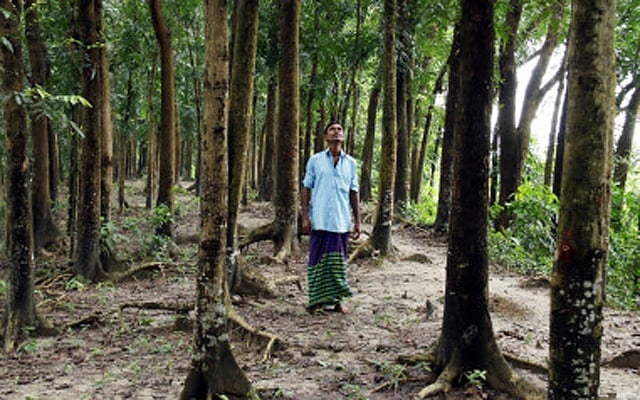
* Massive afforestation programme that has raised forest cover from 7 to 8 percent to more than 17 percent
* Distribution of more than 120 million saplings every year among the people, compared to 40 million in 2001-2006.
* Building four million solar-home systems in off-grid areas and 1.5 million improved cooking stoves to decrease indoor air pollution.
* Creation of the Coastal Greenbelt Project to protect the southern part of Bangladesh, which is surrounded by the Bay of Bengal, from cyclones.
Hasina said Bangladesh was the first developing nation to create a Climate Change Strategy and Action Plan.
"From 2009-2010 to 2014-15, the government allocated Tk 30.3 billion (US$ 385 million) to our climate-change trust fund.
"All of our activities have been targeted toward adaptation to environmental changes with a view to protecting human lives from floods and hurricanes, and protecting the environment from pollution caused by rapid urbanisation and unsustainable industrialisation."
The prime minister said Bangladesh has also made remarkable progress in food production.
"Bangladesh has become a food-exporting country from a food-importing country over the last six years. Our scientists have developed almost 200 varieties of crops that are resilient to changing climactic conditions and techniques to grow crops in less fertile soil."
But she reminded the world that Bangladesh cannot face the threat of climate change alone.
"We cannot do it alone, which is why we need the international community to stand up for nations such as ours through the SDGs and the climate-change process.
"In order to address climate change, a critical balance between adaptation (adjusting to the impacts of climate change) and mitigation (reducing the scale of climate change) will have to be maintained."
Hasina said that commitments made on reducing emissions submitted for the Paris climate meeting must be measurable and verifiable.
"The world should pay attention to carbon budgeting and de-carbonisation pathways. For adaptation planning, adequate and predictable financing is essential."
She claimed Bangladesh was 'leading by example' and said her country was prepared to share its experiences on climate resilience with rest of the world.
Hasina expressed gratitude to the United Nations Environment Programme for honouring her with the Champions of the Earth award this year.
"This will draw attention to Bangladesh's efforts, which show that we can make a difference."













