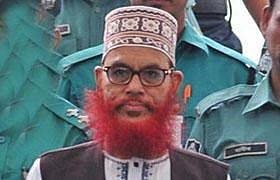
Sayedee defence questioning witness
Jamaat-e-Islami leader Delwar Hossain Sayedee's defence will continue its cross-examination of witness Mahbubul Alam Howladar before the war crimes tribunal on Wednesday.Full story
bdnews24.com News Service
bdnews24.com
Published :
13 Dec 2011, 08:31 AM
Updated :
10 Aug 2022, 05:56 PM
Tanim Ahmed
Dhaka, Dec 11 (bdnews24.com) — Jamaat-e-Islami leader Delwar Hossain Sayedee's defence will continue its cross-examination of witness Mahbubul Alam Howladar before the war crimes tribunal on Wednesday.
Tuesday was the third day that the Jamaat executive council member's defence questioned the 60-year old freedom fighter from Pirojpur in a case where Sayedee has been charged on 20 counts of crimes against humanity.
Defence counsel Mizanul Islam handed over to another colleague of his team Mohammed Kafil Uddin Chowdhury a little after lunch.
Throughout the day, the defence raised numerous objections regarding the prosecution's repeated interventions which they said were obstructing them from establishing that Howladar's veracity as a witness was questionable.
The first attempt of the defence to establish that the freedom fighter was not a dependable witness began with his education. Howladar had apparently taken Matriculation exams and failed.
Mizanul Islam pointed out that he had mentioned his birth year as 1959, which would mean that he was only 12 years during Bangladesh's Liberation War in 1971.
Alluding to the general practice of concealing one's real age at the time of appearing in the secondary education final exam, Howladar replied, "In case of educational records, it could happen."
The defence also asked him about his broken marriage. Howladar had apparently asked for dowry from his first wife, a case in which he was convicted and is currently on bail.
The judges objected to bringing out such matters in public since it only dealt with Howladar's personal life. Judge AKM Zaheer Ahmed said, "There is no point bringing out such matters. They are scandalous."
Nizamul Huq agreed saying that such matters would not really make a difference.
Defence counsel Tajul Islam argued that if a man could ask for money in marriage, he could well ask for money for doing something else indicating that Howladar might have had monetary interests for testifying against Sayedee.
The judges relented and let the defence continue, although with periodic interventions from the prosecution.
The defence objected that the prosecution's statements and comments were preventing them in their cross-examination and the questions were losing their intended result.
Sayedee's counsel, Mizanul Islam, at one point told the court that he would be a lot more vocal except that, "[The chief prosecutor Ghulam Arieff Tipoo] had gotten his licence in 1958 and I was born in 1960!"
"And the less said about us younger ones the better," Tajul Islam was quick to add.
After another round of interventions where Tipoo prompted the defence's line of questioning and suggested alternative questions, Zaheer Ahmed lightly told him, "I see you haven't been able to teach your junior lawyers well enough."
Howladar told the court that he had been framed in a false case of dowry as he had first sued his wife and it was only their ploy.
The defence also asked Howladar about a burglary conviction where he was jailed. The witness said that he had been tried in absentia and jailed. "But I challenged it later and was acquitted."
However, Howladar's statements regarding his presence in the court on the day of the judgement appeared contradictory, which the defence pointed out 'questioned truthfulness of the witness'.
The tribunal had mentioned that as soon as an individual has been acquitted, the entire line of questioning around that specific incident became 'redundant'.
The defence then said that at least the questioning reveals that Howladar was not telling the truth.
Kafil Uddin Chowdhury could not complete his cross-examination by the end of the day and it will continue on Wednesday.
The International Crimes Tribunal had adjourned the cross-examination on Sunday in the face of opposition from the prosecution when defence counsellor Mizanul Islam introduced a document and proceeded to question the witness regarding its contents.
It resumed on Monday after submission of certain documents by the Jamaat leaders' defence.
Just before adjourning for lunch, AKM Zaheer Ahmed, a member of the three-judge tribunal, recounted an anecdote from his younger days about a senior advocate's line of questioning.
The judge had apparently failed to make much out of the advocate's roundabout style of cross-examination and had asked him when he would get to the point. The advocate had replied, "Very soon, sir."
When after an hour, the judge asked the same question, the advocate had the same answer although he apparently did not seem to be anywhere close to the point.
Addressing defence counsel Mizanul Islam, who has been conducting the cross-examination. Zaheer Ahmed said, "I must ask you in the same vein, when will you come to the point?"
It was now Mizanul Islam's turn to recount his anecdote about a senior advocate he had known. "If the judge asked such a question, he would say, 'If you discharge my client, I won't ask even one more question'."
Zaheer Ahmed's anecdote came after hours of cross-examination by Mizanul Islam.
Sayedee is the first to face prosecution for his alleged war crimes in 1971 including murder, rape, arson and loot.
The prosecution on Sept 4 proposed the framing of charges against Sayedee on 31 counts for crimes against humanity and genocide in ICT Case-1/2011. The tribunal indicted Sayedee on 20 counts on Oct 3.
Apart from Sayedee, Jamaat chief Matiur Rahman Nizami, secretary general Ali Ahsan Mohammad Mojaheed and assistant secretaries general Mohammad Kamaruzzaman and Abdul Quader Molla, and Bangladesh Nationalist Party's standing committee member Salauddin Quader Chowdhury, also a lawmaker, have been detained, along with others, on charges of committing war crimes.
The tribunal is expected to take charges against the other Jamaat leaders into cognisance on Dec 18.
The tribunal, however, on March 31 granted conditional bail to former BNP MP and minister Abdul Alim.
bdnews24.com/ta/bd/1613h