


Published : 19 Mar 2016, 04:14 PM
Updated : 08 Aug 2022, 03:37 PM


A major in 1971, Safiullah was the second-in-command of a unit mostly consisting of Bengali soldiers, which was stationed some 30 kilometres outside capital Dhaka.
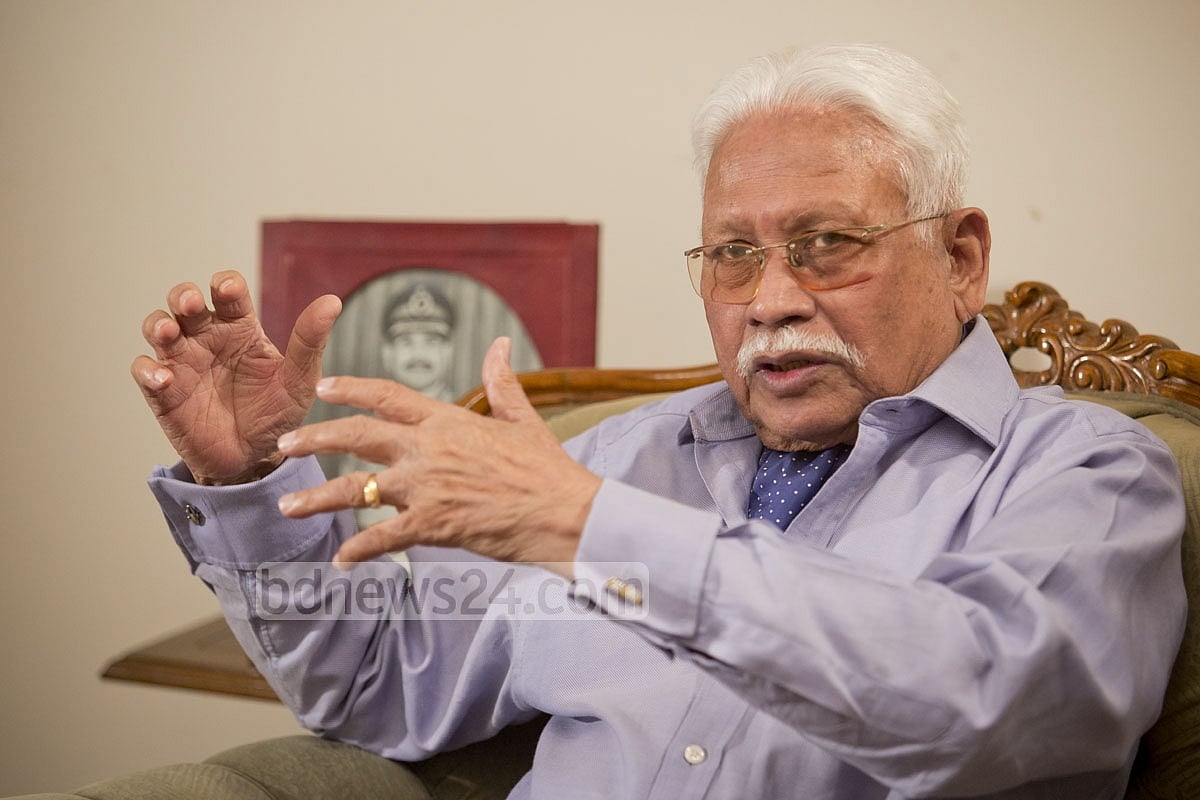
"Many say that Ziaur Rahman proclaimed independence! I had revolted much before Ziaur Rahman did, but I am not into chest-thumping," he said during an interview with bdnews24.com on Monday, on the eve of the Mar 19, 1971, revolt in Gazipur by soldiers.
He said Zia, who was also a major then, was busy supervising off-loading of military hardware from ships docked at the Chittagong port on Mar 25, the night Pakistan army unleashed the brutal crackdown on Bengalis.
Safiullah backed his claim by citing 'reports by American intelligence'.
Bengalis started to gear up for an armed resistance since the Bangabandhu's historic Mar 7 address, when he called for the final struggle for independence from Pakistan.
On the night of Mar 25, Pakistani forces unleashed a military campaign to crush the Bengali struggle.
Before his detention by the military the same night, Bangabandhu proclaimed independence, which was read out by several people on Mar 26 from a radio station in Chittagong, later known as the 'Swadhin Bangla Betar Kendra'.
However, an order from the apex court nullified the claim.
Safiullah, who was the first chief of the army in independent Bangladesh, said that he had figured out Zia's 'ambitions to be the president' during the war.
He claimed that Zia declared himself as the president on Mar 27 at Chittagong's Kalurghat, where the Swadhin Bangla Betar Kendra was based.
"When it was protested, he corrected it to 'I, on behalf of Bangabandhu'.
"Back then we thought it was to inspire others. But it became clear later," said Safiullah.
Bengali soldiers were getting prepared for an armed movement way before the war formally started on Mar 26, according to him. "We were getting ready. We decided to protest if something happened and that too not verbally, but by force of arms."
Safiullah said that the 'desire for independence was so intense' among the people then that they would go for it 'at any cost'.
"75 million Bengalis...they would have done something themselves, even if we (Bengalis in army) were not there."
On the Mar 19 'revolt' in Gazipur, he said that the then brigade commander in Dhaka Jahanzeb Arbab suddenly decided to have lunch with them. "But we understood it was to disarm us."
Safiullah said that he kept troops under his command prepared for anything.
"The brigade commander found that the troops were armed just like during a war," he said adding that machine guns and mortars were stationed all around the unit's base.
"I told him ‘I may be mobbed anytime, but I am ready to protect myself.' My intention was to make him understand that I was aware why he came and if he had any such ideas then he should be ready."
He said that the army opened fire on civilians in Gazipur on Mar 19, upon orders from the Dhaka brigade commander. "Ultimately, we had to use fire...two people died and two others were wounded."
He said that the Bengali people attacked when the brigade commander was leaving Gazipur. "A man tried to snatch the firearm from a soldier. But he failed and was killed by the other soldiers."
The Pakistani forces had to surrender after the nine months of Bengali resistance, said Safiullah. "The Pakistanis wanted to retreat. But how? They wanted a ceasefire, which would allow them to surrender under conditions."
Safiullah, who led one of the 11 sectors during the Liberation War, recalled the Dec 16 surrender of Pakistani forces. "Aurora signed and then General Niazi signed before handing over his pistol...it was 4:31pm on the clock."













