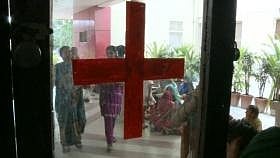
Poor people made guinea pigs
Foreign drug manufacturers are reportedly testing their new medicines on some of the poorest in India without their knowledge.
bdnews24.com News Service
bdnews24.com
Published :
02 Nov 2012, 10:00 AM
Updated :
09 Aug 2022, 04:27 PM
Dhaka, Nov 2 (bdnews24.com)—Foreign drug manufacturers are reportedly testing their new medicines on some of the poorest people in India without their knowledge.
A recent investigative report by BBC Newsnight revealed how they are treating those illiterate people of the underdeveloped part of the country as 'human guinea pigs' for testing the action of their drugs.
Although these trials are causing deaths in numbers, the magazine says this claim is impossible to verify because there was no autopsy.
It also says those poor and uneducated people often used to feel flattered and privileged as they were suddenly offered the chance to receive medicines usually out of their reach. Most of them claim that, contrary to Indian laws governing drugs trials, there was no informed consent.
Newsnight says drug companies are facing mounting pressure to investigate such reports.
"We were surprised," Nitu Sodey recalls about taking her mother-in-law Chandrakala Bai to the Maharaja Yeshwantrao Hospital in Indore in May 2009.
"We are low-caste people and normally when we go to the hospital we are given a five-rupee voucher, but the doctor said he would give us a foreign drug costing 125,000 rupees," she added.
The pair had gone to the hospital, located in the biggest city in Madhya Pradesh, an impoverished province in central India, because Chandrakala was having chest pain.
Their status as Dalits - the bottom of the Hindu caste system, once known as untouchables - meant that they were both accustomed to going to the back of the queue when they arrived and waiting many hours before seeing a doctor.
But this time it was different and they were seen immediately.
"The doctor took the five-rupee voucher given to BPLs [Below the Poverty Line] like us and said the rest would be paid for by a special government fund for poor people," Nitu explains. "This was really expensive treatment for the likes of us."
What Nitu says she did not know was that her mother-in-law was being enrolled in a drugs trial for the drug Tonapofylline, which was being tested by Biogen Idec.
Nitu says neither she nor her mother-in-law remember signing a consent form.
She says her mother-in-law suffered heart abnormalities after being given the trial drug. She was taken off it and discharged after a few days. Less than a month later, she suffered a cardiac arrest and died at the age of 45.
The trial, which was registered in the UK by Biogen Idec, was later halted due to, say the company, the number of seizures recorded. The company also says Nitu's mother-in-law's death was not reported to them.
The magazine says her case is not an isolated incident.
In a different trial with a different company, Narayan Survaiya says neither he nor his late mother Tizuja Bai were asked if she wanted to participate, or even told that she was taking part in one, when she sought treatment for problems with her legs. And, like Nitu's mother-in-law, he claims the family were told that a charity was footing the bill for the care.
A few weeks after taking the drug, Narayan says his mother's health deteriorated and she was left unable to walk.
"I told the doctor, but he said don't stop the doses. It is a temporary paralysis and the drug will make it better," he added.
His mother died a few weeks later.
Newsnight says 53 people were test subjects in these trials, which was sponsored by British and German drug companies, and eight died. There is no hard evidence that the drug was the cause of death, but nor were there any autopsies to enable a full investigation.
Over the past seven years, some 73 clinical trials on 3,300 patients - 1,833 of whom were children - have taken place at Indore's Maharaja Yeshwantrao Hospital.
Dozens of patients have died during the trials, however, no compensation has been paid to the families left behind.
Newsnight says internal hospital documents read since 2005, 80 cases of severe adverse events in trials have been recorded in Indore.
Patients' relatives say that the treatment they received at Maharaja Yeshwantrao Hospital was overseen by Dr Anil Bharani.
Dr Bharani has since been charged by the state government for receiving illegal payments and foreign trips from drug companies, and for carrying out drugs trials without patients' consent.
When approached by the magazine he refused to talk and called security to march out the reporter of the hospital by an armed guard.
Newsnight claims Dr Bharani is just one of a number of doctors at the hospital who have been already been fined for irregularities during drugs trials. None of the problems might have ever come to light if it had not been for another doctor, Dr Anand Rai, who had an office on the same floor of the hospital.
Dr Rai says he was sacked from his job because of his questioning, but that he had been researching the hospital trials ever since.
Dr KD Bhargava, head of the ethics committee at the Maharaja Yeshwantrao Hospital, admits that the hospital's oversight of the trials had been flawed. "Suddenly lots of money got involved and there was too much going on. And, yes, maybe we may have lost control," he says.
BBC says in the past seven years, nearly 2,000 trials have taken place in the country and the number of deaths increased from 288 in 2008 to 637 in 2009 to 668 in 2010, before falling to 438 deaths in 2011.
bdnews24.com/shs/nir/1555h