


Published : 14 Jun 2013, 01:56 PM
Updated : 23 Apr 2022, 05:33 PM


They say a set of unambiguous guidelines is needed to stop the trend.
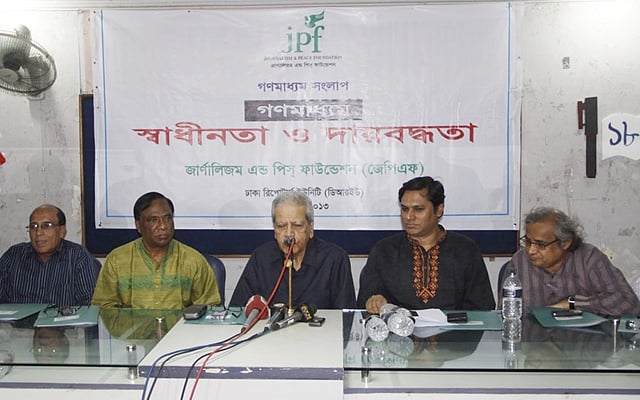
The observations came at a discussion, titled ‘Mass media: Freedom and responsibilities’, organised by Journalism and Peace Foundation at Dhaka Reporters Unity on Friday.
Daily Independent Editor Mahbubul Alam told the discussion: “Journalists in many countries of the developed world have themselves formulated their own code of conduct that they are committed to go by. Nobody imposes [that] on them. The same thing should happen in Bangladesh too.”
He said: “Press freedom doesn’t mean that one will act as one wishes, resort to instigation and unleash social unrest. All [stakeholders] sitting together can determine the limits of the media.”
The veteran journalist said the newly formed Editors Forum can take initiatives in this regard.
“We have to forge a consensus to ensure that we don’t violate democracy and human rights while enjoying the freedom of the media. Everybody has to accept that freedom doesn’t mean recklessness,” Alam said.
Journalism and Peace Foundation Executive Director Harun Habib, who moderated the discussion, presented a paper at the beginning of the session. Newspaper editors and university teachers took part in the discussion.
Daily Janakantha Advisory Editor Toab Khan said: “A quarter with vested interest has been misusing the media since independence. That section is again trying to create social unrest by exploiting the huge freedom that the media now enjoys.”
He urged united effort to help create a ‘healthy’ media trend.
The discussion was held against the backdrop of Daily Amar Desh running several ‘instigative’ stories and articles over the Shahbagh movement that demands capital punishment to all war criminals.
There are allegations that Amar Desh, edited by BNP Chairperson Khaleda Zia’s former Advisor Mahmudur Rahman, has played a key role in the rise of radical group Hifazat-e Islam.
Mahmudur was arrested on Apr 11 on sedition charge and the press of the newspaper was sealed.
The government also ‘temporarily’ stopped the operation of pro-Jamaat-e-Islami private TV channels – Diganta Television and Islamic TV – from May 5 for flouting the conditions of the licences and instigating violence.
The Independent’s Mahbubul Alam was one of the 16 editors who last month had signed a statement calling for release of Mahmudur Rahman, saying his arrest and detention was “a threat to the freedom of press”.
This stirred a storm on the social media website Facebook and Internet blogs.
Dhaka University Professor ATM Safiul Alam Bhuiyan said: “There are many media outlets which are resorting to wantonness in the name of [press] freedom. [They’re] not maintaining objectivity and neutrality. Even [they’re] deliberately fomenting social unrest. The mass media has to shun that trend. The government should formulate a set of guidelines for that.”
State-run Bangladesh Sangbad Sangstha (BSS) Editor Azizul Islam Bhuiyan spoke of a division among the editors.
“I’m not very hopeful of the newly formed Editors Council. Because [I] saw 11 editors are supporting one side and 23 others the other side.”
Dhaka University Professor Golam Rahman said: “The tolerance of opposite views is the inherent beauty of democracy. But the opinions should know the limits. The manner in which we’re using the freedom is unfair. [We need to] stop the recklessness in the name of freedom. For that a set of guidelines is needed.”
“Mahmudur Rahman instigated religious fanaticism and unleashed social unrest. It’s criminal journalism. This sort of journalism should be stopped,” he added.
Daily Ittefaq Executive Editor Shaheen Reza Noor said: “Lack of professionalism is creating a crisis in the media.”
“It’s still not clear whether press freedom means freedom of the owners or of the journalists.”
Also Read:
‘Wicked journalism hinders development’






