


Published : 02 Sep 2013, 09:44 PM
Updated : 09 Aug 2022, 11:04 AM


“It’s mandatory to hold the elections within 90 days of the government’s term coming to an end, which means by Jan 24,” he told reporters on Monday.
Suranjit, Co-Chairman of the special committee, said, “Sub-section 3 (a) and (b) of the Constitution’s Section 123 deal with the ‘time for holding elections’. How these sub-sections are to be followed depends on the decision of the head of the government.”
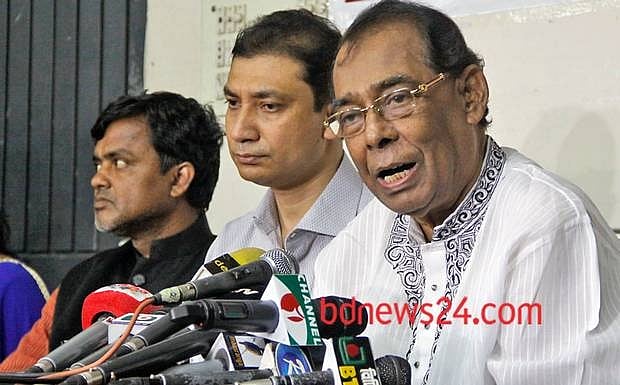
He spoke to several media including bdnews24.com amid the prevailing confusion on the timing of the upcoming general election.
Prime Minister Shekh Hasina has already announced that the Parliament will end on Oct 25, its last business day, suggesting that the polls would be held by Jan 24 next year.
The country’s two major political coalitions are at loggerheads since the provision for a non-party caretaker government system was dropped through the 15th constitutional amendment in June 2011.
Ruling Awami League has been speaking of holding the elections in the 90 days before the present government’s term ends, a call the main opposition BNP rejects and calls for dissolution of Parliament.
Law Minister Shafique Ahmed on Sunday also said the government had no plans to amend the Constitution in the next parliament session over the polls-time interim government system.
Suranjit on Monday mentioned the Prime Minister’s constitutional powers in the five years in office. “The Prime Minister holds the key to activate the Constitution’s Section 123. She will have to do that before her term ends, in those five years in office. Not after that.”
Sub-clauses 3 (a) and (b) of Section 123 says, “A general election of the members of Parliament shall be held - (a) in the case of a dissolution by reason of the expiration of its term, within the period of ninety days preceding such dissolution; and (b) in the case of a dissolution otherwise than by reason of such expiration, within ninety days after such dissolution: Provided that the persons elected at a general election under sub-clause (a) shall not assume office as members of Parliament except after the expiration of the term referred to therein.”
Suranjit, who was a member of the original constitutional drafting committee in 1972, said, “The Prime Minister can request the President to dissolve Parliament as per the Section 57 of the Constitution. The elections will be held in the next 90 days if Parliament is dissolved following the Prime Minister’s call.”
“But if she does not make the request, the elections must be held within 90 days by rule before the term ends [in Jan 24].”
He said the Prime Minister needed to advise the President 90 days before the expiry of Parliament’s tenure to dissolve it.
The Section 57 of the Constitution says: “He (Prime Minister) shall… advise the President in writing to dissolve Parliament, and if he so advises, the President shall… dissolve Parliament accordingly.”
There is no scope to question the Prime Minister’s advice as per Section 48.
The Section reads: “…the question whether any, and if so what, advice has been tendered by the Prime Minister to the President shall not be enquired into in any court.”
Suranjit said: “Once the elction period begins, it (the jurisdiction) will automatically go under the disposal of the Election Commission. There is no scope to dissolve Parliament in those 90 days.”
“Everything will go as per the direction of the Election Commission since the beginning of election countdown. The incumbent MPs can run in elections. Parliament won’t sit and MPs can’t enact any law at the time. They cannot recommend dissolution of Parliament,” he added.
The senior parliamentarian said the Prime Minister and Cabinet would remain in office ‘during the election time’.
“The Prime Minister and Cabinet of this interim government will remain. It’s not mentioned (in the Constitution) whether their size will be small or big. The Cabinet will remain in effect even if the election is held within 90 days (after the expiry of Parliament’s tenure).”
He said there were scopes to discuss with the opposition the size of the Cabinet.
About the Prime Minister and Cabinet, the Section 56 says: “There shall be a Prime Minister, and such other Ministers, Ministers of State and Deputy Ministers as may be determined by the Prime Minister.”
Suranjit said the Election Commission would determine the matter about creating a level playing field for all parties.







